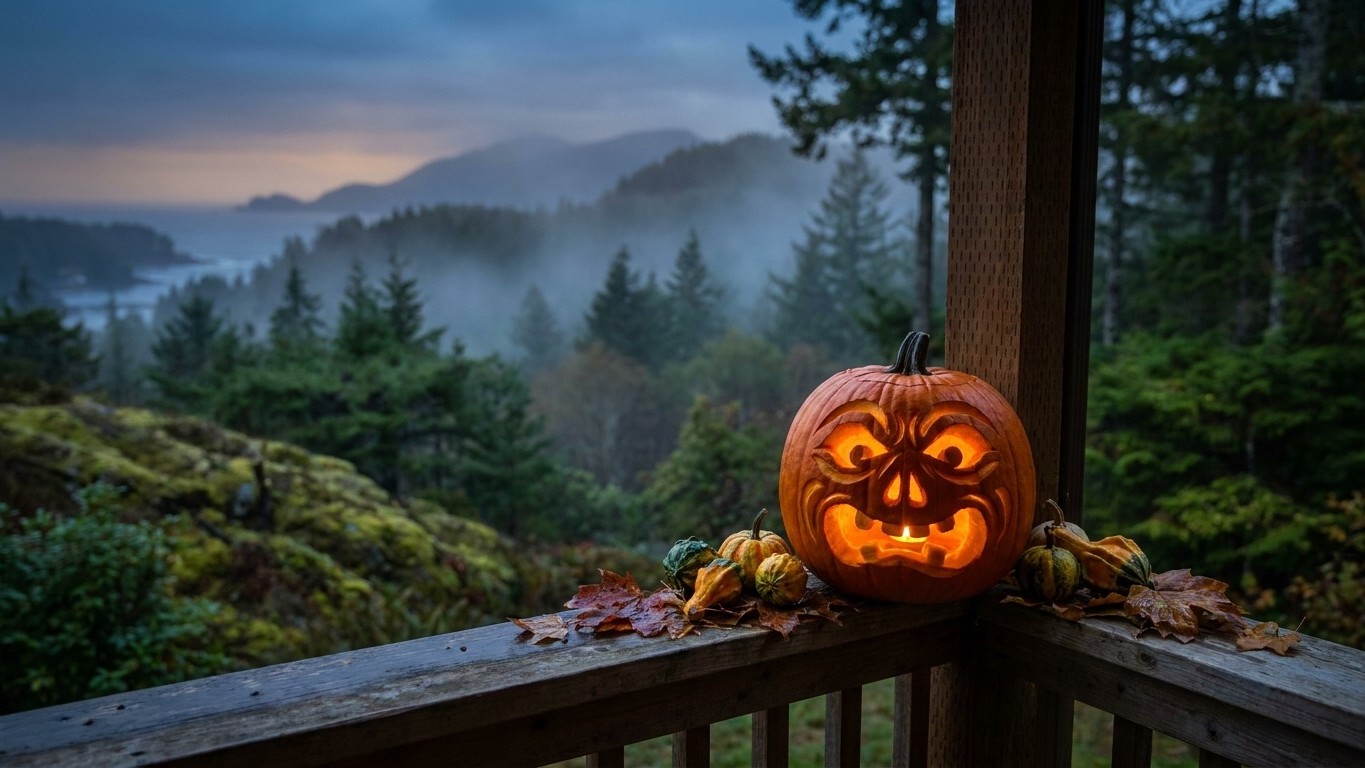

Around Vancouver and much of coastal British Columbia, the mean first fall frost lands around November 10, roughly ten days after Halloween. That single fact reshapes how you should think about pumpkin carving here: frost is rarely the reason a jack-o’-lantern collapses before trick-or-treaters show up. The real question is timing your carving close to the day itself, not racing a freeze.
The short answer

Environment and Climate Change Canada’s 1981-2010 climate normals put the mean first fall frost at Vancouver International Airport around November 10. That’s an average, not a guarantee, so read it as the midpoint of a window rather than a date circled on the calendar. In roughly half the years on record, frost arrived later than November 10; in the other half, it came earlier, sometimes weeks earlier.
What that means practically is this: for most of coastal British Columbia, Halloween on October 31 typically falls a good week and a half before the average frost date. If you’re carving in the Lower Mainland, southern Vancouver Island, or the Fraser Valley, you’re usually working with a window that runs right up to the day itself, without a hard frost forcing your hand early.
That’s very different from what growers face in the BC Interior or in higher-elevation valleys, where cold air settles faster and frost can arrive weeks ahead of the coastal norm. The Vancouver station reading is a coastal number. If you’re in Kamloops, Prince George, or the Okanagan uplands, your own frost risk runs earlier and colder than what this figure describes.
So the practical window for most coastal BC carvers looks like this: choose your pumpkin any time in the weeks leading into Halloween, but hold off on the actual cutting until close to the day, since a carved pumpkin ages faster than an intact one regardless of frost. Frost isn’t your enemy this year, in this region, in the same way it is for growers farther inland. The bigger risk, as you’ll see below, is less about ice and more about how you store the thing once it’s off the vine.
Frost or heat: which one gets it here
The cold end
A whole pumpkin keeps best between 45 and 50 degrees Fahrenheit, according to University of Illinois Extension. That’s a narrow band, and it’s worth comparing against what coastal British Columbia actually does in late October. The coldest month’s mean daily minimum at the Vancouver reference station sits at 33.5 F, a figure that describes deep winter, not late October. Late fall around Vancouver tends to run cooler and wetter than that storage band without being anywhere close to freezing on a typical night.
Once you move past Halloween and into November, though, the cold end becomes the relevant risk. As nights lengthen and that November 10 average frost date approaches, temperatures start dropping past the low end of the safe storage range. A pumpkin left outside on a porch railing into mid-November, in a year where frost arrives on schedule or early, faces real freeze exposure. That’s the risk that applies here: not heat damage, but eventual cold, arriving later in the season than most of the country experiences it.
The warm end
Heat damage, the kind that softens a pumpkin from sitting above 50 F for too long, isn’t the concern in this climate. British Columbia’s coastal regions don’t get the kind of sustained October warmth that pushes pumpkins past their upper storage limit. Interior BC can see warmer fall days, but even there, October temperatures typically fall within or below the safe range rather than above it.
The takeaway: in coastal British Columbia, the cold end of that 45-50 F band is the one to watch, and it becomes relevant later in the season than in most U.S. states, thanks to that later-than-average frost date. Don’t let the region’s northern hardiness zone fool you into thinking frost risk starts in early October. It doesn’t, at least not on average.
Where to keep it until you carve
Given the mild, damp fall that defines much of coastal British Columbia, the goal is finding a spot that’s cool, dark, and dry, without tipping into the kind of cold that shows up once that November frost window opens.
- An unheated garage or carport. This is usually the closest match to that 45-50 F band through most of October in coastal BC, provided it’s shaded from direct afternoon sun.
- A covered porch, out of direct sun and rain. Coastal BC’s fall rain can sit on a pumpkin’s skin and encourage soft spots, so keep it under cover even if the porch itself stays cool enough.
- A cool basement or mudroom. Useful once nights start dropping toward frost in early-to-mid November, since it buffers against the cold better than an open porch.
- Away from the furnace, dryer vent, or any heating duct. Even mild interior heat pushes a pumpkin’s storage temperature above the safe range faster than most people expect.
- Away from the fruit bowl. Ripening apples, potatoes, and tomatoes give off ethylene gas that ages a pumpkin prematurely, according to University of Illinois Extension. Keep it on a separate shelf or in a different room entirely.
When you do bring it in to carve, handle it by the base, never by the stem. A pumpkin with 1 to 2 inches of stem intact is the one worth choosing at the patch or stand, since that stem acts as a seal over the fruit. Once it snaps off, that spot is exposed and spoils faster than the rest of the pumpkin.
Checking this against your own county
The Vancouver airport station is a single coastal reference point, and British Columbia covers a lot of ground between Tofino, Kelowna, and Fort St. John. If you’re inland, at elevation, or simply want a frost date closer to your own backyard, the BC Ministry of Agriculture and Food maintains regional resources worth checking directly at gov.bc.ca’s agriculture and seafood industry pages.
Local frost timing varies enough across the province that a grower in the Peace River region or the Cariboo shouldn’t lean on a Lower Mainland figure. Checking regional data gives you a frost window that actually matches your soil, elevation, and microclimate, rather than a coastal average that may run a week or more ahead of or behind your own conditions.
Common questions
How long does a carved pumpkin last in British Columbia’s climate?
No university extension publishes a fixed number of days for a carved pumpkin, and none recommends specific preservation treatments like bleach dips or petroleum jelly. Those figures don’t come from research. What’s actually documented is how to choose and store a whole pumpkin well, and the practical move is to carve close to the day you plan to display it.
Does BC’s rain affect pumpkin storage more than frost does?
Moisture matters more than most people realize in this climate. Keeping a pumpkin dry, under cover, and off wet ground reduces the soft spots and mold that damp fall weather encourages, often before frost becomes a factor at all.
Is the Interior’s frost timing the same as the coast?
No. The November 10 average comes from a coastal Vancouver station. Interior and higher-elevation parts of British Columbia typically see frost weeks earlier, so growers there should check regional extension resources rather than relying on this coastal figure.
Should I pick my pumpkin early or wait until closer to Halloween?
Picking early is fine as long as storage conditions stay close to that 45-50 F range and away from ripening fruit. Carving is the step to delay, since a cut pumpkin ages faster than an intact one regardless of when you bought it.