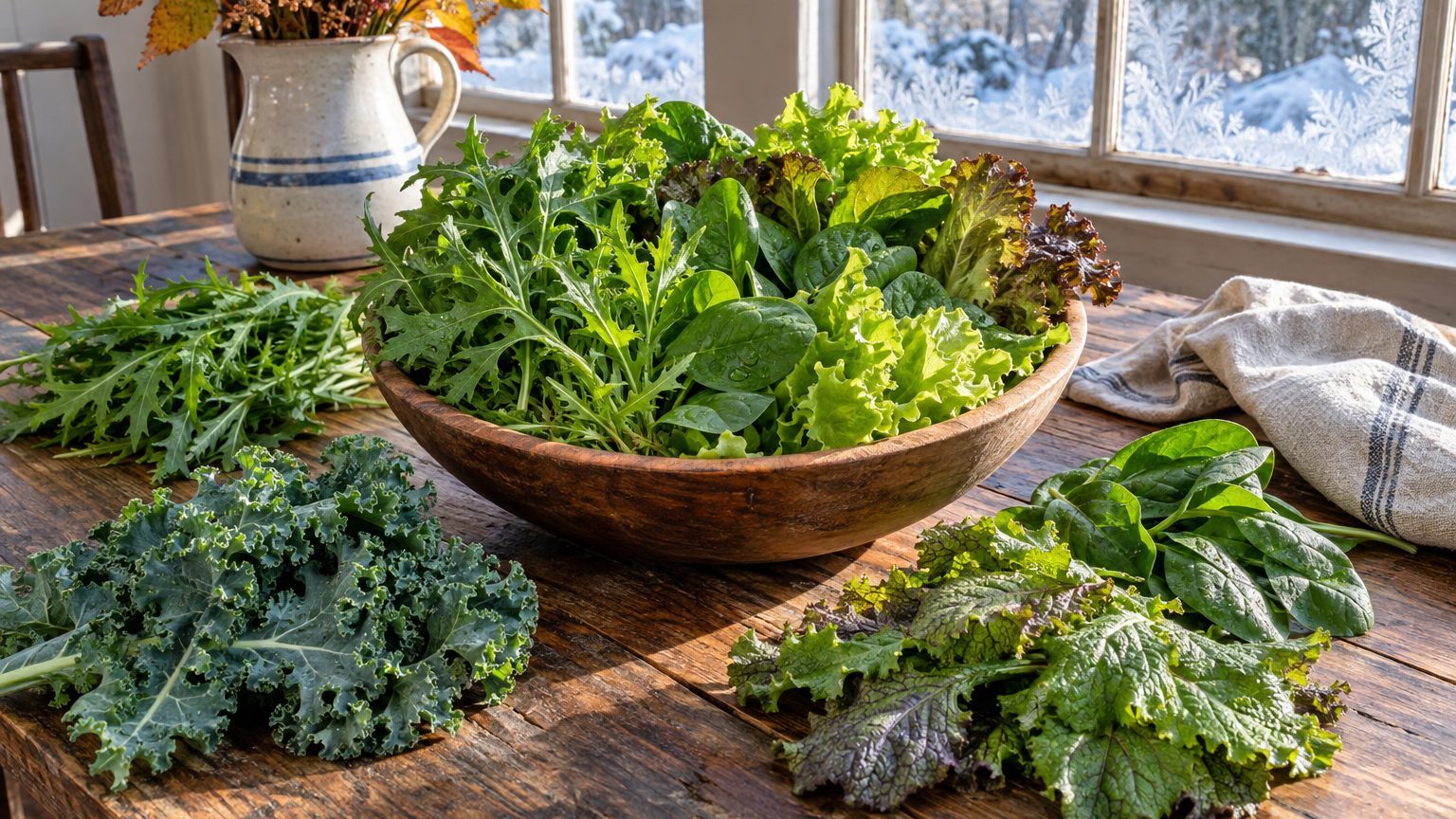

The best winter salads for Manitoba are the cold-hardy leaf crops: mâche, claytonia, spinach and kale, with arugula and mizuna as a second tier. Sow them in late summer, then shelter them under a cold frame or low tunnel. Heading lettuce and tender baby mixes belong in the spring bed instead. A handful of Winnipeg climate numbers explain why.
The short answer for Manitoba
Choose by cold tolerance first and flavor second. Environment and Climate Change Canada’s 1981-2010 normals for the Winnipeg Richardson International Airport station put the average last spring frost on May 23 and the average first fall frost on September 22. That leaves about 122 frost-free days between the two dates, and a winter salad has to be nearly grown before the second one passes.
Both dates are means, not safe dates. In one year out of two, the spring frost falls later than May 23. In one year out of two, the fall frost arrives earlier than September 22. Read each as the midpoint of a window. (These Canadian normals also cover 1981-2010, while the US figures elsewhere on this site cover 1991-2020, so don’t line them up date for date.)
Winter is the other number. The mean daily minimum of the coldest month at the Winnipeg reference station is -21.4 °C (-6.6 °F). That is an average of the lows, so individual nights run colder. It tells you that “winter salad” in Manitoba means a protected salad, not a bed left open to the sky.
Which type goes where
| Type | Examples | Role in a Manitoba winter bed |
|---|---|---|
| Very hardy leaf crops | Mâche, claytonia, spinach, kale | The backbone. Sow in late summer and cover before hard freezes. |
| Hardy, but first to fade in deep cold | Arugula, mizuna, tatsoi and other mustards | Fast fall growth under cover. Plan to eat them early. |
| Tender or slow | Heading lettuce, basil, soft baby-leaf mixes | Spring and summer beds only. |
The rows are general horticultural guidance, not Manitoba trial results, so treat them as a starting order rather than a ranking. Exact sowing dates for each type are laid out in When to Sow Winter Salads in Manitoba, and the wider picture sits in Winter Salads for Manitoba Gardens.
What will not work here
Slow crops fail first. With roughly 122 frost-free days and a fall that cools quickly after the September 22 average, anything that needs many weeks of growth after sowing never reaches size. Heading lettuce started in September is the classic case: it sits as a handful of seedlings through the dark months and then bolts in spring.
The logic of a winter salad is to grow it nearly to harvest size while the days are still long, then let the cold hold it like a refrigerator. Sow late and the plant has nothing to hold. Résultat ? A tidy bed of tiny leaves in December that never gets bigger.
An open bed with no cover also fails. A coldest-month mean minimum of -21.4 °C is beyond what any common salad green can be trusted to take unsheltered. Even mâche and claytonia, which shrug off frost that flattens lettuce, are better treated as covered crops here. The Prairies are also flat and windy. A single sheet of plastic over hoops can be shredded or lifted by one bad gust, so anchor it and think about a second layer inside the first.
Snow can wreck a cover as easily as the cold. Heavy wet snow flattens a shallow low tunnel, and a cold frame lid needs to be cleared after a storm. A sealed, sunny frame on a mild late-winter day is another trap: the plants fog up, sweat, and rot if nobody vents it. The spring swing matters too, since the May 23 mean means frost can still arrive after it in half of all years. Tender transplants set out on that date go in on a coin flip.
Late summer is the opposite problem. Lettuce, spinach and mâche seed can refuse to sprout in hot soil, so an August sowing on bare, sun-baked ground may come up patchy. Shade the row with a board or cloth until it germinates, and water lightly and often until then. Weekly deep watering suits an established tree but not a seed in the top half inch of dry soil.
What changes across Manitoba
Manitoba is not one garden. The reference city here, Winnipeg, sits in Canadian hardiness zone 3b, taken from Natural Resources Canada’s 1991-2020 normals. That is the Canadian system, built on seven climate variables, and it does not convert to a USDA zone. NRCan itself says there are no simple conversions: Canadian zone 4a overlaps nine USDA zones, from 3a to 7a. So a seed packet or a US article that says “zone 4” tells you little about a Manitoba bed.
This page has the Winnipeg figure and nothing else, so it cannot give you the spread across the province. There is no single answer for Manitoba. The south and the north differ in more than a zone number, and the frost dates above come from one airport station. Northern and upland districts run weeks behind it, which pulls the start of the season later and the end of it earlier.
If you garden in the north or on higher ground, shift your plan in three ways. Sow the very hardy types earlier than Winnipeg guidance suggests, since your window to reach size is shorter. Drop the second-tier mustards and Asian greens unless you can offer real shelter. And plan for double cover from the first hard freeze, not as a December fix.
To find your own zone, look up your municipality on Canada’s Plant Hardiness Site. Don’t borrow Winnipeg’s 3b by assumption. Note also that the zone map uses 1991-2020 normals, while the frost dates above use 1981-2010, so the two come from different decades.
Where to check this for your own county
Your provincial agriculture office is the next stop. Manitoba Agriculture is the official source for growing guidance in the province. Look there for two things: a local planting calendar for your area, and any vegetable or leafy green varieties trialled where you live.
The page you are reading is the provincial one, and a provincial recommendation is the weakest kind. It rests on one Winnipeg station and one reference zone. A recommendation for your own county or rural municipality beats it every time, because local trials include your soil, your wind exposure and your frost pockets.
When you find a local calendar, check whether its frost dates are averages or probabilities, and which years they cover. A date labelled “last frost” with no explanation is the same coin flip described above. Where a local trial lists a variety that survived a winter near you, that outranks anything on this page, including the types in the table.
If the site does not have what you need, contact the office directly. This page cannot say which documents Manitoba Agriculture currently publishes or where they sit on the site, so searching for local vegetable guidance is the practical route.
Checking this against your own garden
Dates on a page are averages from an airport. Your yard is not an airport, and what you see in it outranks every date above. Three observations need no instrument beyond your hands and eyes.
- Soil warmth by feel. Push your hand a few inches into the bed in the late afternoon. Soil that feels warm and damp will germinate lettuce and spinach poorly, so shade it and wait. Soil that feels cool means seed can go in. Compare a sunny bed against a shaded one, and you have mapped your own microclimate.
- The first true leaves. Seedlings first show a pair of rounded seed leaves, then the real, shaped leaves. If your fall sowing has true leaves before the first frost, it has a root system to hold through the cold. If it doesn’t, cover it at once and expect slower growth.
- Where frost lands first. On a clear, still morning in September, walk the yard and note where white appears first on the grass. Low corners and open stretches frost first, and walls and south-facing fences frost last. Put your cold frame where frost arrives last.
Write down the dates when each of these happens. After one season you will have a calendar better fitted to your plot than the provincial averages, and it will improve each year.
Common questions
Can winter salads survive in Manitoba without any cover?
Not reliably. The mean daily minimum of the coldest month at the Winnipeg reference station is -21.4 °C (-6.6 °F), and this page has no snow-cover data to show that an open bed would be insulated. Plan on a cold frame, low tunnel or similar protection.
Is spinach or mâche the better first choice?
Both are among the hardiest salad greens. Spinach usually sizes up faster in fall, while mâche forms small rosettes that hold well in cold. Many gardeners grow both, since they fail in different ways.
Should I look for varieties labelled for zone 3?
Zone 3b here is the Canadian system, and it is the zone of Winnipeg only, not of the whole province. It does not convert to a USDA zone. Rely on a variety’s stated cold tolerance and days to maturity, and check local trials through Manitoba Agriculture.
Can I harvest all winter?
Expect gaps. When days are at their shortest, even protected plants nearly stop growing, so what you pick in midwinter is mostly what grew in the fall. Take outer leaves lightly and leave the center of each plant alone, and regrowth in late winter will be quicker.