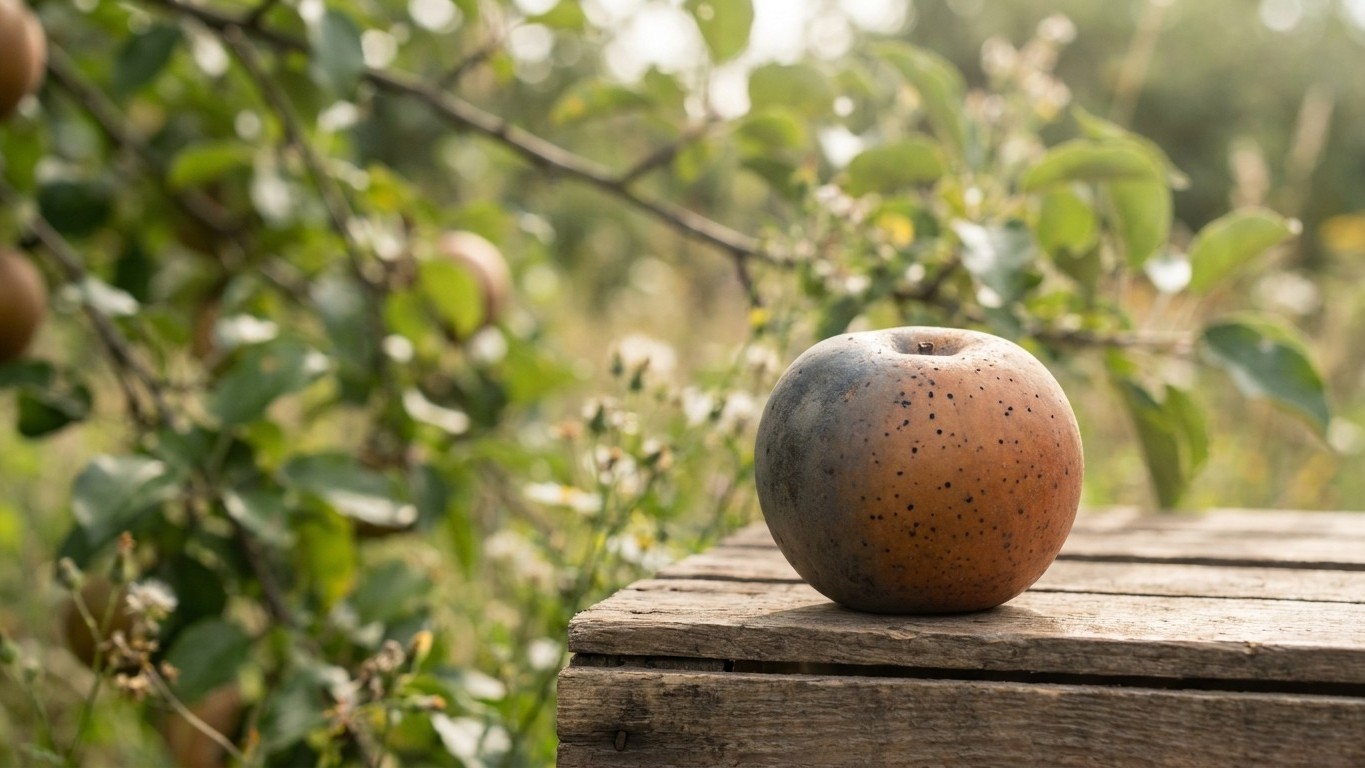

Most Maryland apple varieties reach picking stage between late August and mid-October, timed to fruit maturity rather than a date on the calendar. Early types like Gala come off the tree first; late-storage varieties such as Fuji or Rome-type apples come last, often after the season’s first cool nights. Picked at the right stage and kept cold and humid, those late apples can hold for months. Picked early or left in a warm kitchen, the early varieties are gone in a couple of weeks.
When apples are ready to pick in Maryland
The calendar is a poor guide here. What actually tells you an apple is ready is the fruit itself: background skin color shifting away from green, seeds turning brown instead of white, and the apple separating from the branch with a gentle twist rather than a tug. Those signs show up on the tree’s own schedule, which is set months earlier by when it flowered, and flowering is set by frost risk.
That’s where Maryland’s frost dates matter. Using Baltimore as the reference station, NOAA’s 1991-2020 Climate Normals put the last spring freeze in the window of April 3 to April 16, and the first fall freeze between October 26 and November 5. A tree that blooms into that spring frost window risks losing blossoms before fruit ever sets, which is exactly why growers watch bloom timing as closely as picking time. A late frost after bloom doesn’t delay harvest, it can erase it.
Hardiness and chill are two separate questions, and conflating them is where a lot of confusion starts. Hardiness is about survival: can the tree take the coldest nights of the year without dying back. At Baltimore, the mean daily minimum of the coldest month runs 25.4°F, per NOAA NCEI’s 1991-2020 Climate Normals. That’s mild enough that winter kill isn’t the limiting factor for apples across most of the state. Winter chill is a different filter entirely: it’s the accumulated cold hours a tree needs before it will break dormancy and flower normally the following spring. No figure for accumulated chill hours in Maryland is published in the sources checked for this page, so that number simply isn’t stated here.
Geography still splits the state. Western Maryland, up in Garrett and Allegany counties, sits at real elevation and runs weeks behind the Baltimore reference date on both ends of the frost calendar, which pushes bloom and harvest later too. The Eastern Shore trends milder and often ripens earlier than the Baltimore window suggests. Anyone planting or timing harvest close to those regional edges will get a more useful answer from the University of Maryland Extension (extension.umd.edu) than from a statewide average.
Which ones keep, and which must be eaten
Storage life tracks two things: when in the season a variety ripens, and how dense and thick-skinned its flesh is. Early-season apples ripen on soft, high-moisture flesh that’s built for fast eating, not for sitting in a box. Late-season apples ripen into firmer, lower-moisture flesh that naturally resists breakdown, which is why the same bushel basket can hold varieties with wildly different clocks.
Early, mid, and late in practice
| Maturity group | Typical examples | Storage behavior |
|---|---|---|
| Early season | Gala-type, early summer apples | Best eaten within a few weeks; flesh softens quickly |
| Midseason | Honeycrisp-type | Holds for roughly a month or two under cold, humid conditions |
| Late season | Fuji-type, Rome-type, Granny Smith-type | Can hold for several months in cold, humid storage |
This is also where the mild-winter trade-off shows up again, in a different form. A low-chill variety breaks dormancy on less accumulated cold, so it flowers earlier in the spring, and earlier flowering lands closer to that April 3 to 16 last-frost window at the Baltimore reference station. That earlier bloom often comes bundled with earlier fruit maturity, which means shorter storage life. Choosing a variety for long keeping in a Maryland cellar generally means choosing one that flowers later in the season too, and that later bloom is the safer bet here: it trades a slightly shorter growing window for blossoms that clear the frost risk before opening.
None of this is about flavor ranking. It’s about matching the apple to the plan. A bag of early apples bought at a farm stand in late August is for pies and applesauce this week, not for the pantry in January. A crate of late-season apples picked in October is the one worth setting aside, provided the storage space that follows actually holds up its end.
Storing them through a Maryland winter
Cold, humid, and dark is the standard that keeps apples firm: cold slows the ripening chemistry, humidity keeps the skin from shriveling, and darkness stops any greening or sprouting nearby vegetables might trigger. What that means in a Maryland home varies a lot depending on where the fruit is stored.
An unheated garage or shed is the classic fallback, and in much of the state it works for weeks, sometimes into early winter. But it’s not a stable answer. With Baltimore’s coldest-month mean daily minimum sitting at 25.4°F, a hard cold snap can drop an unheated outbuilding well below freezing for a stretch, and apples held right at the outer edge of an unheated space can freeze solid, which ruins the texture even if the fruit looks fine once it thaws. A root cellar, an insulated basement corner, or the crisper drawer of a spare refrigerator gives more consistent protection than an outbuilding, especially once a real cold front moves through.
Regional differences in practice
In Western Maryland’s mountain counties, that cold-snap risk arrives earlier and harder, so unheated outdoor storage needs backup insulation or a move indoors sooner in the season. On the Eastern Shore, milder winter minimums buy more time before an unheated shed becomes a liability, though a sudden freeze can still catch a late-stored batch off guard.
Checking stored fruit every couple of weeks matters more than people expect. One soft or bruised apple releases ethylene gas that speeds up ripening in everything around it, so pulling the bad apple out (the old saying has real chemistry behind it) protects the rest of the batch. For anyone planning to can, freeze, or otherwise preserve a large harvest rather than store it whole, the University of Maryland Extension publishes food preservation guidance at extension.umd.edu worth checking before the season’s harvest comes in all at once.
What goes wrong here
The most common failure traces straight back to bloom timing. A variety that flowers early, whether because it’s naturally low-chill or because a warm early spring pushed it ahead of schedule, sits exposed during that April 3 to 16 last-frost window at the Baltimore reference station. A freeze during or just after bloom can knock out the season’s fruit set before an apple ever forms, and there’s no fixing that once it happens; the loss shows up as a light or empty harvest months later, with no obvious cause at picking time.
Storage failures usually come from one of two habits: leaving apples in a container with other ripening fruit, which speeds up softening through ethylene exposure, or trusting an unheated space that isn’t actually stable through a real cold snap. Both are avoidable once someone knows to check for them, but both get blamed on “bad apples” when the real issue is the storage setup.
Humid Maryland summers also raise disease pressure on the tree itself, things like fungal leaf and fruit issues that thrive in warm, wet conditions. That’s an orchard health question more than a harvest-timing one, and it’s specific enough to soil, site, and variety that a generic answer isn’t much use. Anyone seeing spotted leaves, cracked fruit, or unexplained drop before harvest is better served contacting the University of Maryland Extension (extension.umd.edu) directly than guessing from a regional article, since diagnosis usually needs to see the actual tree.
Common questions
Does Maryland get cold enough in winter to hurt apple trees?
Not typically. The Baltimore reference station’s coldest-month mean daily minimum of 25.4°F is well within the range apple trees tolerate for survival. The bigger risk to the crop is a late spring freeze hitting open blossoms, not winter cold killing the tree.
Why does bloom timing matter more than the picking month?
Because picking date is downstream of bloom date. A tree that flowers early lands closer to the April 3 to 16 last-frost window at Baltimore and risks losing blossoms to freeze; a tree that flowers on schedule or slightly later clears that window with fruit set intact, which is what eventually determines whether there’s a harvest to pick at all.
Is Western Maryland too cold for apples?
No. It runs weeks behind the Baltimore reference dates on both spring and fall frost, at real elevation in Garrett and Allegany counties, which shifts bloom and harvest later rather than ruling fruit out. Local timing there should be checked against the University of Maryland Extension rather than a statewide average.
How long will a typical Maryland-grown apple keep at home?
It depends entirely on the variety and the storage space. Early-season apples are best eaten within a few weeks. Late-season, thick-skinned varieties held cold and humid, ideally somewhere more stable than an unheated shed once a hard freeze is possible, can hold for several months.