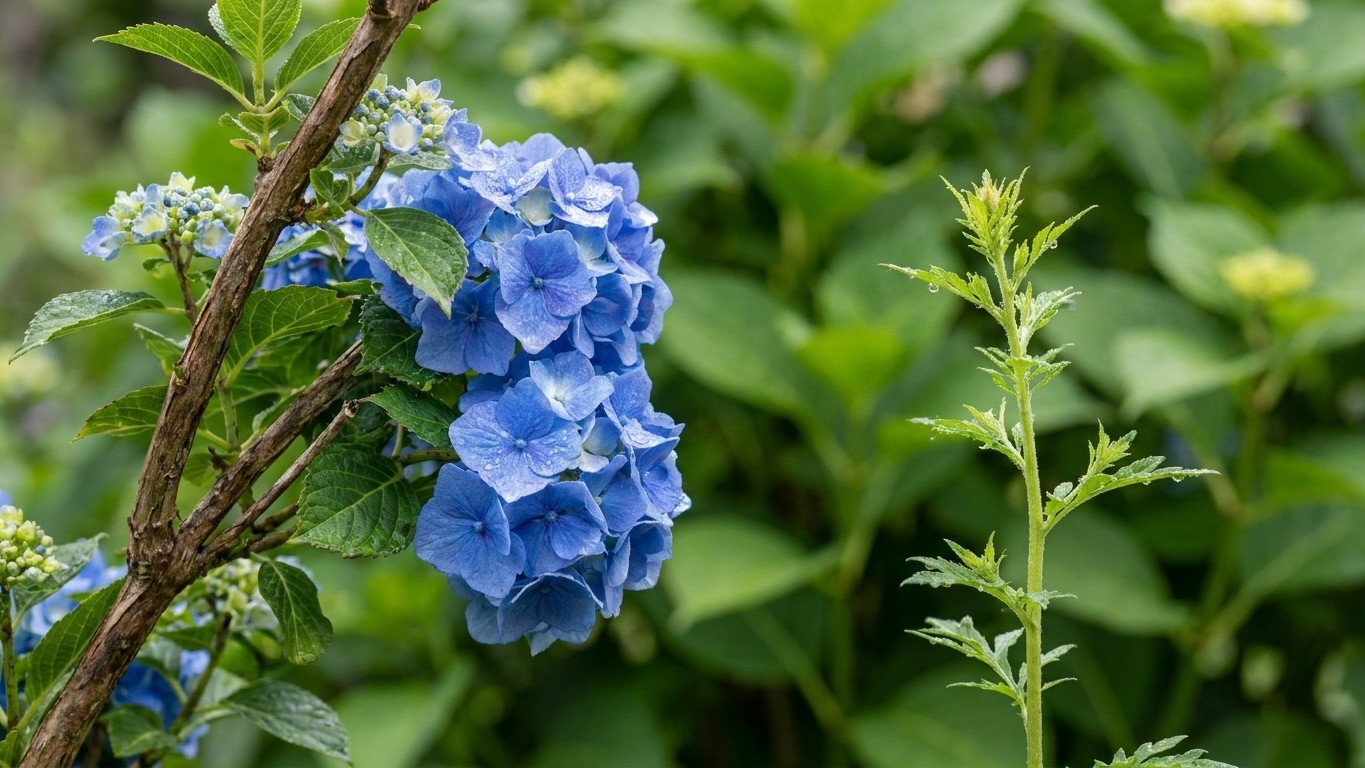

Hydrangeas turn out pink in much of Maryland because the soil is close to neutral, and at that pH the plant can’t take up aluminum. Aluminum is what turns bigleaf hydrangea flowers blue. Bring the soil pH down to roughly 5.0 to 5.5 and the next flush of blooms can come in blue or lavender. Let it drift back up and they return to pink. Only bigleaf and mountain hydrangeas respond. The other common types ignore soil chemistry.
What this comes down to in Maryland

Color is set by soil pH and the timing is set by the calendar: the work starts when leaves open, which happens around the last spring frost, between April 3 and April 16 at the Baltimore reference station (NOAA NCEI climate normals). The first fall frost at that same station falls between October 26 and November 5. The reference station has a last spring frost and a first fall frost, and the color you get is decided by what the roots absorb during that stretch.
Why does soil pH change hydrangea color?
The flower pigment in bigleaf hydrangeas is the same molecule in pink and blue plants. When aluminum reaches the sepals (the showy petal-like parts), it bonds with the pigment and shifts it toward blue. Most soils hold plenty of aluminum. What changes is whether it dissolves into water the roots can drink. In acidic soil it does. Near neutral, it locks up into solids and the flowers stay pink.
Plenty of Maryland yards sit on the pink side of that line. Soils over the limestone valleys around Frederick and Hagerstown lean neutral to alkaline. Lawn lime, concrete foundations, old plaster and builder’s fill all push a planting bed upward. Fertilizer matters too. A high-phosphorus formula ties up aluminum inside the plant and keeps flowers pink even when the soil is acidic enough.
Which hydrangeas can actually turn blue?
Bigleaf hydrangea (Hydrangea macrophylla, the mopheads and lacecaps) and mountain hydrangea (H. serrata) shift with pH. A classic mophead like ‘Nikko Blue’ is known for turning a strong blue in acid soil and a muddy pink-purple when it is not. White varieties of bigleaf stay white. Smooth hydrangea, including ‘Annabelle’, and panicle types such as ‘Limelight’ don’t change with soil at all. Their pink blush in fall is a response to cool nights and age, so no amount of sulfur will make them blue. Check the tag before you spend money on amendments.
Working it out for your own garden
Guessing at pH is how people end up with a bed that is neither pink nor blue. The method below can be adapted to any county and any year, because it starts with your own soil and your own spring.
How do you test the pH of a hydrangea bed?
Pull a few small samples from the top 4 to 6 inches around the drip line of the shrub, mix them, and send them to a soil lab or use a good home meter. A reading of 5.0 to 5.5 supports blue. A reading of 6.0 to 6.5 supports pink, and anything above that locks pink in firmly. Purple, in between, is common and often just means the bush has patches of both. Take the test in early spring, before you add anything, so you know where you are starting.
Take one more reading by testing a spot a few feet away that gets no lime runoff. A bed that tests half a point lower than the lawn edge tells you the amendments are not the problem. The runoff is.
How do you work out the timing?
Start from the frost window. Leaf buds open about when the last frost passes, so a first treatment lands between April 3 and April 16 in the Baltimore area. A follow-up four weeks later falls between about May 1 and May 14. A third, four weeks after that, falls between about May 29 and June 11. Three or four rounds spread across spring and early summer give the plant a steady supply while the flower buds develop.
Take two examples. A bed that tests only slightly above the target, around 6.0 to 6.5, is within reach of blue. Sulfur or an aluminum sulfate drench at label rate, started at leaf-out, can move a mophead like ‘Nikko Blue’ toward blue within that season, though a full blue is more likely the following year. A bed that tests at 7.2 next to a concrete foundation is a different problem. Soil that alkaline buffers hard against change, and each round of amendment gets undone by the next rain on the foundation. Growing that hydrangea in a large container of acidic, low-phosphorus potting mix gives the color a far better chance than fighting the ground.
Always follow the product label. Aluminum sulfate can burn roots if overapplied, so water the soil first and start at the low end of the rate. Retest in the fall to see whether the number moved.
What changes across the state
The calendar above belongs to Baltimore. Maryland stretches from the Atlantic coast to the Allegheny Plateau, and both the timing and the soil chemistry shift along the way.
Western Maryland, in Garrett and Allegany counties, is mountainous and runs weeks later than the reference station. Leaf-out follows that delay, so treatments there start later in spring, and a late frost can still catch buds that look safe by Baltimore standards. Soils in the ridges tend toward acid, which helps blue color, but cold winters are the bigger obstacle there. Bigleaf types bloom on old wood, and a hard winter can kill the buds before color ever matters. Protecting Hydrangeas Through a Maryland Winter covers what to do about it.
The Eastern Shore runs milder. Growth starts earlier and the frost-free season is longer. Its sandy Coastal Plain soils are often naturally acidic and low in buffering, so they move quickly in either direction: a bed can turn blue with modest amendment, and it can drift back to pink just as fast if lime or shell mulch gets near it. Crushed oyster shell on driveways and paths is a common culprit in that part of the state.
The Piedmont and central region fall between those two. Clay holds pH steadier than sand, so changes come slowly, and builder’s fill around newer houses can make two neighboring yards behave differently. Hardiness zones in the USDA system, which measures only the average annual extreme minimum temperature, run from 5b to 8a across Maryland, so your own zone depends on where you live.
The mistakes this state punishes

A common error is dosing without testing. Adding aluminum sulfate to soil that is already acidic does nothing for color and can injure roots. Adding it to a bed that is strongly alkaline wastes a season. Test first, treat second, retest in fall.
Feeding with the wrong fertilizer comes next. Many all-purpose and bloom-booster products are high in phosphorus, which keeps flowers pink. A formula lower in phosphorus and higher in potassium works better for blue. Lawn fertilizer and lime spread near the bed will undo your work, so keep the spreader away from the edge.
Warm spells in March fool plants. Mid-Atlantic weather can run mild for ten days and then drop below freezing in early April, inside the frost window. Plants that leafed out early lose their flower buds, and then little or no color appears, blue or pink. Hold off on treatments until buds are swelling steadily, and keep a sheet or frost cloth handy for the nights that dip below 32 F.
Pruning in the wrong season does the same damage. Cutting bigleaf stems in fall or early spring removes the buds. The guide to when to prune hydrangeas in Maryland sets out the timing.
Finally, raising pH by accident is easy. Wood ash, lime near foundations, and watering with alkaline well water all push a bed back toward pink. Pine bark or shredded oak leaf mulch helps hold acidity.
Checking this against your county
The dates here come from one reference station, so treat them as a starting point. Your county office at University of Maryland Extension can tell you how local conditions differ, point you to a soil testing lab, and explain how the soils around you tend to behave. For everything beyond color, including planting, watering and siting, see the guide to growing hydrangeas in Maryland.
Common questions
How long does it take to turn a pink hydrangea blue?
Plan on one full growing season to see a change, and often two for a deep blue. Flowers that are already open keep their color, so treatments show up in new blooms, often not until the following year.
Can I turn a blue hydrangea back to pink?
Yes. Raise the soil pH toward 6.0 to 6.5 with garden lime, using the amount a soil test calls for, and switch to a higher-phosphorus fertilizer. The shift is gradual, and flowers may pass through purple on the way.
Will white hydrangeas turn blue?
No. White bigleaf varieties lack the pigment that responds to aluminum, and smooth and panicle hydrangeas do not change with pH at all.
Why did my blue hydrangea turn pink on its own?
Usually the soil pH crept up. Lime from a nearby lawn, concrete, alkaline irrigation water, or a fertilizer high in phosphorus can all reverse the color within a season or two. Retest the bed and trace where the change is coming from.