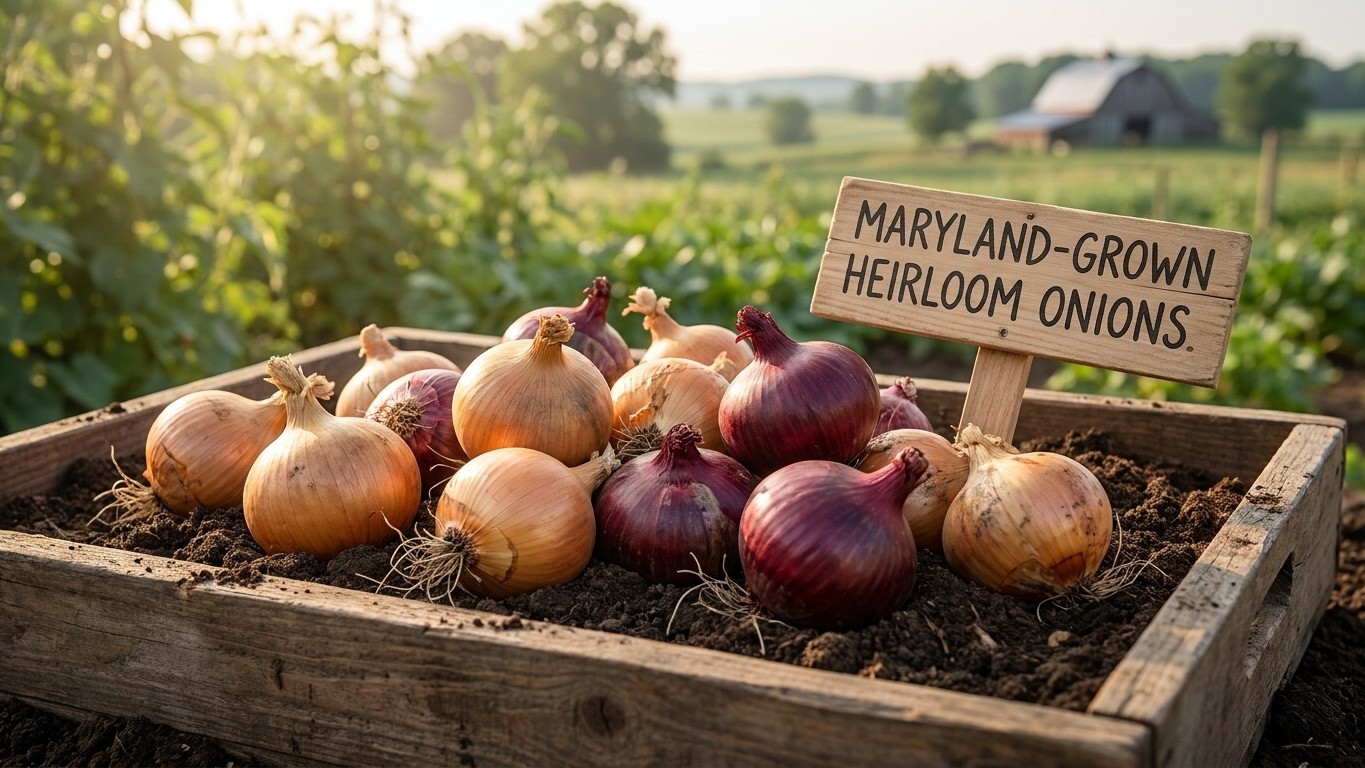

Maryland sits at 39.17 degrees north, measured at the Baltimore-Washington reference station, where the longest day of the year delivers 14 hours and 45 minutes of daylight. That single number rules out an entire category of onion and opens the door to two others. Here’s what actually bulbs in a Maryland garden, and what just makes leaves until it rots.
The short answer for Maryland

Onions don’t respond to heat the way tomatoes do. They respond to day length, and at 14 hours 45 minutes of summer daylight, Maryland lands squarely in territory that favors intermediate-day and long-day varieties. Short-day onions, bred to trigger at around 12 hours of daylight, would start bulbing here while the plant is still small, wasting most of the growing season it never gets to use.
Among the varieties whose published latitude range covers 39.17°N, ten are intermediate-day types: Cabernet, Calibra, Candy, Elsye, Expression, Monastrell, Red Long of Florence, Red Long of Tropea, Scout, and Sierra Blanca. These bulb on a slightly earlier daylight trigger than long-day types, which suits Maryland’s moderate summer daylight without cutting the season too short.
Eight more are long-day varieties that also fit this latitude: Ailsa Craig, Barolo, Blush, Bridger, New York Early, Patterson, Rossa di Milano, and Walla Walla Sweet. These wait for a longer daylight trigger, which means the plant has more weeks to build leaf mass before bulbing starts, and in Maryland’s climate that extra leaf growth translates into a larger bulb by harvest.
That’s eighteen varieties total that match Maryland’s day length, split roughly down the middle between the two groups. Neither group is automatically better here. The choice between them comes down to what you want on the plate versus what you want in the pantry in February, which is the trade-off covered further down. What matters first is ruling out the group that doesn’t belong here at all.
What will not work here
Short-day onions are bred for the Gulf Coast and the Deep South, where 12 hours of daylight arrives early in the season and the plant hasn’t had time to grow much before bulbing kicks in. Plant one in Maryland and the opposite problem shows up: Maryland’s daylight climbs past the 12-hour mark well before summer, so the plant gets tricked into bulbing early, before it has built any real leaf structure. The result is a golf-ball-sized onion where a full-sized one should be.
On the other end, some long-day varieties need more daylight than Maryland’s sky ever provides, even on June 21. Those don’t shrink. They fail completely, because the trigger that tells the plant to stop making leaves and start making a bulb never arrives.
- Gabriella (short-day, 20-35N), bulbs too early and too small at this latitude, published range sits well south of Maryland.
- Madalyn (short-day, 20-35N), same problem, bred for daylight hours Maryland reaches too early in the season.
- Red Rock (short-day, 30-36N), still south of Maryland’s range, still triggers before the plant has grown.
- Powell (long-day, 43-47N), needs more daylight than Maryland’s 14h45 ever supplies; makes leaves all season, never bulbs, eventually rots.
- Redwing (long-day, 43-65N), bred for far-northern daylight hours; same failure, no bulb at all.
- Safrane (long-day, 42-50N), daylight threshold too high for this latitude.
- Talon (long-day, 42-50N), same story: the trigger day length simply doesn’t happen here.
None of these fail gently. A short-day variety planted this far north gives you a small onion, not a missing one, because it still bulbs, just too soon. A long-day variety bred for latitudes above Maryland gives you nothing at all: leaves through August, then a soft, rotting bulb-that-never-was once the plant runs out of season. That’s a variety mismatch, not a fertilizing or watering mistake, and no amount of extra care fixes it.
What changes across Maryland
The 39.17°N figure belongs to the Baltimore-Washington corridor, not to the whole state. Maryland runs from roughly 37.9°N at the southern tip of the Eastern Shore up to about 39.7°N along the Mason-Dixon line, a spread of nearly two degrees. That’s not huge compared to a state like California, but it’s enough to nudge a garden near either edge into a slightly different bulbing window than the reference city.
| Location | Approx. latitude | What changes |
|---|---|---|
| Southern Maryland / lower Eastern Shore | ~37.9°N | Slightly less summer daylight than the reference figure; sits closer to the edge of the 38°N bound published for several long-day varieties, including Ailsa Craig, Barolo, Blush, New York Early, Patterson, and Rossa di Milano. |
| Baltimore-Washington corridor (reference) | 39.17°N | Baseline figure this page is built on: 14h45 of daylight on the longest day. |
| Northern Maryland / Mason-Dixon line | ~39.7°N | Slightly more summer daylight than the reference figure; edges toward the blurred zone for Frontier and Red Carpet, both bounded at 40°N. |
A gardener near Frostburg or Oakland, in Maryland’s western panhandle, gains a bit more elevation-driven cold on top of that latitude shift, which mostly affects planting dates rather than variety choice. A gardener on the lower Eastern Shore, closer to Virginia, should treat the 38°N-bound varieties as being right at their edge rather than comfortably inside their range.
Sweet now, or onions that last
The bite in an onion comes from volatile sulfur compounds, and those same compounds are what keep the bulb from breaking down in storage. Fewer of them makes an onion mild and pleasant raw, but soft and short-lived in a mesh bag on the counter. More of them makes an onion sharp on the cutting board and tough enough to sit in a cool closet until spring. According to University of Missouri Extension, “as a rule, ‘sweet’ onions do not store as well as the more pungent types,” and that’s chemistry, not marketing.
This lines up directly with the day-length split covered above. The intermediate-day varieties that suit Maryland, Candy, Elsye, Sierra Blanca, Scout, and the others, tend to run sweeter and softer, better eaten within a few weeks of harvest. The long-day varieties, Patterson, Bridger, New York Early among them, tend to carry more of those sulfur compounds and hold up longer in storage.
A Maryland gardener growing only intermediate-day types is signing up for onions that taste great in July sandwiches and are mostly gone by October. A gardener who mixes in a few long-day varieties buys a pantry that still has onions in March, just sharper ones that need a minute in a hot pan before they turn sweet. Growing both isn’t complicated. It’s just a matter of deciding, row by row, whether that onion is meant to be eaten this season or stored through the winter.
Checking this against your own garden
Everything above is built on one station’s coordinates and one calculated daylight figure. A Maryland garden thirty or forty miles from the Baltimore-Washington corridor is close enough that the advice holds, but it’s worth confirming rather than assuming, especially near the state’s northern or southern edges.
- Look up your own latitude if you’re closer to Ocean City, Cumberland, or the lower Eastern Shore than to Baltimore or Washington, since a degree or more of difference shifts which side of a variety’s range you’re on.
- Check your local frost dates rather than relying on a statewide average; western Maryland’s higher elevation pushes the last frost weeks later than the coastal plain.
- Call your county extension office before ordering seed. Maryland’s University of Maryland Extension offices track soil and season data at the county level, which a state-wide figure can’t capture.
- Confirm the day-length group printed on the seed packet or catalog listing matches intermediate-day or long-day, since a mislabeled short-day variety is the single most common reason for undersized onions in this region.