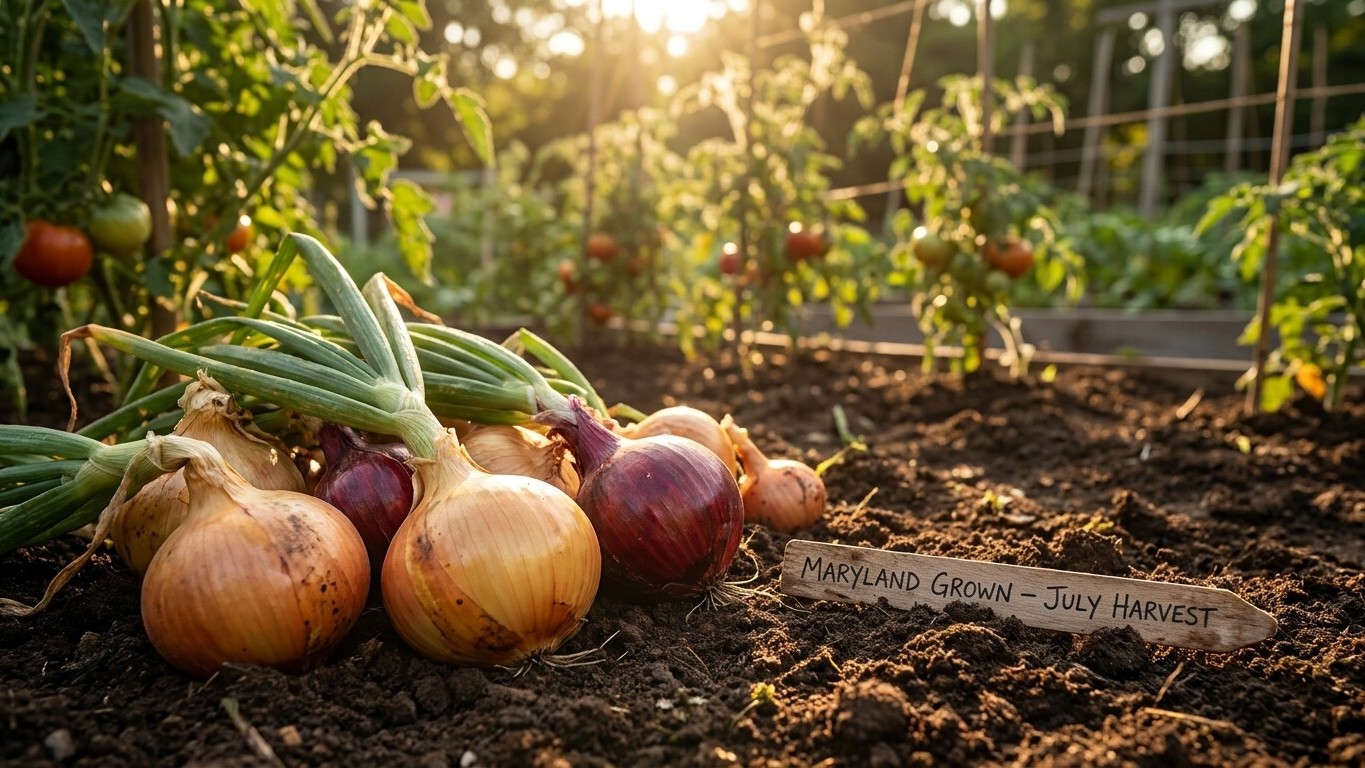

An onion doesn’t care how warm your Maryland spring gets. It cares how long the day is. At 39.17 degrees north, the reference station near Baltimore-Washington sees 14 hours and 45 minutes of daylight on the longest day of the year, and that single number decides which onion varieties will actually form a bulb here and which ones will leave you with a pile of green leaves and nothing underground.
How long your longest day is

Fourteen hours and forty-five minutes. That’s the daylight ceiling at 39.17 degrees north on the June solstice, and it’s the number every onion variety is quietly measuring before it decides whether to keep growing leaves or switch over to building a bulb. Short-day onions trigger at around 12 hours of daylight, according to Clemson Cooperative Extension’s Home & Garden Information Center. Maryland blows past that threshold by nearly three hours every summer, which means a short-day onion here starts bulbing while the plant is still small and undersized, then stops growing. Intermediate-day types, which need roughly 12 to 14 hours, fit comfortably. Long-day types, which hold off until 14 to 16 hours, also work, since 14 hours 45 minutes clears their minimum with a bit to spare.
So the group that fits Maryland is intermediate-day and long-day. The group that doesn’t is short-day, full stop. That’s the entire logic of this page in one sentence, and everything below is just the detail work of applying it.
One caution worth repeating: 39.17 degrees is the latitude of a single reference station, not the whole state. Maryland stretches from the Eastern Shore up into the Appalachian ridges of Garrett and Allegany counties, and while the north-south spread in latitude is modest compared to states like California or Texas, it’s not zero. A gardener near the Pennsylvania line gets marginally more summer daylight than one near the Virginia line. If you’re gardening at either edge of the state, it costs nothing to look up your own coordinates and compare them against the 12-hour and 14-hour thresholds before you commit to a packet of seed.
Which varieties bulb in Maryland
Eighteen varieties documented on this site have a published latitude range that covers 39.17 degrees north, meaning the day-length math works for a Maryland garden without qualification:
- Ailsa Craig (long-day, 38-60N)
- Barolo (long-day, 38-55N)
- Blush (long-day, 38-55N)
- Bridger (long-day, 35-50N)
- Cabernet (intermediate-day, 35-45N)
- Calibra (intermediate-day, 35-45N)
- Candy (intermediate-day, 33-40N)
- Elsye (intermediate-day, 32-45N)
- Expression (intermediate-day, 32-45N)
- Monastrell (intermediate-day, 35-46N)
- New York Early (long-day, 38-50N)
- Patterson (long-day, 38-55N)
- Red Long of Florence (intermediate-day, 38-50N)
- Red Long of Tropea (intermediate-day, 35-48N)
- Rossa di Milano (long-day, 38-50N)
- Scout (intermediate-day, 32-46N)
- Sierra Blanca (intermediate-day, 32-45N)
- Walla Walla Sweet (long-day, 35-55N)
Three more sit close enough to a published boundary that they belong in a gray zone rather than a firm yes: Frontier (long-day, 40-50N), Red Carpet (long-day, 40-45N), and White Castle (short-day, 30-38N) all fall within about a degree and a half of their listed limits. These bounds describe a continuum, not a hard cutoff, so treat these three as possible rather than guaranteed, and expect more variability in bulb size if you plant them.
Now the list that actually matters more, because it’s the one that explains a failed onion patch. Seven varieties documented on this site will not bulb in Maryland, for two different reasons.
- Gabriella (short-day, 20-35N), too far south in its range; bulbs form early and stay small.
- Madalyn (short-day, 20-35N), same problem, tiny undersized bulbs.
- Red Rock (short-day, 30-36N), bulbs too soon, before the plant has built enough leaf mass.
- Powell (long-day, 43-47N) : Maryland’s summer day never reaches its trigger length.
- Redwing (long-day, 43-65N), same story, no bulb signal ever arrives.
- Safrane (long-day, 42-50N), leaves keep growing, nothing forms underground.
- Talon (long-day, 42-50N), the plant simply never gets the daylight cue it needs.
The three short-day varieties fail by bulbing too early and too small, a variety mismatch rather than a growing mistake. The four long-day varieties fail more dramatically: since Maryland’s longest day never reaches their 15-to-16-hour requirement, the plant just keeps making leaves, then eventually rots in the ground with nothing to show for it. If you’ve ever planted a grocery-store set that produced a big green top and no onion, this is almost certainly why.
When to plant onions in Maryland
Planting season is downstream of the day-length group, and it varies a lot from one part of the country to another. Mild-winter regions plant onions in autumn and let them overwinter as small plants. Maryland isn’t one of those regions. With average frost dates running late here, the state falls into the late-winter-to-early-spring planting camp that most of the mid-Atlantic and Northeast shares.
NOAA’s 1991-2020 Climate Normals put the average last spring freeze (32°F) at April 3 to April 16, and the average first fall freeze at October 26 to November 5, based on the 30-70% probability band at station USW00093721. Onion transplants and sets typically go in the ground four to six weeks before that last spring frost date, which for most of Maryland puts planting somewhere in late February through March, depending on how the season is running and how far inland or upland the garden sits.
Two things to keep straight about those dates. First, they’re averages pulled from three decades of data, not a promise. A given year can bring a hard freeze well after April 16, and a gardener who plants strictly by the calendar rather than watching the actual forecast can still lose a bed of young onion plants to a late cold snap. Second, the caution baked into the NOAA data applies here directly: western Maryland, up in Garrett and Allegany counties, runs weeks later than these dates because of elevation and mountain cold-air drainage, while the Eastern Shore tends to run milder and earlier. A grower in Oakland, Maryland is not on the same clock as one in Salisbury, even though both are technically the same state.
Sweet onions or onions that keep
Maryland sits in a middle ground, and that shows up on the plate as much as in the garden. The pungency that makes an onion sting your eyes and bite on the tongue comes from volatile sulfur compounds, and those same compounds are what let a bulb sit in a mesh bag through the winter without going soft. University of Missouri Extension puts it plainly: sweet onions, as a rule, don’t store as well as the more pungent types, because the chemistry that gives them a mild flavor is the same chemistry a storage onion relies on for protection.
That trade-off tracks with day length. Short-day varieties, grown further south than Maryland can support, tend to run sweeter and softer, meant to be eaten within weeks of harvest. Long-day varieties, suited to higher latitudes, tend to run sharper and hold for months. Since Maryland’s day length allows both intermediate-day and long-day types, a Maryland garden can produce either kind, but rarely gets the extremes of either one. A Walla Walla Sweet grown here will taste closer to what you’d get from it further west, mild and best used quickly, and it will not last into winter no matter how carefully it’s cured. A Patterson or a Redwing-type long-day storage onion, by contrast, cures down hard and sulfur-rich and can realistically still be sitting in a cool, dry pantry in March.
The practical takeaway for planning a bed: decide what you actually want before you order seed. A kitchen that goes through onions fast and prizes a milder bite in salads and sandwiches does better with the sweeter intermediate-day types like Candy or Scout. A household that wants onions to last from harvest through the following spring should lean toward long-day keepers like Patterson or Ailsa Craig, and should not expect a sweet variety to fill that role no matter how it’s stored. Growing both, in separate rows, is the closest thing to having it both ways.