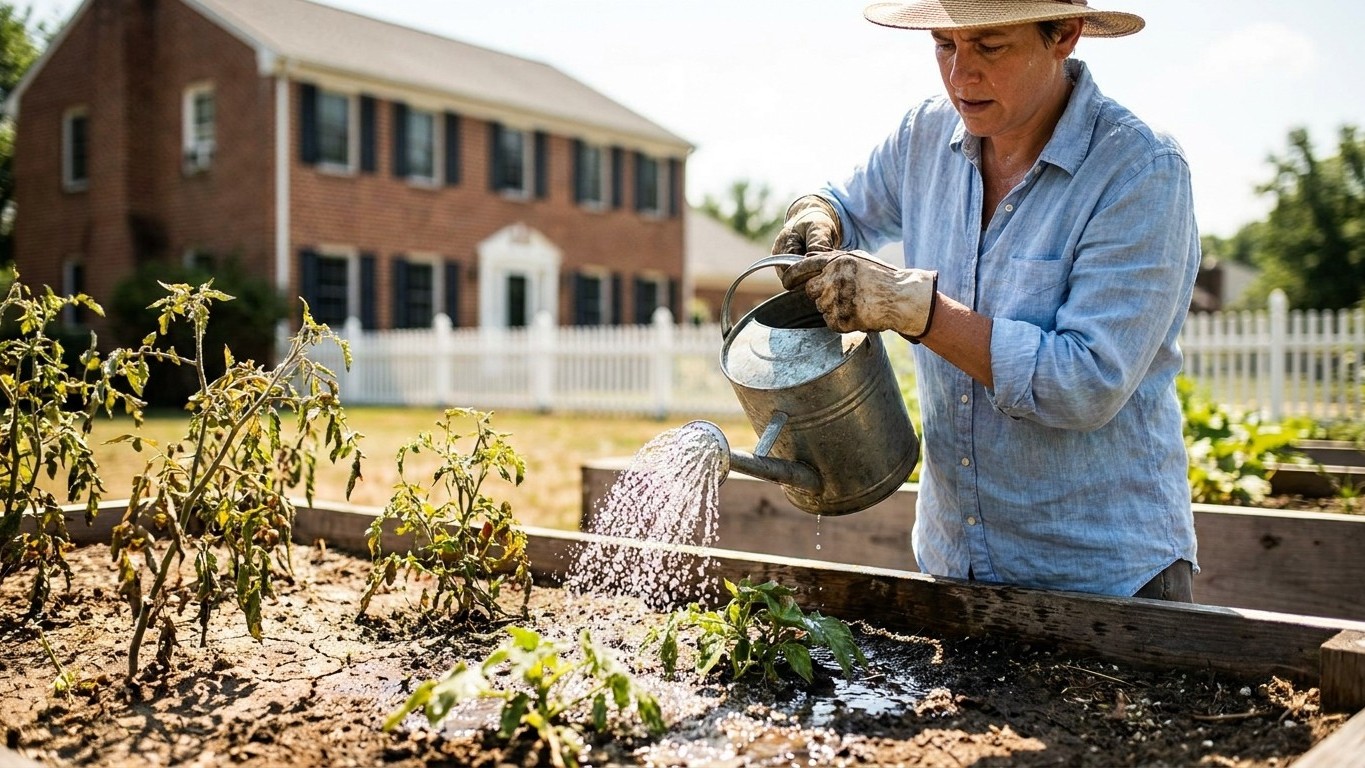

Maryland gardens live or die on two things: how hot it gets and how the rain falls, or doesn’t, when it matters most. The state’s climate data points to a clear pattern of summer heat stress, and the rules that follow are built on what the numbers actually say, not on a generic idea of “Watering a Garden.”
What the climate asks of you

Start with the figure that decides whether a garden coasts through July or gasps for it: Maryland’s reference station in Baltimore averages 24.6 days a year at 90F or hotter, based on the NOAA NCEI 1991-2020 Climate Normals. That’s not a summer average, it’s a hard count of days when soil moisture evaporates fast and shallow-rooted plants show stress by afternoon. It’s also the number that rules out treating a Maryland vegetable bed or lawn the way you’d treat one in coastal Maine, where 90F days are rare.
Heat is the trigger, but the state isn’t one climate
Maryland runs from USDA hardiness zone 5b up to 8a, a range wide enough that a planting or watering schedule dated for one part of the state can be weeks off for another. The western mountains around Garrett and Allegany counties freeze later in spring and earlier in fall than the rest of the state, while the Eastern Shore stays milder on both ends. The last spring frost falls somewhere between April 3 and April 16 at the Baltimore reference station, and the first fall frost lands between October 26 and November 5. That gives most of central Maryland a growing season of roughly six months, but a Garrett County garden works with a noticeably shorter window, and an Eastern Shore garden gets a longer one on both edges.
Rainfall varies more than a single statewide number could show
This is also why a single statewide summer rainfall figure would be misleading rather than useful here. Maryland’s geography, from the Appalachian ridges in the west to the Chesapeake Bay shoreline in the east, produces real differences in summer storm patterns county to county. Rather than force a state average onto your yard, check the closest station data through the University of Maryland Extension, which tracks local conditions and can tell you how your specific county’s summer rainfall compares to a garden bed’s rough weekly need of about an inch of water. What the 90-day-plus heat count already tells you is that whatever rain does fall in July and August, it’s evaporating fast, and the gardener should plan to make up the difference rather than assume the sky will handle it, a challenge covered in more depth in Watering Through a Dry Spell in Maryland.
How much, how often
The rule that holds up across almost every Maryland yard, sandy Eastern Shore soil or heavy Piedmont clay, is the same: water deep and infrequently, not shallow and daily, a principle that applies whether you’re working garden beds or Watering Pots and Containers in Maryland. A quick daily sprinkle wets the top half-inch of soil and trains roots to stay near the surface, exactly where the day’s heat bakes them hardest. A deep soak that reaches six to eight inches down pushes roots to chase the moisture, which builds the kind of root system that survives a string of 90F days without wilting by 3 p.m.
Reading the soil before you turn on the hose
Skip the calendar and check the dirt instead. Push a finger or a garden trowel two inches into the soil near the plant’s base. If it comes out dry at that depth, it’s time to water. If it’s still damp, wait another day and check again. This single habit prevents the two most common mistakes in Maryland gardens: watering a bed that’s already saturated after a heavy summer thunderstorm, and letting a sandy strip near the Bay go bone dry because the schedule said Tuesday.
Soil texture changes the math directly. Sandy soil, common on the Eastern Shore and in parts of Southern Maryland, drains fast and holds little water in reserve, so it needs shorter, more frequent soakings rather than one big weekly dose. Heavy clay, more typical of the Piedmont region running through the middle of the state, holds a week’s worth of water but drowns roots if it’s soaked again before it has had a chance to dry out, and working or watering clay while it’s still wet compacts it further and makes the problem worse over the season.
- Check the soil two inches down at the plant’s base before deciding to water at all, using a finger or trowel rather than a fixed schedule.
- Water early in the morning, before 10 a.m. if possible, so moisture soaks in before the day’s heat pulls it back out through evaporation.
- Aim at the base of the plant, not the leaves, to cut down on fungal disease that spreads fast in Maryland’s humid summers.
- Apply roughly one inch of water per session for sandy soil applied twice a week, or the same inch applied once a week for clay-heavy ground that holds moisture longer.
- Adjust after any rain heavier than half an inch by skipping the next scheduled watering and rechecking the soil before resuming.
Restrictions and rules
Watering restrictions aren’t unusual in Maryland during dry stretches, and they’re set locally rather than statewide, so the rule that applies to a yard in Montgomery County may not match one in Wicomico County. Local water utilities and county water authorities issue these restrictions, typically tied to reservoir levels or drought monitoring, and they can appear or lift within a season depending on how a summer plays out.
Where to check before you set a timer
Because the rules shift by jurisdiction and by year, the only reliable source is the water provider itself, not a general guide. Contact your local water utility or county government directly, and check the University of Maryland Extension for county-specific guidance on drought response and best watering practices tailored to your region. Given how many days each summer already push past 90F in the Baltimore reference data, it’s worth treating a restriction check as a normal part of setting up a summer watering routine here, not an afterthought only pulled out once a drought is declared. A five-minute call before installing an irrigation timer beats finding out mid-July that odd-even day watering is in effect.
Using less
Cutting water use in a Maryland garden doesn’t mean watching plants struggle. It means putting the water that does go down to better use, so less of it evaporates or runs off before a root ever touches it.
- Mulch, two to three inches deep, around beds and shrubs to slow evaporation from the soil surface, which matters most on the days the reference station counts among its 24.6 annual highs above 90F.
- Drip irrigation or soaker hoses deliver water directly to the root zone instead of spraying it into the air, cutting losses to wind and evaporation that overhead sprinklers can’t avoid.
- Group plants by water need rather than scattering thirsty annuals among drought-tolerant natives, so you’re not overwatering the tough plants just to keep the delicate ones alive.
- Work organic matter, like compost, into the soil each season, which helps sandy Eastern Shore soil hold moisture longer and helps heavy clay drain a bit better, moving both toward that easier middle ground.
- Rain barrels, where local rules allow them, capture roof runoff for reuse in the garden between storms.
What a rain barrel can and can’t cover
The math on a rain barrel is straightforward once you know the conversion: an inch of rain falling on a thousand square feet of roof works out to roughly 600 gallons of runoff. A standard residential roof section feeding a single downspout can fill a typical barrel fast during a good summer thunderstorm. The catch in Maryland is that those storms aren’t evenly spaced. A barrel can fill in one heavy afternoon system and then sit empty through the following dry stretch, especially during the state’s hottest weeks when the 90F-plus days cluster together and rain becomes less reliable. Treat a rain barrel as a supplement that stretches your tap water use, not as a stand-alone water source for the driest part of the season.
Common questions
How do I know if my Maryland soil is more sand or clay?
Squeeze a handful of moist soil in your fist. If it falls apart immediately when you open your hand, it’s sandy. If it holds a tight ball and feels sticky, it’s clay-heavy. Most Piedmont soil through central Maryland leans clay, while Eastern Shore and Southern Maryland soils run sandier.
Does Maryland’s growing season length affect how long I need to water?
Yes. With the last spring frost landing between April 3 and April 16 and the first fall frost between October 26 and November 5 at the Baltimore reference station, most of central Maryland gets close to six months of watering season, though Western Maryland’s mountain counties run shorter and the Eastern Shore runs a bit longer on both ends.
Should I water differently during a heat wave with several 90F days in a row?
Check the soil daily rather than skipping straight to a heavier schedule. A string of 90F-plus days speeds up evaporation, so soil that stayed moist for four days in cooler weather might need checking every two days instead, especially in sandy ground.
Who do I contact if I’m not sure whether watering restrictions apply to my address?
Reach out to your local water utility or county government directly, since restrictions are set locally rather than statewide in Maryland. The University of Maryland Extension can also point you toward county-level drought and water-use resources.