
Most pepper varieties, from sweet bells to hot chilies, can complete a full cycle in a Maryland garden if the transplant goes in as an 8-to-10-week-old seedling and the soil has already warmed past 60°F. The limiting factor isn’t the length of the season. It’s two temperature extremes that can stall fruit set no matter which variety you’ve planted, and no matter how many weeks of calendar you have left.
The short answer

Baltimore’s reference station averages 24.6 days a year at or above 90°F, based on NOAA NCEI Climate Normals covering 1991-2020. That’s not a trivia number. Pepper flowers abort when daytime highs push past 90°F for a stretch, which means every one of those two dozen-plus days is a day when open blossoms may drop instead of setting fruit. A plant that’s flowering heavily in late July, right when Maryland typically racks up its hottest stretch, can lose a wave of blossoms and simply skip a beat. The plant doesn’t die. It just doesn’t fruit that week.
Utah State University Extension, in its guidance on growing peppers, is specific about this: fruit set fails at both ends of the temperature range, not just the hot one. Nights below 55°F cause the same kind of blossom drop as days above 90°F. That’s the half of the equation gardeners tend to forget, because it’s easy to fixate on heat when you’re sweating through a Maryland August and forget that a cool snap in a Garrett County spring, or even a chilly night on the Eastern Shore in late April or early September, can do the identical damage.
Here’s where this site has to be honest about its limits: it carries daytime heat data (the 90°F count above) for Maryland, but it does not track summer night minimums. There’s no reliable way to state, for any given Maryland county, how many nights drop below 55°F in a typical growing season, and it would be a mistake to guess based on latitude or on how cold the coldest month of the year gets. Winter lows and growing-season night lows are different climate variables, driven by different factors, and one doesn’t predict the other. If you garden near the Bay, in a valley, or at higher elevation in the western counties, you need to watch your own overnight lows during flowering. A cheap min-max thermometer left in the garden bed tells you more than any statewide average ever will.
Utah State’s guidance also names six pepper varieties suited to home gardens, but it publishes no heat-tolerance rating, no days-to-maturity figure, and no fruit-size figure for any of them. That’s worth knowing before you go shopping for seed based on a promised number you saw somewhere else. The variety name alone doesn’t guarantee a specific maturity window; growing conditions, especially those two temperature extremes, do more to determine whether a plant fruits on schedule than the label on the seed packet.
When to start seed here
The math for starting pepper seed indoors is straightforward once you have two dates: your local last spring frost, and the date your soil typically hits 60°F. Work backward from there.
- Find your last spring frost window. NOAA NCEI’s 1991-2020 Climate Normals put Maryland’s 32°F freeze-probability window (the 30-70% band) at April 3 to April 16 for the reference station. That’s a two-week spread even within the same normals dataset, and it shifts further depending on where you are: western Maryland, particularly Garrett and Allegany counties, runs weeks later because of elevation and mountain cold-air pooling, while the Eastern Shore tends to warm up earlier thanks to the moderating effect of the Bay.
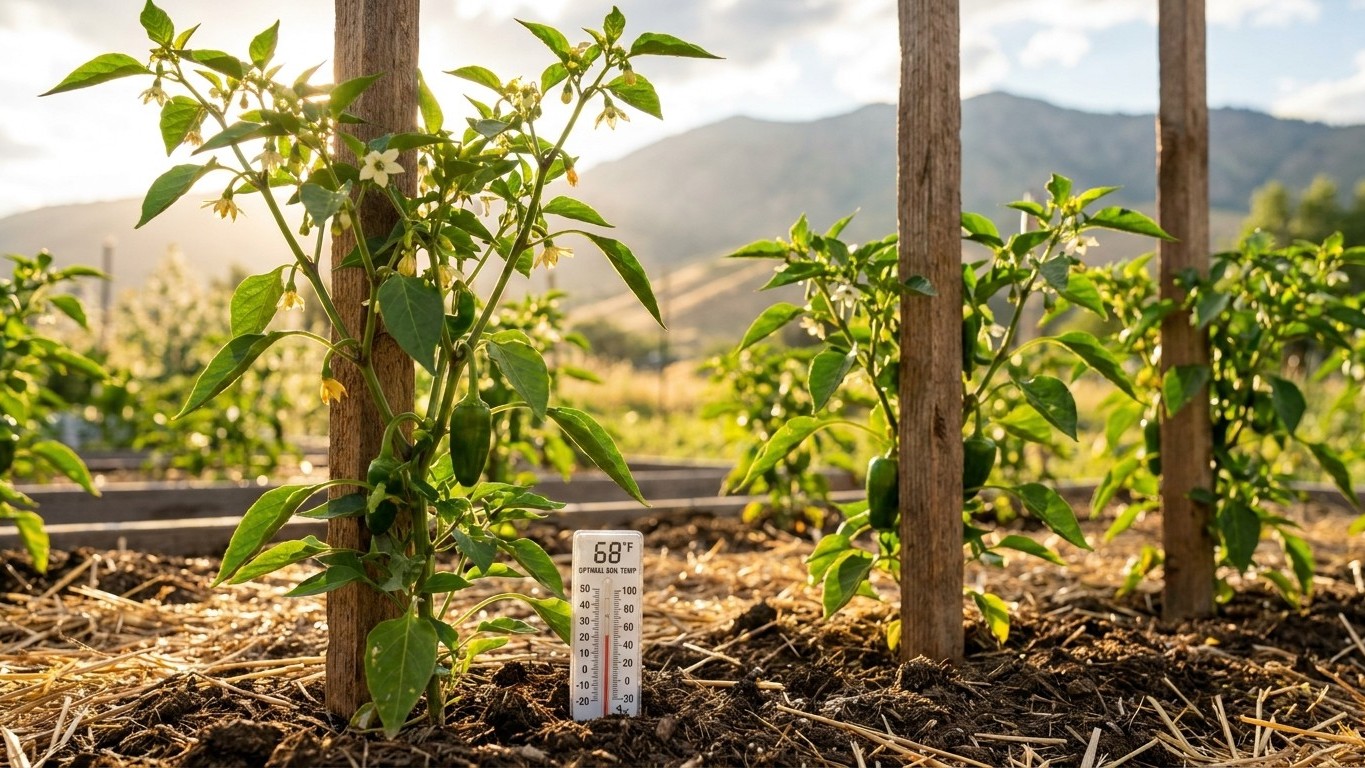
- Confirm your soil temperature separately. Air temperature and soil temperature don’t move in lockstep. A calendar date passing frost-free doesn’t mean the ground has caught up. Utah State University Extension is clear that pepper transplants should go into the ground only after frost has passed and the soil has reached 60°F, whichever comes later. A soil thermometer pushed a few inches into the bed, checked over several mornings, tells you more than any date on a calendar.
- Count back 8 to 10 weeks from your transplant date. If your county’s last frost typically falls in the middle of that April 3-16 window, and your soil warms to 60°F around the same time or a little after, that transplant date becomes your anchor. Subtract 8 weeks for a fast estimate, 10 weeks if you want more margin for slow germination or a stocky, well-rooted seedling. That lands most Maryland seed-starting dates somewhere in the back half of winter into very early spring, indoors, under lights or on a warm windowsill.
- Adjust for your specific county, not the statewide average. If you garden in the mountains of far western Maryland, push your whole timeline later by however many weeks your local frost date runs behind the reference station. If you’re on the lower Eastern Shore, you may be able to start a bit earlier. Redo the subtraction with your own numbers rather than borrowing the reference station’s dates wholesale.
None of this arithmetic accounts for the flowering-to-ripe stretch that comes later. Once a pepper plant sets fruit, it still needs roughly 35 to 45 days from the point of flowering to reach a ripe, colored fruit, according to Utah State’s guidance. That window starts at flowering, not at the seed-starting date and not at transplant. It’s a separate clock that only starts ticking once blossoms are open and setting successfully, which loops back to those two temperature thresholds. A late-May transplant that hits a hot spell in July before it flowers well simply pushes its ripening date further into an already compressed Maryland fall.
What goes wrong here
- Blossom drop from a hot spell. When daytime highs climb past 90°F, which Maryland sees on an average of 24.6 days a year at the reference station, open pepper flowers can abort before setting fruit. The remedy isn’t a spray or a fertilizer change; it’s shade cloth over the row during the hottest stretch, timed watering in the early morning so plants aren’t drought-stressed on top of heat-stressed, and patience. The plant typically resumes setting fruit once temperatures ease.
- Blossom drop from a cool night. The flip side, nights below 55°F, causes the identical symptom: flowers fall without setting fruit. Because this site doesn’t track summer night minimums for Maryland, the remedy starts with observation. Keep a thermometer in the bed during flowering, especially in early- and late-season stretches when a cool front can drop temperatures overnight. If you’re seeing consistent drop with no heat spell to blame, suspect the cool end and consider row cover on the chilliest nights.
- Sunscald on exposed fruit. Strong summer sun can scald pepper fruit that’s left uncovered by foliage, showing up as a pale, papery patch on the side facing the sun. This tends to follow aggressive pruning or a plant that’s lost leaves to disease or wind damage. Leave enough foliage cover on the plant, and avoid removing leaves near fruit clusters just to “clean up” the plant during a hot stretch.
- Blossom-end rot on the fruit. A sunken, leathery patch at the blossom end of the fruit is a calcium-delivery problem, usually triggered by uneven watering rather than a true calcium shortage in the soil. Consistent, even moisture, mulch to buffer swings between wet and dry, and avoiding letting the bed dry out hard between waterings during fruit development are the practical fixes.
Common questions
Can I skip starting seed indoors and direct-sow peppers in Maryland?
Direct-sowing is risky here because peppers need 8 to 10 weeks as an established seedling before they go outside, and Maryland’s frost-free window, April 3 to April 16 at the reference station, doesn’t leave enough season for seed sown directly in the ground to reach maturity and ripen before fall cold arrives, particularly in western counties where frost comes later.
Does the 24.6 days above 90°F mean my whole pepper crop will fail?
No. It means roughly two dozen days a year, typically clustered in mid- to late summer, carry a real risk of blossom drop during flowering. Plants recover and resume setting fruit once temperatures moderate; the practical response is shade cloth and consistent watering during those specific hot stretches, not abandoning the crop.
How do I know if my nights are dropping below the 55°F threshold?
This site doesn’t carry summer night-minimum data for Maryland, and that figure shouldn’t be estimated from latitude, elevation guesses, or winter cold. Place a min-max thermometer in the bed during flowering season and check it directly; that’s the only reliable way to know your own site’s overnight lows.
Once flowers appear, how long until the peppers are ripe?
Utah State University Extension puts that window at 35 to 45 days from flowering to ripe fruit, not from the seed-starting or transplant date. A plant that flowers late because of a hot or cool interruption pushes its ripening date out by roughly that same window, which matters when you’re counting down to Maryland’s fall frost.