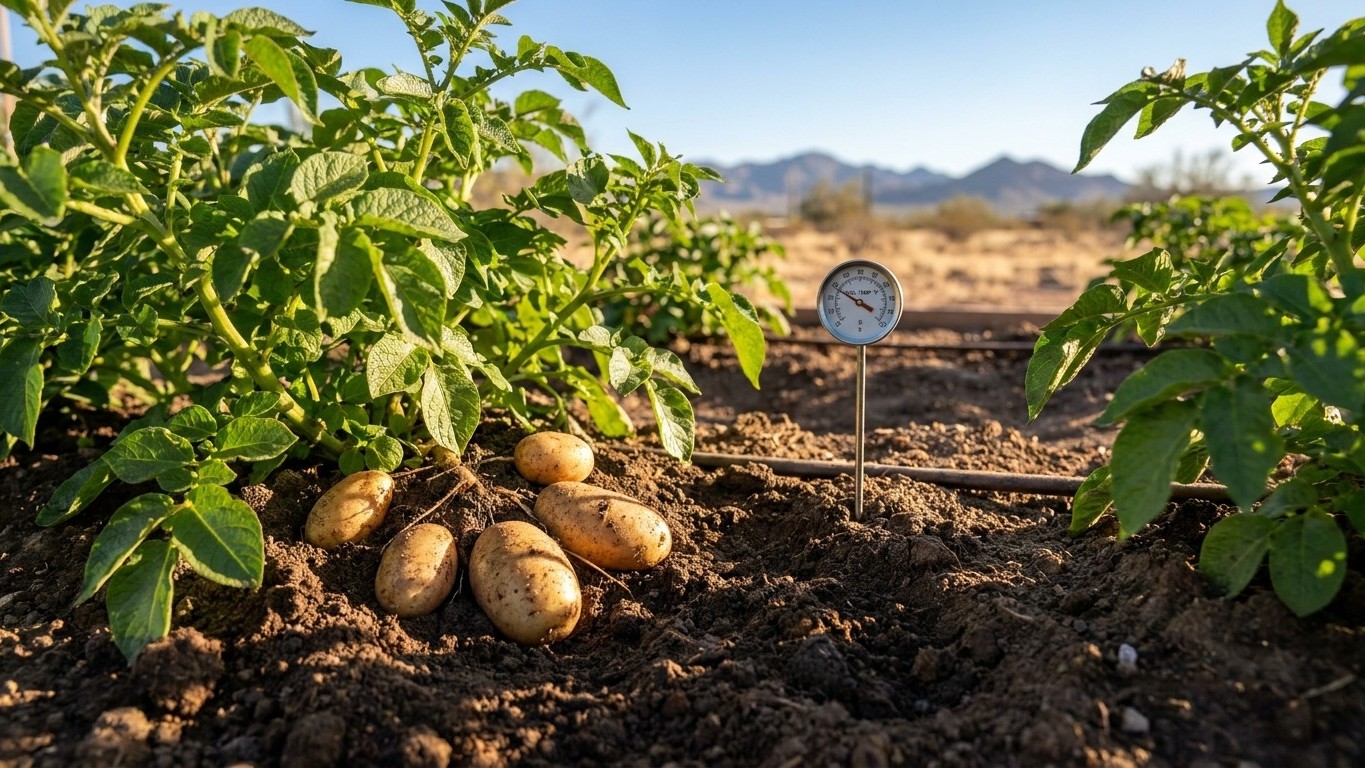

Three insects actually feed on potato in Maryland: Colorado potato beetle, flea beetles, and tomato hornworm. All three are documented for the state by University of Maryland Extension Home and Garden Information Center. Colorado potato beetle shows up first as soil warms, flea beetles follow with pinhole damage, and tomato hornworm arrives later, stripping foliage from established plants. When each one appears tracks Maryland’s frost-free window, not a fixed month on a calendar.
Which pests attack potato in Maryland
University of Maryland Extension Home and Garden Information Center documents ten insect pests across Maryland home landscapes and gardens: Box tree moth, Brown marmorated stink bug (Halyomorpha halys), Colorado potato beetle, Flea beetles, Harlequin bug, Spotted lanternfly, Squash bug, Squash vine borer, Tomato hornworm, and Viburnum leaf beetle. That is the complete list this service tracks for the state. It is not long, and there is no reason to pad it with anything else.
Only three of those ten belong on a potato patch. Colorado potato beetle is the classic potato feeder, chewing foliage down to bare veins if left alone. Flea beetles attack potato leaves too, leaving a fine peppering of tiny holes across the surface. Tomato hornworm, despite its name, feeds on any plant in the nightshade family, and potato qualifies, so it shows up on potato vines as readily as on tomato plants.
The other seven are real pests, just not for this crop. Box tree moth and Viburnum leaf beetle are shrub specialists that feed on boxwood and viburnum, woody ornamentals with nothing in common with a potato leaf. Spotted lanternfly prefers sap from woody plants and grapevine, and has no documented interest in potato foliage. Brown marmorated stink bug feeds mainly on fruiting structures like fruit and pods, not on the leafy growth or underground tubers of a potato plant. Harlequin bug is a cabbage-family specialist, drawn to broccoli, kale, and their relatives, not to nightshades. Squash bug and squash vine borer are both cucurbit feeders, tied to squash, pumpkin, and cucumber vines. Seeing any of these seven in a garden is worth noting for whatever else is planted nearby, but finding one on a potato leaf and blaming it for the damage is the wrong call.
The gardening error worth avoiding here is assuming every green insect crawling on a potato plant is guilty. Confirming which of the three actual potato feeders is present, before reaching for any control, saves both the plant and the effort.
When each one shows up, and what it does first
Insect activity on Maryland potatoes tracks the frost-free window rather than a specific date on the calendar. NOAA’s 1991-2020 climate normals put the last spring frost between April 3 and April 16 for the reference station in the Washington D.C. area, with a wide caution attached: Western Maryland’s mountain counties, Garrett and Allegany, run weeks later, while the Eastern Shore tends to warm earlier and stay milder. A gardener in Oakland is planting on a different clock than one in Salisbury, even though both are in the same state.
Colorado potato beetle is usually the first to appear once the ground has warmed past that frost-free threshold and young potato foliage is up. The first sign is rarely the beetle itself. It is small, round holes chewed into new leaves, often before anyone spots the orange-and-black striped adult resting on the underside. Bright yellow-orange egg clusters on the leaf underside are frequently the earliest confirmed evidence, showing up before the larvae start feeding in earnest.
Flea beetles tend to overlap with that early beetle activity, favoring the same tender young growth. Their signature is different from chewed holes: a fine, shot-hole peppering across the leaf surface, as if someone tapped it with a pin dozens of times. The insects themselves are tiny and jump the instant a leaf is disturbed, which is often how a gardener first notices them, movement rather than the insect at rest.
Tomato hornworm shows up later in the season, once potato plants have put on substantial growth and are heading toward tuber bulking. Its first sign is rarely the caterpillar, which is camouflaged almost perfectly against the stem and leaf color. What gives it away first is the damage pattern: large, ragged sections of leaf missing, sometimes whole stems stripped bare near the top of the plant, along with dark, pellet-shaped droppings on the leaves below the feeding site.
Telling the damage apart from everything else
Chewed or spotted potato leaves get blamed on insects more often than they should. The decisive test is presence, not appearance: an actual insect, egg cluster, or frass on the plant, not just the damaged tissue itself. Damaged leaves with nothing living on or near them point somewhere else entirely.
| What you see | Likely cause | What settles it |
|---|---|---|
| Small round holes in young leaves, beetle visible | Colorado potato beetle | Striped adult or bright egg cluster on leaf underside |
| Fine shot-hole peppering across leaf surface | Flea beetles | Tiny insects jump when the leaf is touched |
| Large ragged missing sections, stripped stems | Tomato hornworm | Dark frass pellets on leaves below the damage |
| Yellowing between veins, starting on older leaves | Nutrient deficiency | Pattern is uniform across the plant, no chew marks |
| Wilting despite damp soil, scorched leaf edges | Heat or drought stress | Whole plant affected evenly, no insect present |
| Dark spots with concentric rings on leaves | Fungal leaf disease | Rings form a target pattern, not a feeding hole |
| Torn leaves in no consistent pattern | Wind or mechanical damage | Damage is random, not concentrated on new growth |
A photo of the damage alongside anything living on the plant is worth more than a guess based on the leaf alone. When none of the three documented potato pests are visible, the more likely explanation is soil, water, or disease, and that calls for a different kind of help than an insect problem does.
What actually works here, and what is a waste of time
On a season this short, timing does more work than any single treatment. Floating row covers, set over the row before Colorado potato beetle adults emerge rather than after they’ve already found the plants, keep the first wave off entirely. Cover before the beetles arrive, not after they’ve settled in, because once eggs are laid under the cover, the barrier is protecting the problem instead of blocking it.
Handpicking adult beetles and crushing the yellow-orange egg clusters is tedious but effective on a small planting, especially early in the season before larvae hatch in numbers. Crop rotation matters too: planting potatoes in a different bed than last year’s nightshades makes it harder for overwintering beetles to find the row immediately.
Certified seed potatoes are not a minor detail. Uncertified seed pieces can carry viruses that no amount of pest control will fix once the plant is infected, and the problem shows up as poor vigor that gets blamed on insects when the seed piece was compromised from the start. Starting with certified stock removes that risk before the season begins.
What wastes time: spacing plants further apart in hopes of confusing flea beetles, which barely slows them down, and hosing plants with water to knock off Colorado potato beetle adults, which mostly just wets the foliage since the beetles climb right back on. Any decision about a pesticide, timing, or which product is legal to use on food crops in Maryland belongs with University of Maryland Extension Home and Garden Information Center, not with general advice, since labeled uses and restrictions are state-specific and change.
Where to check this for your own county
University of Maryland Extension Home and Garden Information Center is the source for everything documented on this page, and it is also the right place to confirm what is actually active in a specific garden. State-level documentation says what has been recorded across Maryland; it does not say what is present on one property in one county this season. A pest documented statewide is not the same as a pest confirmed in your yard, and that gap is exactly what a local office fills.
Presence varies inside the state as much as frost timing does. A garden on the Eastern Shore, warming earlier, can see Colorado potato beetle activity ahead of a garden in the mountain counties of Garrett or Allegany, where the season starts later and runs cooler. Central Maryland sits somewhere between the two. None of that variation shows up in a general write-up, only in what a county office is seeing that particular week.
The next step, if a potato plant is showing damage that does not match anything on this page, is contacting the county office of University of Maryland Extension directly, ideally with a photo of both the damage and anything living on the plant. That is the fastest way to get a confirmed answer instead of a guess.
Common questions
Do Colorado potato beetles overwinter in Maryland soil?
The adults overwinter in soil and garden debris near where they fed the previous season, which is one reason crop rotation away from last year’s potato bed helps reduce early pressure.
Can flea beetle damage kill an established potato plant?
Shot-hole damage on mature foliage is mostly cosmetic; young seedlings with heavy peppering are more vulnerable since they have less leaf area to spare.
Is tomato hornworm damage on potato as serious as on tomato?
It can be, since the caterpillar strips leaf tissue regardless of which nightshade it is feeding on, and a heavily defoliated potato plant loses the ability to bulk up tubers normally.
Should Eastern Shore gardeners expect earlier pest activity than the rest of the state?
Generally yes, since the Eastern Shore’s milder season starts earlier than central Maryland’s, while Western Maryland’s Garrett and Allegany counties lag behind both.