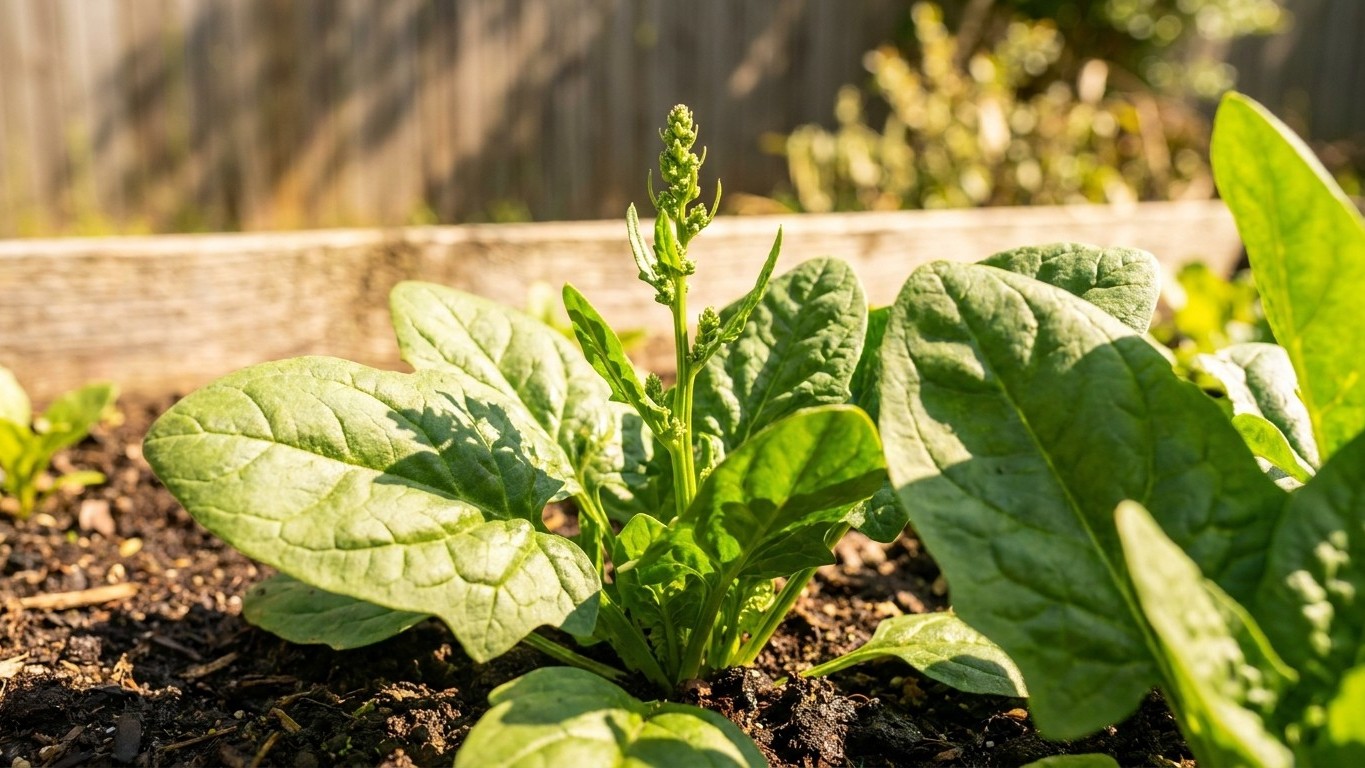

Flea beetles are the pest actually documented on spinach in Maryland, and they show up twice: once as soil warms after the last spring frost, and again in early fall once the ground cools enough to sow a second crop. Most of the other pests tracked in this state target trees, vines, or fruiting vegetables, not leafy greens.
Which pests attack spinach in Maryland
The University of Maryland Extension Home and Garden Information Center documents ten pests for gardeners across the state: box tree moth, brown marmorated stink bug (Halyomorpha halys), Colorado potato beetle, flea beetles, harlequin bug, spotted lanternfly, squash bug, squash vine borer, tomato hornworm, and viburnum leaf beetle. That’s the full list, and it’s worth being upfront that it’s short on spinach-specific entries.
Sorting through it, most of these have no business being discussed on a spinach page. Box tree moth and viburnum leaf beetle feed on ornamental shrubs, not vegetables, so they’re irrelevant here. Spotted lanternfly targets trees and grapevines. Squash bug and squash vine borer are cucurbit specialists, meaning they go after squash, pumpkins, and cucumbers, never leafy greens. Colorado potato beetle and tomato hornworm both feed on nightshade family plants (potatoes, tomatoes, eggplant), which spinach isn’t. Harlequin bug prefers cabbage-family crops. Brown marmorated stink bug is a generalist known mostly for damaging fruiting vegetables and tree fruit, not for feeding on leafy spinach foliage.
That leaves flea beetles as the one pest on this list with a real, documented connection to leafy greens like spinach. They’re small, dark, jumping beetles that chew tiny round holes in leaves, and they’re most damaging on young seedlings that haven’t built up enough leaf tissue to shrug off the feeding.
A short list isn’t a gap in reporting. It reflects what the extension service has actually documented for this state, and padding it with pests that belong on tomato or squash pages would only send a gardener chasing the wrong problem. If a plant in the garden shows chewing damage that doesn’t match flea beetle holes, that’s a reason to call the local extension office rather than guess from a list built for a different crop.
When each one shows up, and what it does first
Timing here runs off the frost-free window, not a fixed date on a calendar. Maryland’s last spring frost falls between April 3 and April 16, and that’s roughly when flea beetle adults become active as soil temperatures climb. Spinach seeded or transplanted right around that window is at its most vulnerable stage, because young seedlings with just their first true leaves have little leaf area to spare.
What shows up first isn’t a beetle sighting. It’s a scatter of small, round, shot-hole punctures across the leaf surface, sometimes dense enough to make the leaf look like it’s been peppered with a fine spray. Growth doesn’t stop outright, but a seedling covered in holes puts energy into recovery instead of size, which matters on a crop that’s already racing a short cool-weather window before it bolts.
The second appearance comes in fall, and it’s tied to a different rule: the fall sowing window opens once soil temperature drops, since germination drops off above 80 F soil, not because of any frost date. Extension guidance for a fall crop is to plant 50 to 75 days before the date you actually want to harvest, working backward from the first fall frost (October 26 to November 5 here). Flea beetles are still active in that stretch, and a second wave often targets the tender fall seedlings just as they emerge, before cooler nights start slowing the beetles down on their own.
Between those two windows, spinach also has a clock running that has nothing to do with insects at all. Long days push the plant toward flowering, and Maryland’s longest day carries 14 hours and 45 minutes of daylight, well past the point where spinach starts bolting instead of growing leaves. That means the practical spring window is already short before a single beetle shows up, and any feeding damage on top of it just shortens it further.
Telling the damage apart from everything else
Not every ragged or discolored spinach leaf is an insect problem, and confusing the two leads to spraying for a pest that isn’t there while ignoring what actually caused the damage.
| What you see | Likely cause | What separates it |
|---|---|---|
| Small, round, scattered holes | Flea beetle feeding | Holes are numerous, roundish, and concentrated on younger leaves |
| Leaves turn bitter, plant sends up a central stalk | Bolting | Triggered by long days and heat, not chewing; growth slows once temperatures push past 75 F, and that same number marks where flavor turns bitter |
| Seeds fail to come up at all | Soil too warm | Germination drops once soil runs above 80 F; no leaf damage exists because nothing emerged |
| Pale, uniform yellowing across older leaves | Nutrient deficiency | Even, not patchy, and spreads gradually rather than overnight |
| Torn or bruised leaf edges | Wind, hail, or foot traffic | Damage is irregular and tends to follow one direction or one side of the plant |
A gardener staring at a damaged spinach bed shouldn’t try to name the cause from a photo alone. The table above is a starting point for narrowing things down, not a diagnosis. If the pattern doesn’t clearly match flea beetle feeding, and heat or day length don’t explain it either, that’s exactly the kind of question a county extension office is set up to answer with a sample in hand.
What actually works here, and what is a waste of time
Given how short the good-growing window already is on both ends of the season, timing matters more than any treatment. A lightweight physical barrier laid over the bed right at seeding, before flea beetles are active, keeps them off the plant without needing to identify or treat anything after the fact. That single move, done early, does more than most reactive steps taken once damage is already visible.
Spraying for stink bugs, hornworms, squash bugs, or any of the other pests on the state’s documented list is a waste of effort on a spinach bed, since none of them are known to target this crop. Time and attention spent watching for those insects here is better spent elsewhere in the garden, on the crops they actually feed on.
It’s also worth being honest about what no product can fix: bolting. Once day length and heat push spinach toward flowering, there’s no spray or treatment that reverses it, because the trigger is environmental, not biological. The only lever that helps is planting early enough in spring, or late enough in fall once soil has cooled below that 80 F germination threshold, so the plant matures before long days and heat take over.
Beyond the row cover, specific product recommendations aren’t something to guess at here. What’s labeled for use on spinach, and legal to apply in Maryland, is a question for the University of Maryland Extension Home and Garden Information Center, not a generic gardening guide.
Where to check this for your own county
A statewide list documents what’s been found across Maryland as a whole, not what’s necessarily present in one backyard. Before treating anything, the more useful move is contacting the local county extension office, since pest pressure shifts noticeably within the state.
Western Maryland counties like Garrett and Allegany sit at higher elevation, with frost dates running weeks later than the rest of the state, which shifts both the spring planting window and when flea beetles first become active there. The Eastern Shore trends milder, often allowing an earlier start and a longer fall window than inland areas. A pest calendar built for the whole state is a starting point, not a substitute for local conditions.
The University of Maryland Extension Home and Garden Information Center maintains the pest documentation referenced throughout this page, and county offices under that same extension system can look at a specific sample or photo and speak to what’s actually active in that area this season. That’s the next step for anyone unsure whether what’s chewing on their spinach matches flea beetles or something else entirely.
Common questions
Do flea beetles kill spinach plants outright?
Rarely on mature plants. The bigger risk is on young seedlings, where heavy feeding slows growth right when the plant needs to establish before heat and long days push it toward bolting.
Can spinach be planted at the same time as tomatoes to save space?
Spinach and tomatoes don’t share pest pressure or a growing window, since tomatoes attract Colorado potato beetle and tomato hornworm, both absent from spinach’s documented pest list, and tomatoes go in well after spinach’s cool-season window has already closed.
Is a fall spinach crop less bothered by flea beetles than a spring one?
Not necessarily. Flea beetles remain active into fall, and a crop sown once soil finally cools below 80 F can still face a second wave of feeding on the young seedlings, just as it does in spring.
What variety of spinach should be planted in Maryland?
The extension source names four varieties, Bloomsdale, Melody, Teton, and Olympia, without publishing performance or timing data for any of them here, so choosing between them isn’t something this data can settle.