
Yes, insulation helps keep a Utah home cool, though how much depends on where in the state you sit. Salt Lake City averages 52.1 days a year above 90°F, and the state’s 29 counties split across three IECC climate zones, so the payoff from insulation isn’t identical from Cache County to St. George.
The short answer for Utah

Yes, and it matters for a real chunk of the calendar, not just a handful of scorching afternoons. At the National Weather Service’s Salt Lake City reference station, the 1991-2020 climate normals put the average at 52.1 days a year hitting 90°F or higher. That’s not a description of every valley and canyon in the state, but it’s a solid stand-in for summer heat load along the Wasatch Front, where most Utahns live.
Fifty-two days above 90°F is a real summer, but it’s not a year-round one. Compare that to a Gulf Coast city racking up 100-plus days above 90°F, and Utah’s cooling season looks like the shorter half of the energy story rather than the dominant one. That’s the honest framing here: insulation earns its keep in summer, but in most of the state it’s still carrying more weight against winter cold than against July heat.
The climate zone map backs that up. Under the 2021 IECC, Utah’s 29 counties break out as 21 counties in zone 5B, 7 counties in zone 6B, and 1 county in zone 3B. Zones 5 and 6 are cold-climate zones, the “B” means dry, not humid, and cold-climate zones are winter-dominated by definition. Only that single zone 3B county sits in a warmer classification where summer cooling starts to rival winter heating for the bigger share of the energy bill.
None of that means insulation is wasted in a 5B or 6B county in summer. It means the same insulation is doing double duty: resisting heat loss from October through April, and resisting heat gain during those 52-plus days above 90°F. A house with weak attic insulation in Cache or Summit County will still bake upstairs in August, it just won’t bake for as many weeks as a house in a warm-humid Southern zone. The zone map is not something to self-assign from a state average, though. Individual counties can vary from the state’s mix, and ENERGY STAR publishes the zone map directly for anyone who wants to confirm their own county before buying material.
What happens above the ceiling
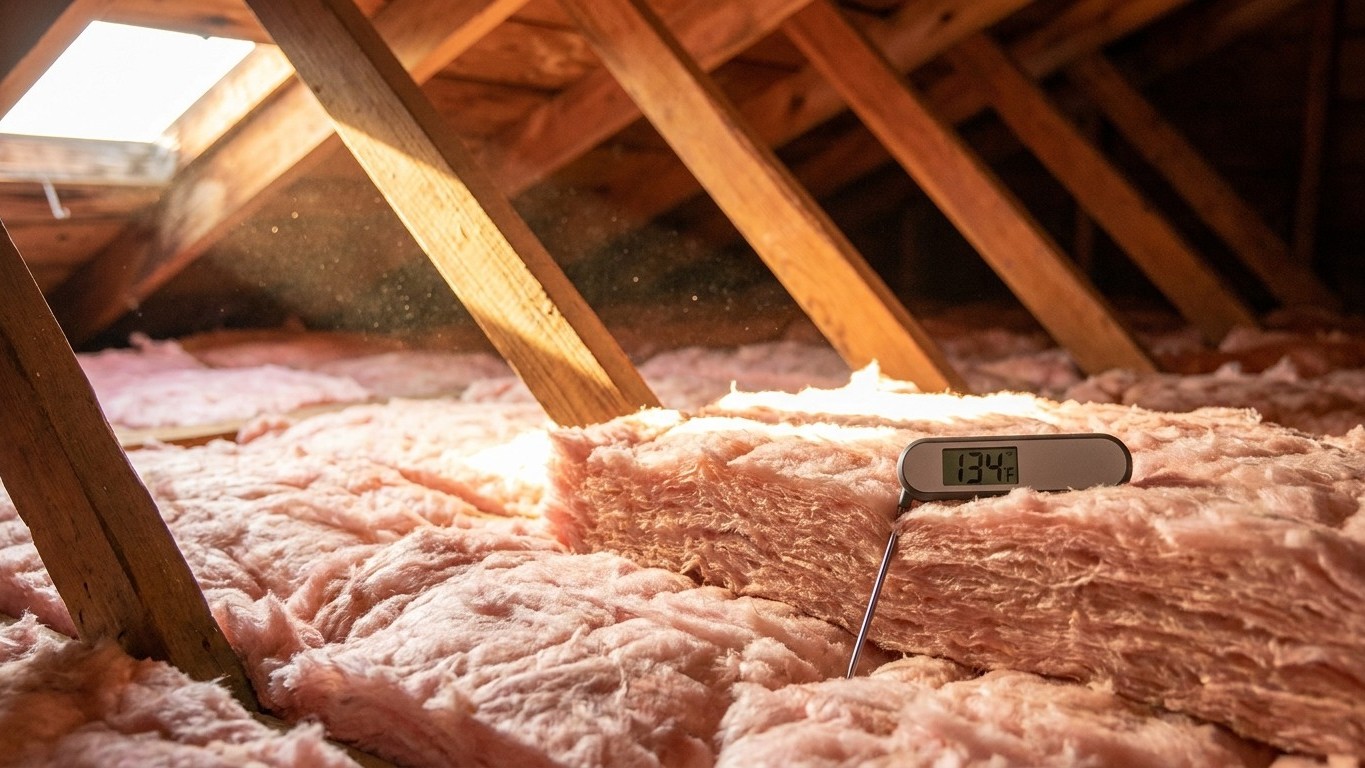
A roof deck sitting under direct summer sun doesn’t just warm up, it can run 40°F or more above the outdoor air temperature by mid-afternoon. That heat radiates and conducts down into the attic space below, and an under-ventilated, under-insulated attic can turn into one of the hottest rooms in the house, easily topping 130°F on a 90-plus-degree day. Everything under that attic floor lives with the consequences: the ceiling drywall, any ductwork routed through the space, and whatever holiday decorations are stored in boxes up there.
The insulation laid across that attic floor doesn’t care which direction the heat is trying to move. It’s not a “winter product” that happens to also work in summer, it’s simply resistance to heat flow, and resistance works both ways. In January, that resistance slows heat escaping from the living space up into a cold attic. In July, it slows heat pushing down from a superheated attic into the living space. Same material, same R-value, same job, opposite direction.
ENERGY STAR’s retrofit guidance for existing wood-framed homes lays out target R-values by climate zone, and the table separates attic insulation into two conditions: a completely uninsulated attic, and an attic that already has 3 to 4 inches of existing material. A third column covers floor insulation over unconditioned spaces like crawl spaces. The full set of recommendations:
| Zone | Attic if uninsulated | Attic if you already have 3-4 inches | Floor |
|---|---|---|---|
| Zone 1 | R30 | R25 | R13 |
| Zone 2 | R49 | R38 | R13 |
| Zone 3 | R49 | R38 | R19 |
| Zones 4A and 4B | R60 | R49 | R19 |
| Zones 6, 5 and 4C | R60 | R49 | R30 |
| Zones 7 and 8 | R60 | R49 | R38 |
For Utah’s mix, that means the state’s 21 zone-5B and 7 zone-6B counties fall under the “Zones 6, 5 and 4C” row, and the single zone-3B county falls under the “Zone 3” row. These are retrofit targets for existing wood-framed construction, not new-construction code minimums, and they’re the same numbers whether the goal is a warmer winter or a cooler summer, which is exactly why attic insulation is the one upgrade on this list that pays in both seasons rather than just one.
What homes in Utah cool with
National survey data from the U.S. Energy Information Administration’s Residential Energy Consumption Survey gives a sense of how American homes actually stay cool, and the split between central and individual equipment changes what insulation can and can’t fix. Across the households surveyed nationally, 92% use some form of air-conditioning equipment, 79% use a central air-conditioning unit, and 14% rely on individual equipment, a ductless mini-split, a window or wall unit, or a portable. Another 68% also run ceiling fans, usually alongside one of those systems rather than instead of them.
That 13-point gap between “uses air conditioning” and “uses a central unit” is where the insulation story gets complicated. In a home with central air and ductwork routed through the attic, those ducts are sitting in the hottest space in the building, sometimes 130°F or more on a summer afternoon. Ceiling insulation laid across the attic floor does essentially nothing to protect ducts suspended above that floor, that’s a separate problem, solved by duct insulation and sealing, not by more material on the attic deck. A house can have a well-insulated ceiling and still lose a meaningful share of its cooled air to leaky, uninsulated attic ductwork before it ever reaches a supply register.
In a home cooling with a window unit, a wall unit, or a mini-split instead, the calculation shifts. There’s no attic duct run to worry about, the equipment is cooling a specific room or zone directly, so the insulation and air sealing of that room’s own walls, windows, and ceiling become the whole ballgame for keeping the cooled air where it’s wanted. Readers dealing with attic ductwork specifically, or relying on a window or wall unit, will find more targeted detail in this site’s duct insulation guides and room air conditioner guides.
What the heat asks for that the cold does not
Two upgrades exist almost entirely because of summer heat, and neither one shows up on a winter-focused checklist.
A radiant barrier is not insulation, and it carries no R-value at all. Instead of slowing conducted heat the way fiberglass or cellulose does, it reflects radiant heat away, typically a reflective foil layer stapled to the underside of roof rafters. It earns its place specifically under a sun-loaded roof deck, cutting the radiant heat that would otherwise pour down into the attic. For most of Utah, where the reference station logs 52.1 days above 90°F rather than the 100-plus of a genuinely hot climate, a radiant barrier is a marginal add rather than a priority — the money buys more against attic heat gain than it does against Utah’s shorter, drier summer. It’s a tool built for longer, more relentless heat seasons than the state’s climate-zone mix typically delivers.
The second summer-specific issue is which direction water vapor moves through a wall. In a warm, humid climate, the moisture is coming from outside during the cooling season, which is exactly why the model energy code doesn’t require an interior vapor retarder in the country’s warmest, wettest zones, trapping vapor on the inside of a wall in that climate would just cause it to condense in the wrong place. Utah’s dry-side “B” moisture regime across zones 3B, 5B, and 6B is a different situation from that warm-humid case, and vapor barrier placement is specific enough to the state’s zone mix that it deserves its own answer rather than a shortcut here — this site’s vapor barrier page for Utah covers it directly.
What the work is worth
ENERGY STAR’s own estimate is specific, and it’s worth quoting exactly rather than rounding: “EPA estimates that homeowners can save an average of 15% on heating and cooling costs (or an average of 11% on total energy costs) by air sealing their homes and adding insulation in attics, floors over crawl spaces, and accessible basement rim joists.”
Notice what that figure covers and what it doesn’t. The 15% applies to combined heating and cooling costs together, not to summer bills alone, which is the whole point of treating attic insulation as a two-season upgrade rather than a winter one that happens to carry over. The 11% is a separate number against total energy costs, including everything else the home runs on. Both numbers are averages drawn from energy modeling of a typical existing U.S. home, not a guarantee for any specific house — a home in a zone-3B county with more cooling load will see a different split between the heating and cooling shares of that 15% than a home in a zone-6B county where winter heating dominates.
The estimate also names its scope precisely: attics, floors over crawl spaces, and accessible basement rim joists. It doesn’t extend to walls, windows, or doors, and stretching it to cover a full envelope upgrade would overstate what the modeling actually measured. For a Utah homeowner deciding where to start, that scope lines up with the areas already discussed here, the attic doing double duty against both winter loss and summer gain, floor insulation over any crawl space, and rim joists as the often-skipped detail in an otherwise reasonable insulation job.