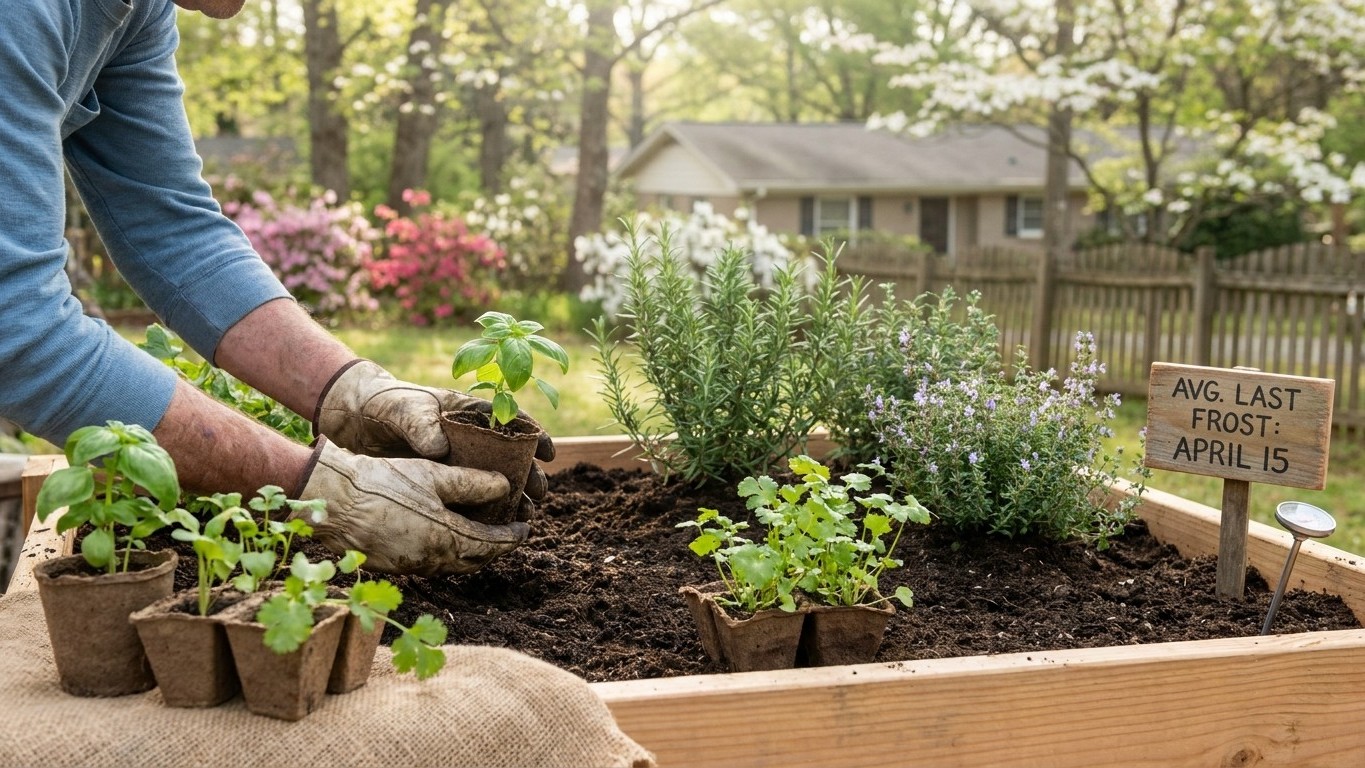

Sow hardy herbs like parsley, chives, and cilantro two to three weeks before the last spring frost, which arrives between April 1 and April 8 in the mildest parts of the state. Tender herbs like basil, cilantro’s replacement crop, and rosemary starts wait until after that window closes, because that date range is only a probability, not a guarantee.
The short answer for Massachusetts
That April 1 to April 8 window comes from NOAA’s 30-70% freeze probability band at Boston’s Logan Airport station, covering the 1991-2020 period. It means that on any given year, there’s a real chance of a 32°F freeze on either side of those dates, not a hard line you can circle on the calendar. Gardeners who plant basil on April 9 and call it safe are gambling on the mild end of that curve.
Work backward from the two frost dates the state actually has. Hardy herbs like chives, thyme, and parsley tolerate light frost and can go in the ground three to four weeks before April 1, meaning mid-to-late March for the earliest risk-tolerant gardeners near Boston. Cilantro and dill follow a similar logic since they bolt in heat anyway, so an early, cool start actually favors them.
Tender herbs are a different calculation entirely. Basil, in particular, sulks and yellows below 50°F even without a frost touching it, so pushing transplants out right at April 8 usually backfires. The safer play is waiting until nighttime lows stabilize above 50°F, which in most of eastern Massachusetts lands in early-to-mid May, a full month past the technical frost date.
On the other end of the season, the first fall frost arrives between November 3 and November 14 at that same Logan station. That gives the Boston area a frost-free stretch of roughly seven months on paper. But basil, cilantro re-seeding for a fall crop, and other heat-lovers should be wound down well before that November window, since cool, damp September nights slow them long before an actual freeze shows up.
The page does not have a documented last frost date for inland valleys or the Berkshires specifically. Logan is a waterfront, urban station, and it runs mild compared to almost everywhere else in the state. Treat these dates as the earliest realistic case, not the statewide one.
What will not work here
Rosemary planted directly in the ground and left outdoors through a Massachusetts winter is the single most common herb failure in this state. The coldest month here averages a daily minimum of 23.1°F, and that’s not a one-night dip, it’s the average low across the entire month. Rosemary’s hardiness threshold sits well above that figure in most cultivars, which is why the plant reliably dies in open ground even in a mild winter and needs to be treated as an annual or brought inside.
Bay laurel runs into the identical wall. It’s a Mediterranean shrub with no meaningful cold tolerance, and a 23.1°F average monthly low will kill an unprotected plant outright, not just set it back. Anyone who’s seen bay laurel survive outdoors year-round in photos from warmer states is looking at a different climate, not a technique that transfers here.
Basil sown too early is the opposite failure mode: not a winter death, but a stall. Because the reliable frost-free stretch doesn’t lock in until well past the official last-frost window, basil transplanted in mid-April sits in cold soil, stops growing, and often turns purple or yellow at the leaf edges before it ever recovers. It’s not dead, but it’s lost weeks it never gets back, and the plants that go in three weeks later usually overtake it by July.
Cilantro and dill face a different problem: not the cold, but the state’s own frost-free season working against them. Once temperatures climb into the 75-80°F range, which happens reliably by mid-to-late June in most of the state, cilantro bolts to seed within days and stops producing usable leaf. Successive small sowings every two to three weeks through spring, rather than one big planting, is the only real workaround here.
Anyone trying to keep a tender perennial herb bed going year-round outdoors, expecting it to behave like it would in a zone 8 or 9 garden, is fighting the coldest-month figure directly. That number is what decides survival, not the record low, and not the average across the whole season.
What changes across Massachusetts
Massachusetts spans USDA hardiness zones 5a through 7b, built on the USDA’s Plant Hardiness Zone Map using 1991-2020 normals. That’s not a narrow spread. A 5a-to-7b range covers a genuinely large swing in average annual extreme minimum temperature, and it means there is no single planting date, or single answer on which perennial herbs survive winter, that applies evenly from Cape Cod to the Berkshires.
The Logan Airport frost dates cited above sit at the mild end of that range. Coastal and southeastern parts of the state, including the Cape and the Islands, tend to track closer to that milder window, with later fall frosts and earlier spring ones. Interior valleys, the hill towns, and especially the Berkshires in the west run colder, meaning both a later last frost in spring and an earlier first frost in fall, which shortens the safe planting window on both ends at once.
Elevation compounds this inside the same county. A garden at the base of a hill and one a few hundred feet up the same slope can differ by a real margin in both frost timing and winter minimum, simply because cold air drains downhill and pools in low spots on clear nights. That’s the kind of variation no statewide date range can capture.
What this means practically: a reader gardening near the coast can likely lean toward the earlier end of any planting window described here, while someone in the Berkshires or a cold inland valley should assume both frost dates arrive on the more cautious side, hardy herbs going in later in spring, tender ones held back longer, and any borderline-hardy perennial treated with more suspicion. Neither reader should guess which zone applies to their own yard. That’s a question for a map, not for a paragraph of state-level averages.
Where to check this for your own county
The University of Massachusetts Amherst runs the state’s land-grant extension service, and it’s the right next stop for anything county-specific: ag.umass.edu. This state-level page can only describe Massachusetts in broad strokes, using a single reference station and a zone range spanning half the USDA map. A county extension office works from local trial data, not a statewide average, and that’s a meaningful upgrade in accuracy.
Two things are worth specifically looking for once there. First, a local or county-adjusted planting calendar, since UMass extension offices and their published guides often break planting windows down by region within the state, rather than relying on one airport’s frost data for everywhere from Provincetown to Pittsfield. Second, any list of herb varieties actually trialled in your part of the state, since cultivar performance, especially for perennials like rosemary, thyme, and sage attempting to overwinter, varies by local microclimate in ways a general state guide can’t capture.
A county recommendation beats a state one every time, for the simple reason that it’s built on a narrower, more relevant slice of data. This page describes Massachusetts as a whole, using one coastal station’s frost probabilities and a hardiness zone range that spans from 5a to 7b. That’s useful as a starting frame, but it’s not a substitute for guidance built around your specific stretch of the Connecticut River Valley, the North Shore, or the Berkshire foothills.
If a local extension guide contradicts a statewide frost date, the local guide wins. It almost certainly reflects a station, an elevation, or a set of field trials closer to the actual garden in question, and that beats a statewide range every time.
The Moon calendar is a separate, older custom: see when to plant herbs by the moon, written as tradition rather than fact.
Checking this against your own garden
Dates and frost probabilities are a starting estimate, not a verdict, and the reader’s own garden will usually contradict them at least a little. Three simple checks, needing no equipment beyond a hand and a pair of eyes, tell you more about your specific plot than any regional average.
First, soil warmth by feel. Push a finger a couple inches into the bed where herbs are headed. If it feels cold and damp rather than cool and slightly dry, the soil hasn’t caught up to the calendar yet, and tender transplants like basil will sit and sulk no matter what the frost date says. This single check catches the gap between “frost-free” and “warm enough,” which is exactly where basil struggles most in this state.
Second, watch for the first true leaves on any direct-seeded herb like dill or cilantro. The initial seed leaves look thin and simple; true leaves come in with the plant’s actual mature shape and signal the seedling has moved past its most fragile stage. A garden that’s slow to reach true leaves compared to a neighbor’s, even a few blocks away, is telling you something real about its own soil temperature and drainage.
Third, for anyone growing dill or fennel alongside herbs prone to bolting, an early flush of flower buds forming well before the plant has reached a useful size is a heat and daylength signal specific to that spot, often tied to a warmer microclimate, a south-facing wall, or reflected heat off pavement nearby. That’s worth noting for next year’s timing far more than any statewide date range, because it’s information about the one plot that actually matters.