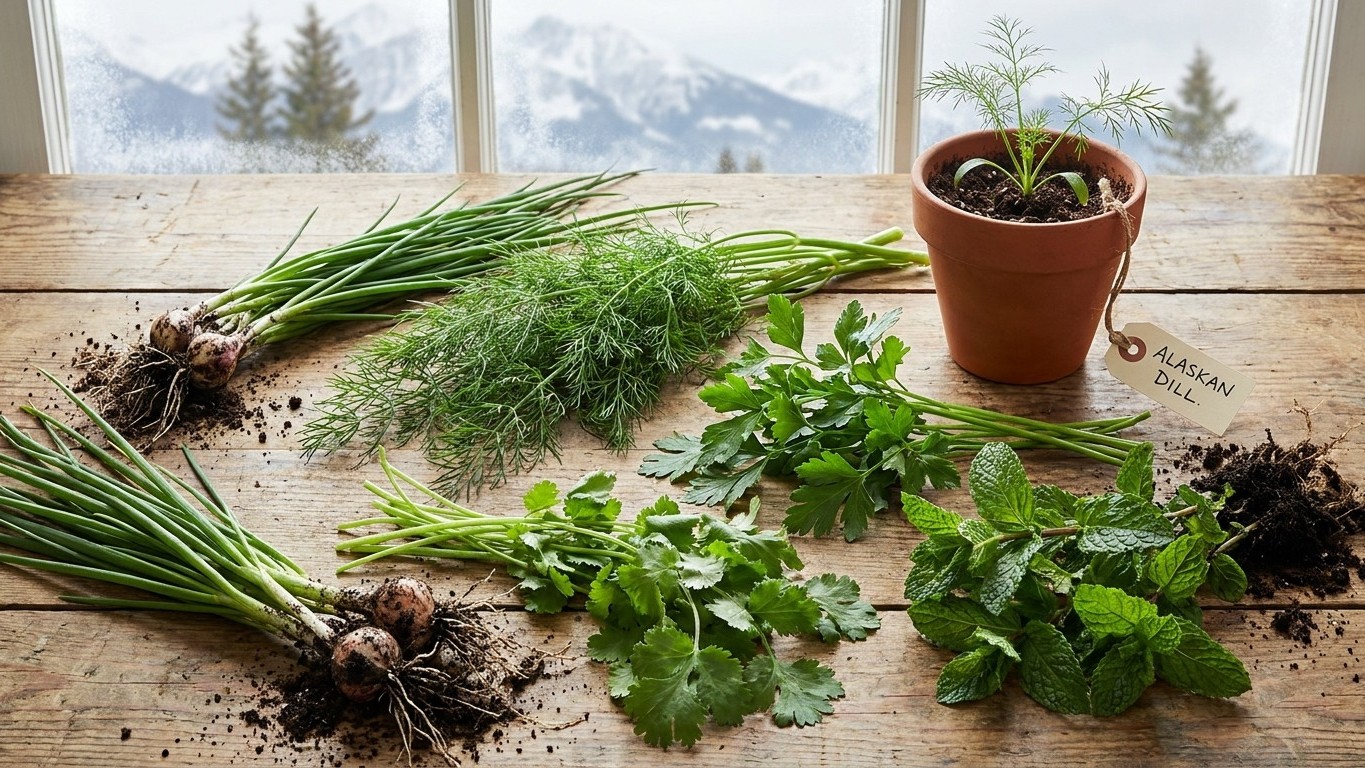

The best herbs for Michigan gardens are the hardy perennials rated for cold winters, chives, oregano, thyme, sage, mint, and tarragon among them, paired with fast annuals like basil, dill, and cilantro sown after the last frost. What changes the answer is where in the state you garden and how the winter treats tender perennials like rosemary.
The short answer for Michigan
Michigan’s growing season is set by two dates: a last spring frost that lands around April 30 in the Detroit area but slides to early or mid-May across most of the Lower Peninsula, and a first fall frost that falls between October 6 and October 21 in zone 6a, according to MSU Extension. That gives southern Michigan roughly five months of frost-free growing, less further north. This window is the ruler against which every herb decision gets made.
Split herbs into two groups and the decision gets simple. Hardy perennials, chives, oregano, thyme, sage, mint, and tarragon, are typically rated to USDA zones 4 or 5, which means they can survive winter outdoors across most of Michigan’s 4a-6b range without extra protection. Plant them once and they come back year after year, which matters in a state where the coldest month averages a daily minimum of 19.2°F at the Detroit reference station, per NOAA NCEI Climate Normals (1991-2020). That figure, not the record low, is what decides whether a perennial’s roots survive a typical winter here.
The second group is fast annuals: basil, dill, cilantro, and parsley. None of them need to survive winter at all. They just need to complete their life cycle inside the frost-free window, and Michigan’s five-month stretch in the south, shorter up north, is plenty for all four. Basil in particular rewards waiting until nighttime soil temperatures have climbed well past the last frost date rather than rushing it into cold ground.
Where this gets more complicated is the borderline tender perennials, rosemary and bay laurel chief among them. Both are commonly rated to USDA zones 7 or 8, milder than anywhere in Michigan’s 4a-6b spread. Grown here, they’re annuals unless brought indoors for winter, a detail that trips up a lot of gardeners who assume “perennial” on a plant tag means permanent in every climate.
What will not work here

Rosemary left outdoors through a Michigan winter is the single most common herb failure in the state, and the mechanism is straightforward. A mean daily minimum of 19.2°F in the coldest month is well below what rosemary’s root system tolerates without dieback, even in a mild winter by Michigan standards. Gardeners who see it survive a warm winter in Grand Rapids or Ann Arbor and assume it’s hardy statewide are extrapolating from one lucky year, not from the climate record. Bay laurel fails for the same reason and is even less forgiving of cold.
Slow-maturing herbs run into a different wall: the calendar itself. In the northern reaches of the state, where the frost-free window shrinks well below the roughly five months available near Detroit, an herb that needs a long stretch of warmth to bulk up before it’s worth harvesting simply doesn’t get there. This is less of an issue for most kitchen herbs, which tend to be fast growers, but it rules out treating Michigan like a place where you can start slow, heat-loving herbs from seed outdoors and expect a full harvest before frost shuts things down.
Humidity and close spacing
Michigan’s Great Lakes-influenced summers bring stretches of humid air that sit differently on a garden than the dry heat of a plains state. Herbs like oregano, basil, and thyme that get planted too close together, on the theory that a small kitchen garden should be tightly packed, lose the airflow that keeps foliage dry between rains and dew. The result shows up as powdery mildew on stems and leaves, especially on basil, which is susceptible to fungal pressure in a humid, poorly ventilated bed. Spacing plants a few inches further apart than the seed packet’s minimum, and watering the soil rather than the leaves, does more to prevent this than any fungicide applied after the fact.
Weekly watering schedules, common advice for hotter, drier states, also mismatch Michigan’s rainfall pattern. A garden that gets watered on a fixed schedule regardless of recent rain tends toward either soggy roots after a wet stretch or a stressed, wilted bed during the dry spells that do occur in a Michigan July. Checking soil moisture by hand before watering matters more here than following a calendar.
What changes across Michigan
Michigan is not one climate. The USDA Plant Hardiness Zone Map places the state across a 4a-6b range, built from the average annual extreme minimum temperature recorded at weather stations statewide, and that spread is wide enough that there is no single herb-hardiness answer for “Michigan.” A perennial that sails through winter in a 6b pocket near Lake Michigan’s shoreline can die back to the ground, or die outright, in a 4a spot in the northern Lower Peninsula or the Upper Peninsula.
The frost dates back this up. The last spring frost arrives around April 30 near Detroit but stretches into early or mid-May across most of the Lower Peninsula, meaning a gardener further north or inland is losing one to two weeks of usable season on the front end alone. The first fall frost figure given for zone 6a, October 6 to October 21, also implies an earlier shutdown further north, where colder zones typically see frost sooner in the fall.
What this means in practice: a gardener in the state’s colder zones should treat borderline-hardy perennials, sage and tarragon in particular, with more skepticism than a statewide guide can responsibly resolve. Mulching the root zone heavily going into winter, or accepting that a plant might act as a short-lived perennial rather than a permanent fixture, is a reasonable hedge. A gardener in the milder southern pocket has more room to experiment, including pushing rosemary as a multi-year outdoor perennial in an unusually sheltered spot, though it remains a gamble rather than a safe bet anywhere in the state.
None of this tells you which zone your own yard sits in. That requires checking the USDA Plant Hardiness Zone Map directly for your address, since the 4a-6b figure describes the state’s full range, not any one location within it.
Where to check this for your own county
The state-level answer above is a starting point, not a finish line. For anything more specific, county extension offices under MSU Extension are the right next stop, and they exist precisely because a single Michigan-wide recommendation glosses over real differences between, say, a county along the Lake Michigan shoreline and one further inland or north.
Two things are worth pulling from your county office specifically. First, the local planting calendar, which translates the statewide frost-date range into a date, or narrow window, tied to your actual location rather than the Detroit reference point used above. Second, the list of herb varieties that have actually been trialled in your county’s conditions, since extension offices often track which cultivars of common herbs, oregano, thyme, mint, held up well locally versus which underperformed. That’s information a state-level page simply cannot carry, because it changes county to county.
It’s worth being direct about the hierarchy here: a county-level recommendation beats a state-level one every time there’s a conflict between the two. The state-level answer is useful for understanding the general shape of what works in Michigan and why, but it is not a substitute for the county-specific detail your local extension office can provide. Treat it as the framework you bring to that conversation, not the last word on your own backyard.
Checking this against your own garden
Every date and zone number here describes an average. Your own garden, with its specific exposure, soil, and microclimate, is the thing that actually decides whether an herb thrives, and it will tell you faster than any calendar if you know what to look for.
Start with soil warmth, checked by hand rather than guessed from the date. Push a finger a couple of inches into the bed where you plan to direct-sow basil or dill. If it still feels cold and damp rather than mild, the soil hasn’t caught up to the calendar yet, regardless of what the last frost date says, and seeds sown now will simply sit and rot rather than germinate.
Watch the first true leaves on any herb seedling you’ve started indoors or bought as a small transplant. The first true leaves, the ones that follow the initial rounded seed leaves and actually look like the mature plant, are the sign that a seedling has enough root and leaf structure to handle transplant stress. Moving a plant outdoors before those leaves appear tends to set it back for weeks.
For perennials already in the ground, the tell is the new growth flush at the base of the plant once winter breaks. Chives, mint, and oregano that survived the winter push up new shoots from the crown, often before you’d expect based on the frost calendar. No new growth by the time nearby plants are clearly active is the clearest sign that particular clump didn’t make it, and it’s telling you something specific about your yard’s own microclimate that no statewide hardiness range can.