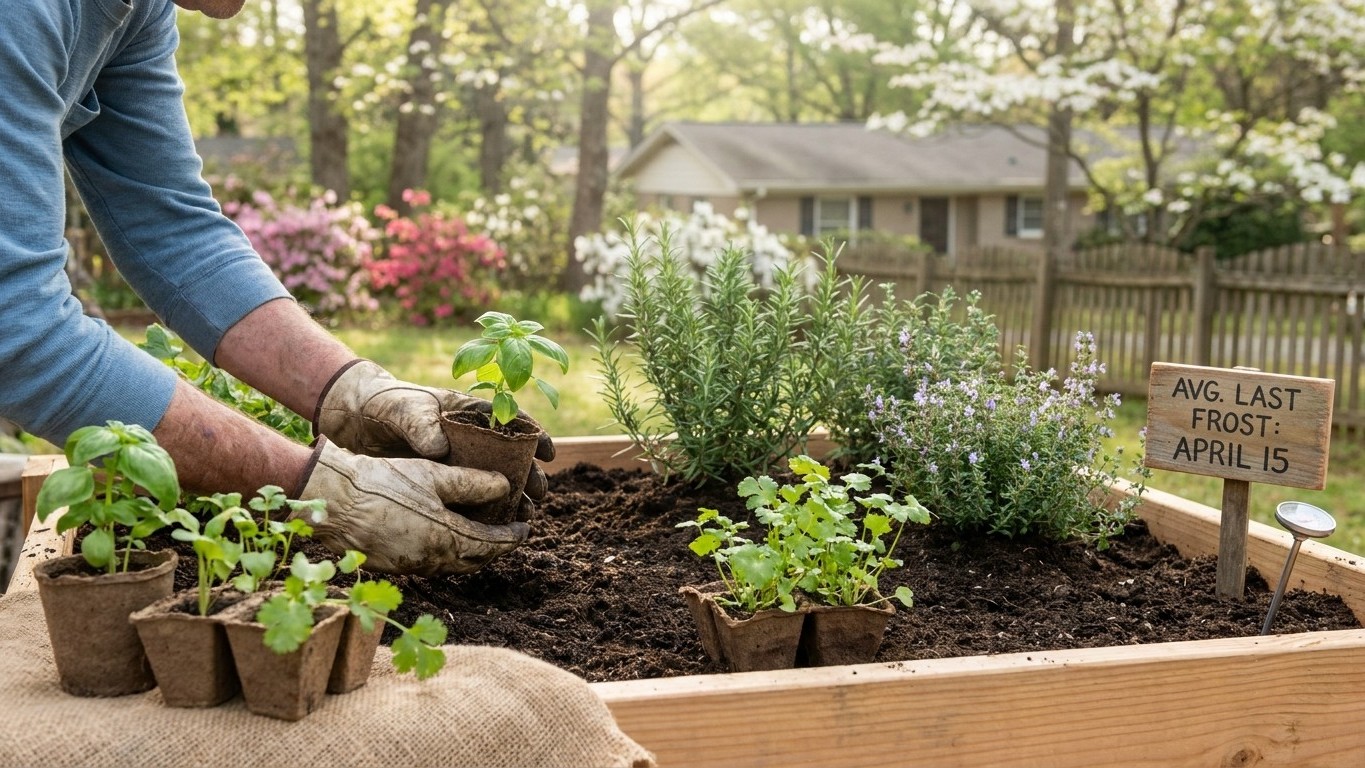

Plant hardy herbs like parsley, cilantro, and chives two to three weeks before your last frost date. Tender herbs like basil, and any herb you’re moving outdoors as a transplant, wait until after that date has passed and nighttime soil has warmed. In Michigan, that means late April in the Detroit area, and often into mid-May farther inland or north.
The short answer for Michigan
MSU Extension puts the last spring frost around April 30 in the Detroit area, with early to mid May typical across most of the Lower Peninsula. That’s the number to build a calendar around, but it’s worth being clear about what it actually means. A frost-free date is a probability threshold, not a promise. It marks the point where the odds of a damaging frost drop to roughly even or lower, based on decades of weather records at that reference station. Plant tender herbs the week before, and you’re gambling against history, not just bad luck.
For hardy herbs, that gamble doesn’t matter much. Parsley, chives, cilantro, and dill tolerate a light frost and can go into the ground two to three weeks ahead of the date above, once the soil can be worked. Basil is the opposite story. It sulks below 50°F and dies outright at 32°F, so it should never go outside before the Detroit-area window, and gardeners farther from Lake Erie’s moderating effect should push a week or two later still.
On the fall side, MSU’s Michigan Garden Calendar lists the first fall frost arriving between October 6 and October 21 in zone 6a. That’s a two-week spread even within a single zone, which tells you something about how much local terrain and water bodies shift the calendar. For herb growers, this window matters for succession planting: a second cilantro or dill sowing in July still has time to mature before that October frost shuts things down, but a basil sowing that late almost never does.
Put together, the practical calendar looks like this: hardy herb seeds or starts from mid-April onward, tender herbs and basil transplants from late April in the Detroit area to mid-May elsewhere, and a fall cutoff for any new sowing by late July to early August depending on how close you are to that October frost line.
What will not work here

Rosemary is the herb most Michigan gardeners get wrong, and the reason is in the numbers. NOAA’s 1991-2020 climate normals put the coldest month’s mean daily minimum at 19.2°F for the Detroit reference station. That’s not the record low, it’s the average low night after night through the coldest stretch of winter. Rosemary’s roots start to suffer real damage below the mid-teens, and most of Michigan spends weeks at or below that threshold every winter. Left outside in a container or unprotected bed, it dies. Gardeners who want rosemary here treat it as an annual, or they bring the pot indoors before the first hard frost.
Bay laurel runs into the same wall, only worse. It’s rated hardy to roughly zone 8, and nowhere in Michigan gets close to that. Any bay plant left outdoors past October is a bay plant you’ll be replacing in spring.
The season length itself trips up the slower herbs even when they survive the cold. Michigan’s growing window, roughly late April to mid-October depending on location, gives you five to six months at best. That’s enough for basil, dill, and cilantro, all of which mature in six to eight weeks. It’s tight for herbs that want a longer runway from seed, like a full-size French tarragon grown from seed rather than root division, or a slow parsley variety started late. Gardeners who direct-seed these in June instead of starting them indoors in March often find frost arrives before the plant has done much of anything.
Humidity causes a different, quieter failure. Michigan summers aren’t desert-dry, and herbs planted at nursery-tag spacing in a humid July often develop powdery mildew, especially bee balm, oregano, and mint crowded into a small bed. The fix isn’t a fungicide, it’s air. Wider spacing than the seed packet suggests, and afternoon sun that dries leaves before evening, keeps most of these problems from starting.
What changes across Michigan
The USDA Plant Hardiness Zone Map lists Michigan spanning zone 4a to 6b, built from the average annual extreme minimum temperature recorded across the state. That’s a wide range for one state, and it means there is no single hardiness answer for “Michigan.” A gardener near the Ohio border in zone 6b is working with a materially different winter than someone in the Upper Peninsula’s 4a pockets, where perennial herbs that shrug off winter downstate can die outright.
Practically, this cuts both ways on the calendar. In the warmer zone 6b areas, the frost-free window opens earlier and closes later, so a gardener there can often sneak in an extra couple of weeks on both ends of the season compared to the Detroit reference date used above. In the colder 4a stretches, that same calendar needs to shift later in spring and earlier in fall, sometimes by three or four weeks, and perennial herbs rated hardy to zone 5 or 6, like some sage and thyme cultivars, may not reliably survive winter without mulch or container protection.
Elevation and proximity to the Great Lakes complicate this further. Land near Lake Michigan or Lake Huron tends to warm slower in spring and cool slower in fall than inland spots at the same latitude, which is why frost dates a few counties apart can differ by more than a week. None of this means a reader should guess. It means the zone number for a specific address matters more than the state’s headline range, and the only reliable way to get it is the USDA’s own map, searchable by ZIP code.
The takeaway isn’t which zone a given county sits in, it’s that “Michigan” isn’t one growing climate, and any planting date needs adjusting toward earlier in the south, later in the north, before it’s trusted for a specific yard.
Where to check this for your own county
Michigan’s state-level pattern is built from the Detroit reference station and the Lower Peninsula’s general frost data. A county recommendation will always beat a state one, because it accounts for the local microclimate. Michigan State University Extension runs the state’s land-grant outreach program, and its site at canr.msu.edu/outreach is where that county-level detail lives.
Two things are worth looking for once there. First, the local planting calendar for the specific county office, which will list frost dates and sowing windows tuned to that area rather than the Detroit-area figures used as a statewide proxy here. A county in the Upper Peninsula or along the Lake Superior shoreline will show a noticeably later spring window and earlier fall cutoff than what’s listed above.
Second, look for any variety trial results specific to herbs in that county or region. Extension offices often publish results from local demonstration gardens, noting which basil or parsley varieties held up best against that county’s particular disease pressure, rainfall pattern, or soil type. That’s information no statewide calendar can offer, because it comes from actual plants grown in that actual ground.
Contacting the local extension office directly, rather than relying only on the website, also opens the door to a Master Gardener volunteer who can answer a specific question about a specific yard, something no general planting calendar, including this one, is built to do.
Checking this against your own garden
Every date is a starting estimate, not a verdict. The garden itself gives better information than any calendar once the season is underway, and three signs are worth watching.
Soil warmth by feel is the first. Push a finger a couple of inches into the bed in the morning. If it feels cool and slightly damp rather than cold, most hardy herb seeds will germinate. Basil and other tender herbs want it to feel closer to room temperature, which in Michigan usually doesn’t happen reliably until after the calendar window above has already opened.
The first true leaves on any seedling started indoors or direct-sown are the second signal. The initial pair of leaves after germination are seed leaves, not the plant’s actual foliage. Once the second set appears, looking like a miniature version of the mature leaf, the plant has enough root and leaf structure to handle a move outdoors or a light frost, depending on the herb.
The third is watching how established herbs in the yard, even weeds, respond after a cold snap. If dandelions and other early volunteers are pushing new growth without frost damage, the soil and near-surface air have stabilized enough that tender transplants are usually safe to follow. That kind of on-the-ground observation, tracked over a season or two in one specific yard, ends up being a more reliable planting guide than any single date, because it reflects that yard’s actual microclimate rather than a regional average.
If you follow the almanac, here is when to plant herbs by the moon. It is a tradition, not a proven method.