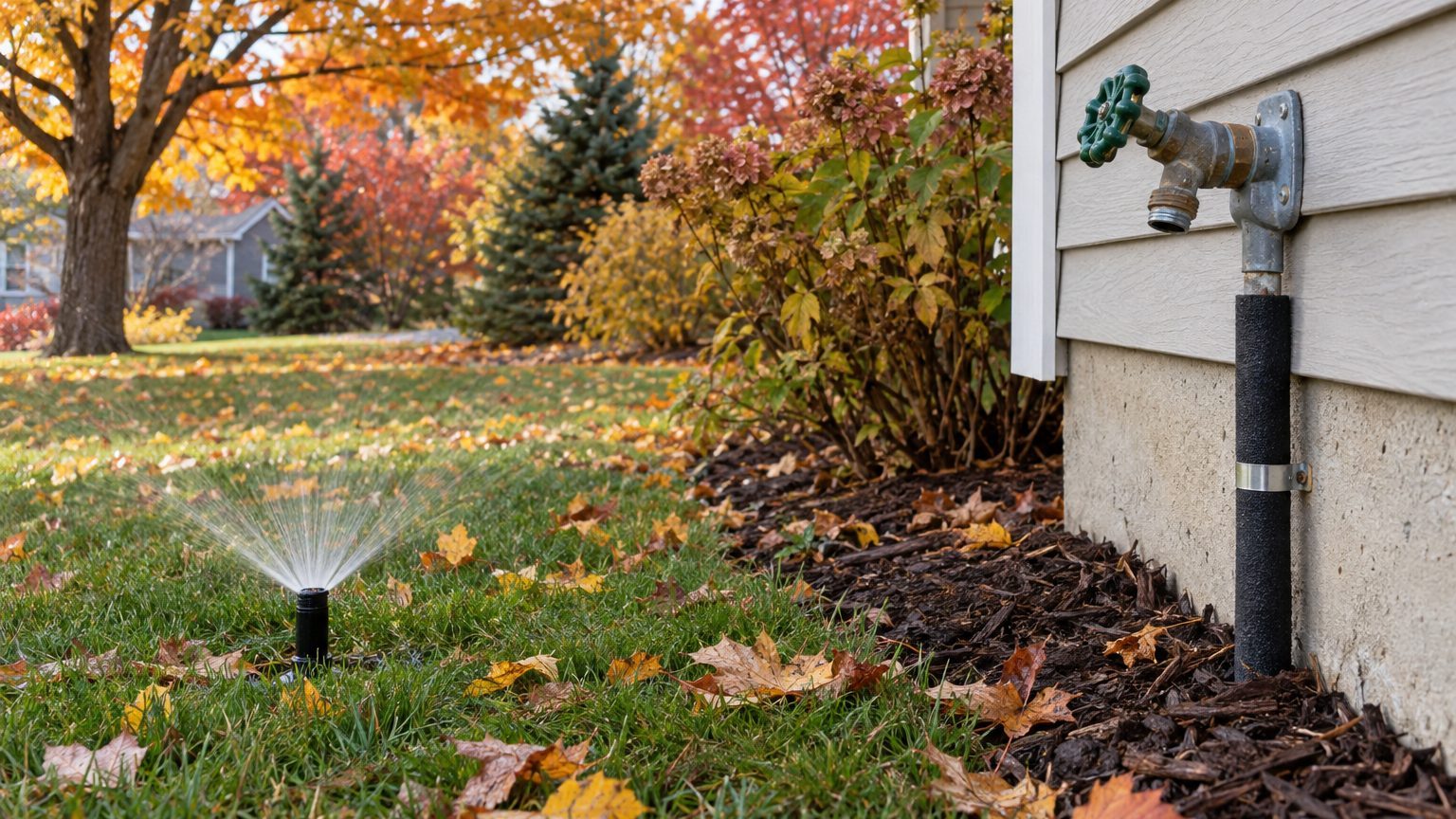

Minnesota’s sprinkler and faucet season ends the same week the ground starts to lock up. Drain the irrigation system and disconnect every hose in the two weeks before the average first fall freeze, not after the first frosty morning tricks you into thinking you have more time. Shut off the water to the system, drain or blow out the lines, and unhook the hoses before that window closes.
When to do it in Minnesota
The window for winterizing a sprinkler system and outdoor faucets in Minnesota runs from October 11 to October 23, the range NOAA’s 1991-2020 Climate Normals give for the first fall freeze at the Minneapolis reference station. That is a range, not a date circled on the calendar. Some years the cold arrives at the early edge of it, some years it holds off until the back end, and the only safe habit is to finish the work before the window opens rather than racing it once the forecast turns.
The rule that matters more than any single date is the difference between a light frost and a hard freeze. A light frost rims the grass white before sunrise and burns off by mid-morning. It does nothing to a pipe. A hard freeze holds the air well below 32°F for hours at a stretch, long enough for standing water in a line, a valve, or a backflow device to turn to ice and expand. Ice does not compress. It pushes outward against whatever is holding it, and a length of PVC pipe or a brass fitting loses that argument every time. The goal is to have every irrigation line empty and every hose disconnected before the first hard freeze, not after the first cosmetic frost.
Why the range shifts across the state
NOAA’s figure describes the Twin Cities area specifically. Northern Minnesota, and any location at meaningfully higher elevation, runs two to three weeks tighter at both ends of the year: winter arrives earlier there and spring lets go later. Subtract that two to three weeks from the October 11 to October 23 range and a homeowner near the Iron Range or the Arrowhead is looking at a window closing in late September to early October, not mid-October. The first and last frost dates in Minnesota break that regional spread down further for specific parts of the state.
Compare that to a state where the coldest-month minimum barely dips below freezing in places and a full sprinkler blowout is often unnecessary. The guide to winterizing sprinklers and outdoor faucets in Florida covers that different calculus. Minnesota is not that state. The USDA Plant Hardiness Zone Map, built on NOAA’s 1991-2020 normals, places the state across zones 3a to 5a, and the mean daily minimum in the coldest month at the Minneapolis station runs 8.8°F. That is cold enough that any water left in a line freezes solid for weeks at a time, not just for one bad night.
That same freeze window lines up closely with when furnaces switch on for the season, covered in the page on when the heating season starts in Minnesota. For other seasonal deadlines across the state, the Minnesota guides hub covers everything from planting dates to snow removal timing.
Sprinkler lines: drain or blow out
Water left inside a sprinkler line behaves the same way it does inside a faucet or a hose. It freezes, expands, and splits whatever is holding it. Inside an irrigation system that means the lateral pipes, the backflow preventer, each control valve, and the fittings sitting inside every valve box. None of that damage shows up in October. It shows up in spring, when the system is switched back on and water finds the crack that formed months earlier, often somewhere inside a valve box that now has to be dug out to fix.
Three ways to clear a line
A manual drain uses valves built into the low points of the piping: open them, let gravity pull the water down and out, then close them again. It only works if the system was installed with those valves in the right places and enough slope to actually drain, which not every yard has. An automatic drain valve opens on its own once the pressure in the line drops low enough, removing the manual step, but it depends on the same layout. Most systems in this climate, and nearly all systems installed on flat ground, rely instead on a compressed-air blowout: a compressor forces air through the mainline and out through each sprinkler head in turn, pushing the water ahead of it until the line runs dry.
| Method | How it works | Best suited to |
|---|---|---|
| Manual drain | Low-point valves opened by hand, water drains by gravity | Sloped systems with drain valves built in |
| Automatic drain | Valve opens on its own once line pressure drops | Same sloped systems, less hands-on upkeep |
| Compressed-air blowout | Compressor pushes air through the mainline and out each head | Flat ground, most Minnesota installations |
A blowout is also the method with the most room for error. Too much air pressure, or air pushed through with the wrong fitting for the system, cracks a head or a valve just as effectively as ice does. That is the case for calling a licensed irrigation contractor for this specific job rather than renting a compressor and working it out alone. The pressure has to match the pipe material and the head type, and a contractor who does this every fall already knows the range that works for a given system. For a closer look at what freezing water actually does inside a pipe, and why a cracked line so rarely shows itself before spring, see the guide to frozen pipes.
Outdoor faucets and hoses
The faucet itself is usually the smaller part of the risk. The hose left attached to it is what causes the failure. Water trapped between the hose and a closed faucet has nowhere to expand, and that pressure travels back into the faucet body and the pipe behind the wall. Disconnect every hose from every outdoor spigot before the season’s first hard freeze, coil it up, and drain it before storing it for winter.
Why a frost-free faucet still needs this
A frost-free faucet, sometimes called a frost-free sillcock, is built with a long stem that moves the actual shutoff point well back inside the heated wall, so the section exposed to outdoor cold holds no water once the valve closes and the line drains forward. That design only works if water can actually drain out the spout after the valve closes. Leave a hose threaded onto the end and the faucet cannot drain. The trapped water sits right at the coldest point in the whole assembly and freezes exactly where the design was meant to prevent it. The mechanics of that faucet type, and how to tell whether the one on the house is actually frost-free, are covered in the guide to frost-free outdoor taps.
For a standard faucet without that internal design, the sequence is simple and does not require any plumbing beyond turning valves. Shut the interior supply valve that feeds the outside spigot, usually found in a basement or crawl space directly behind where the pipe exits the wall. Then open the outside faucet fully and let it run until no more water comes out, and leave it open through the winter so any water that does creep back in has somewhere to expand instead of splitting a fitting. A full walkthrough of that sequence, including where the interior valve tends to sit in an older Minnesota house, is in the guide to winterizing outdoor faucets before the first freeze.
Anything past shutting the interior valve and draining the line is a plumber’s job: replacing a shutoff valve that will not fully close, insulating an exposed pipe run in an unheated space, or converting a standard spigot to a frost-free one. Forcing a stuck valve is how a five-minute fall chore turns into a winter emergency.
What goes wrong here
The most common failure in Minnesota is timing, not equipment. An early cold snap arrives before the calendar window has technically closed, catching a system that was scheduled for a blowout the following weekend. NOAA’s 1991-2020 normals put the average first fall freeze at October 11 to October 23 for the Minneapolis area, but an average is not a guarantee, and a year that runs a week or two ahead of that range leaves no grace period for anyone who waited for a firm date instead of respecting the range as a whole.
Signs of the damage next spring
- A sprinkler head that sprays weakly or not at all once the system is turned back on, often meaning a cracked lateral line underground
- Standing water or ice inside a valve box that was not graded to drain, which then freezes around the solenoids and cracks the wiring
- A hairline split in an outdoor faucet body, visible only once the water is turned back on and it leaks from the housing rather than the spout
- A hose left connected all winter, now brittle and cracked at the coupling, with a faucet behind it that failed for the same reason described above
The valve box deserves a specific mention because it fails quietly. Groundwater or snowmelt can seep into a buried valve box that was not graded to shed water, and if that water sits around the valve through a hard freeze it damages the solenoid and wiring even when the pipe itself survives untouched. Checking that valve boxes drain freely before the ground freezes catches this before it turns into a spring repair. Lawn care in these same weeks interacts with the same freeze schedule: mowing height, the last fertilizer pass, and leaf cleanup all matter, and the specifics are in the guide to winterizing a lawn.
Common questions
Can I blow out my own sprinkler system with a home air compressor?
You can, but most home compressors do not sustain enough continuous airflow at the right pressure to clear a full system without risk. Too little airflow leaves water sitting in the lines. Too much pressure cracks a head or a valve. A licensed irrigation contractor uses equipment sized to the pipe material and the number of zones, which is why this is one of the few winterizing steps worth paying someone else to do.
What if the first freeze hits before I’ve drained everything?
Get the blowout done as soon as the ground softens back up, and in the meantime inspect for damage rather than assuming none occurred. A hard freeze that catches a full system usually shows itself as a cracked head, a leaking valve, or a split section of mainline once the system is pressurized again. Have a contractor check the backflow preventer and valve boxes specifically, since those fail even when the visible piping looks fine.
Does leaving the outdoor faucet dripping all winter protect it?
No. A slow drip is sometimes used to protect an indoor pipe run through an unheated wall, but it does nothing for an outside spigot with a hose still attached, and it does not replace draining the line behind the faucet. The faucet still needs the interior valve shut and the spigot opened to drain fully before the first hard freeze.
When is it safe to turn the sprinkler system back on in spring?
Wait until the ground has fully thawed and the risk of another hard freeze has passed for the season, since restarting a system that still has ice in a low point or a valve box can crack something that survived the winter intact. Watching the same freeze data used to time the fall shutdown, in reverse, is the simplest way to judge that the season has turned.