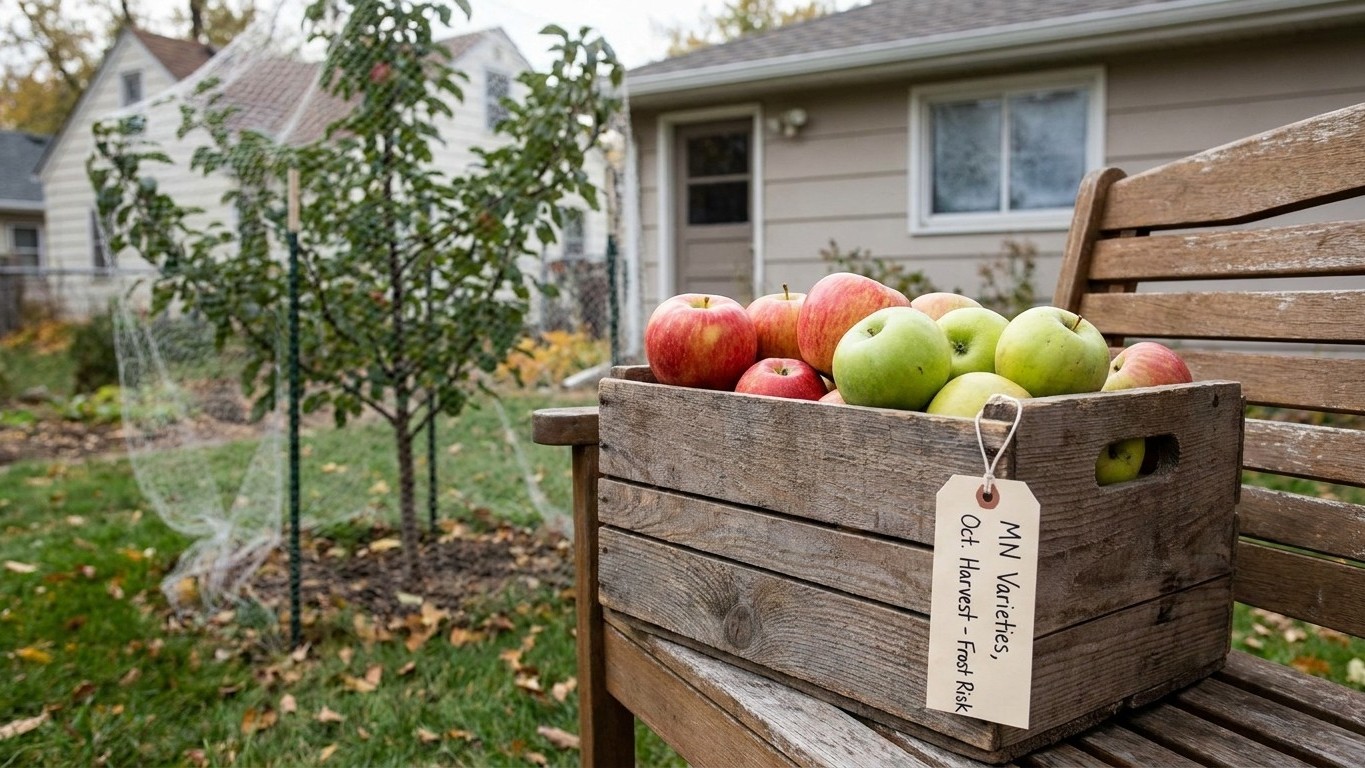

Yes — most of Minnesota can grow good apples, as long as you match the tree to the winter, not the other way around. Winters here run cold enough that the average low in the coldest month sits around 7.5°F, and that number, not some record-breaking cold snap you half-remember, is what decides whether a tree limps along or actually bears fruit every year. So before you dig a hole, walk over to your local nursery and ask for a cultivar bred for zone 3 or 4 winters — something like Honeycrisp, Haralson, or Zestar! — rather than whatever bin of bare-root trees showed up trucked in from a warmer state.
Can you grow apples in Minnesota
Apples survive and fruit across nearly all of Minnesota, but the state is not one climate. The USDA’s 2023 map, built on 1991-2020 normals, spreads the state across zones 3a to 5a, with the Minneapolis area sitting toward the milder end of that range and the Arrowhead region and far north running colder, closer to zone 3a. NOAA’s NCEI normals for the Minneapolis station put the coldest month’s mean daily minimum at 7.5°F, a figure worth understanding correctly: it is not the record low, it is the average low across the coldest month, and it is the number that actually predicts whether a tree’s wood and buds survive a typical winter rather than an exceptional one.
The cold that matters
A single brutal night rarely kills an apple tree outright if the tree is dormant and the wood is mature. What kills trees over years is a pattern of winters colder than the variety was bred to handle, which shows up as dead branch tips, split bark, and weak bloom the following spring. That’s why the coldest-month average, not the record low, is the number that matters for choosing a cultivar, and it’s also why a variety rated for zone 5 struggles in Minneapolis winters even though it might survive one mild year there.
Where it’s easier
Southern Minnesota, including the Twin Cities metro and the river valleys running along the Minnesota and Mississippi, gives the longest frost-free stretch and the mildest winters in the state, which makes variety choice more forgiving there. Farther north, toward Brainerd, Bemidji, and the Arrowhead near Duluth and International Falls, growers need to stay strictly inside the zone 3 to 3b hardy cultivars and accept a shorter, later season. Neither end of the state rules apples out. It just narrows which named varieties belong where, and timing matters just as much as variety — a Minnesota apple Calendar can help track when to plant, prune, and expect harvest across these different regions.
Which varieties suit this climate

Once hardiness is settled, the working list of Minnesota apple Best varieties is short but real, and several of the best-known names were bred specifically for this climate at the University of Minnesota’s fruit breeding program.
Honeycrisp

Bred at the University of Minnesota and released in 1991, Honeycrisp is rated hardy through zone 3, ripens in early to mid September in catalog listings, and is the variety most home growers recognize by name before they know anything else about apples.
Haralson

An older University of Minnesota release, Haralson is rated to zone 3, ripens later than Honeycrisp, typically late September into October by catalog timing, and has a reputation for reliable bearing in cold winters where less hardy varieties struggle.
Zestar!

Also a University of Minnesota introduction, Zestar! is rated hardy to zone 3 and ripens early, generally in late summer well ahead of Honeycrisp, which makes it a useful variety for a grower who wants fruit before the main fall harvest push.
Sweet Sixteen

Another zone 3 cultivar from the same breeding program, Sweet Sixteen ripens in the same general window as Honeycrisp and is often planted alongside it for a longer harvest spread and a backup crop if one variety has a light year.
Wealthy

Bred in Minnesota in the 1860s, long before the university program existed, Wealthy remains one of the hardiest apples available and is still sold by cold-climate nurseries specifically because it shrugs off winters that damage newer varieties.
| Variety | Catalog hardiness | Typical ripening | Notes |
|---|---|---|---|
| Zestar! | Zone 3 | Late summer | Earliest of this group |
| Honeycrisp | Zone 3 | Early-mid September | Most widely planted by name |
| Sweet Sixteen | Zone 3 | September | Overlaps with Honeycrisp |
| Wealthy | Zone 3, arguably colder | September | Oldest, toughest option here |
| Haralson | Zone 3 | Late Sept-October | Latest, most winter-tolerant |
Winter chill is not the problem here
Most apple guides spend a paragraph warning about winter chill, the number of cold hours a tree needs before it can bloom properly. In Minnesota that filter runs the opposite direction from how it works in the South. A low-chill apple bred for a mild climate like Alabama, covered in our guide to Growing Apples in Alabama, would break dormancy too early here and get hit by frost. Minnesota’s winters deliver far more chill hours than any commercially sold apple variety requires, so chill is never the limiting factor in this state. Cold hardiness, not chill, is the filter that actually matters here, which is why every variety above is chosen for surviving the winter first.
Planting a pair that works here
Almost no apple variety reliably fruits alone. Plant two trees that bloom in the same window and at least one needs to carry fertile pollen, a rule covered in more general terms on pollination pages but worth stating in local terms. Among the cold-hardy varieties named above, Honeycrisp, Haralson, Sweet Sixteen, Zestar!, and Wealthy are all standard diploid apples with fertile pollen, so any two of them planted within about 50 feet of each other, with overlapping bloom, should cross-pollinate without extra planning.
Bloom timing tracks ripening loosely but not exactly. Zestar!, the earliest to ripen, also tends to open its blossoms earlier than Haralson, the latest ripener, so a grower planting only those two should confirm bloom overlap with the nursery before assuming they’ll pollinate each other. Honeycrisp and Sweet Sixteen, which ripen close together, are a safer bet for overlapping bloom without checking further.
The variety to watch out for is a triploid apple, a category that produces little or no usable pollen and needs a third, fertile tree nearby to set fruit at all. None of the University of Minnesota cold-hardy releases fall into that group, but a grower adding a heirloom or specialty variety to the planting, something like Jonagold, should check ploidy before assuming a simple two-tree pairing will work. Growers in warmer states run into the identical trap, a wrinkle our guide to Growing Apples in Missouri walks through with different named varieties.
Crabapples deserve a mention here too. A flowering crab such as Dolgo blooms over a long window and produces abundant fertile pollen, which makes it a useful backup pollinizer planted near any two named apples above, especially on a small lot where space for a third full-size apple tree doesn’t exist.
The frost that costs a crop here

Near Minneapolis, NOAA’s NCEI 1991-2020 climate normals put the last spring freeze in the window of April 17 to April 30, measured as the 30-70% probability band for a 32°F freeze. That’s the mild south of the state. Northern Minnesota, including the Arrowhead and the area around International Falls, typically runs two to three weeks tighter at both ends of the season, which pushes the effective last-frost risk later into spring there.
The detail that catches new growers off guard: a frost that arrives after the buds show pink kills the flowers, not the tree. The tree leafs out normally and looks perfectly healthy for the rest of the year. The crop, however, is gone, because those damaged blossoms will not set fruit. A grower who sees a fine-looking tree with almost no apples in August is usually looking at the aftermath of a single cold night back in April or early May, not a disease or a nutrient problem.
What actually helps
- Track the forecast closely once buds move past green tip toward pink, since that’s when a frost starts costing bloom.
- Cover small trees with frost cloth or an old sheet on a night when a hard freeze is forecast during bloom.
- Run overhead sprinklers through the night on larger plantings, a standard commercial technique that relies on the latent heat released as water freezes on the buds.
- Favor a later-blooming variety such as Haralson where the last frost date historically arrives late, since a flower that opens after the risk window has passed needs no protection at all.
Of the options above, choosing a late bloomer is the only one that works every year without the grower doing anything on the night itself, which is why it’s worth weighing at planting time rather than treating frost purely as a weather-watching problem.
The apple year in Minnesota
Timing an apple tree by the calendar month is a mistake, since a warm March and a cold March put the tree in completely different places by April 1. The stages below are anchored to the tree’s own condition and to the frost windows NOAA’s NCEI normals give for the Minneapolis station, with the reminder that northern Minnesota runs two to three weeks behind at every stage.
Dormancy through green tip
Winter dormancy is pruning season, done while the tree is fully asleep and the coldest-month cold, averaging 7.5°F at Minneapolis per NOAA, has already passed its worst. Green tip, the first sign of leaf buds opening, typically shows before the April 17 to April 30 last-frost window closes, and the tree tolerates a freeze at this stage far better than it will a few weeks later.
Pink through bloom
Pink bud is the danger stage described above, arriving as the tree approaches or overlaps the last-frost window. Full bloom generally follows once the freeze risk from that window has mostly passed, though in a cold spring bloom can open while frost risk is still live, which is exactly the scenario the frost section above addresses.
Petal fall through harvest
Petal fall marks the start of fruit set, when pollinated flowers begin swelling into fruit and unpollinated ones drop. Summer is simply growth, with thinning in June a useful step to size up the remaining fruit. Harvest runs from Zestar!’s late-summer window through Haralson’s October finish, and growers should have the crop in well before NOAA’s NCEI normals put the first fall freeze at October 11 to October 23 near Minneapolis, since a hard freeze on unharvested fruit still on the tree damages texture even if the tree itself takes no lasting harm.
Local help
For a variety list built around what actually performs in Minnesota’s specific counties, and for current spray timing against apple scab and codling moth, the University of Minnesota Extension is the source to check before buying trees or setting up a spray schedule. Extension recommendations are updated more often than most nursery catalogs and reflect real regional trial data rather than a national average.
Common questions
Do I need two apple trees in Minnesota to get fruit?
Almost always, yes. The cold-hardy varieties covered above are self-incompatible, meaning they need pollen from a different variety blooming at the same time, so a single tree standing alone typically produces little to no fruit even if it flowers well.
What’s the coldest zone in Minnesota where apples still produce?
Zone 3a cultivars like Haralson and Wealthy are grown successfully in the coldest parts of the state, including areas near the Canadian border, though the season runs later and shorter than in the Minneapolis area. Check the USDA Plant Hardiness Zone Map for your specific location rather than assuming the statewide range applies evenly.
My apple tree bloomed and then we got a frost, will I still get apples this year?
Probably not from the blossoms that were open during the freeze, though a tree in full bloom over several days sometimes has some flowers open before or after the cold night that escape damage. The tree itself is almost always fine and will bloom normally again next spring.
Can I grow apples near Duluth or International Falls?
Yes, using only cultivars rated to zone 3a and expecting a later bloom and a shorter season than the Minneapolis figures in this article describe.
How long before a new apple tree bears fruit?
Most young apple trees need several years of growth before they flower reliably, and a tree that blooms in its first year or two often drops that early fruit anyway so it can put energy into root and branch growth instead. Patience in the first few seasons pays off in stronger bearing later.