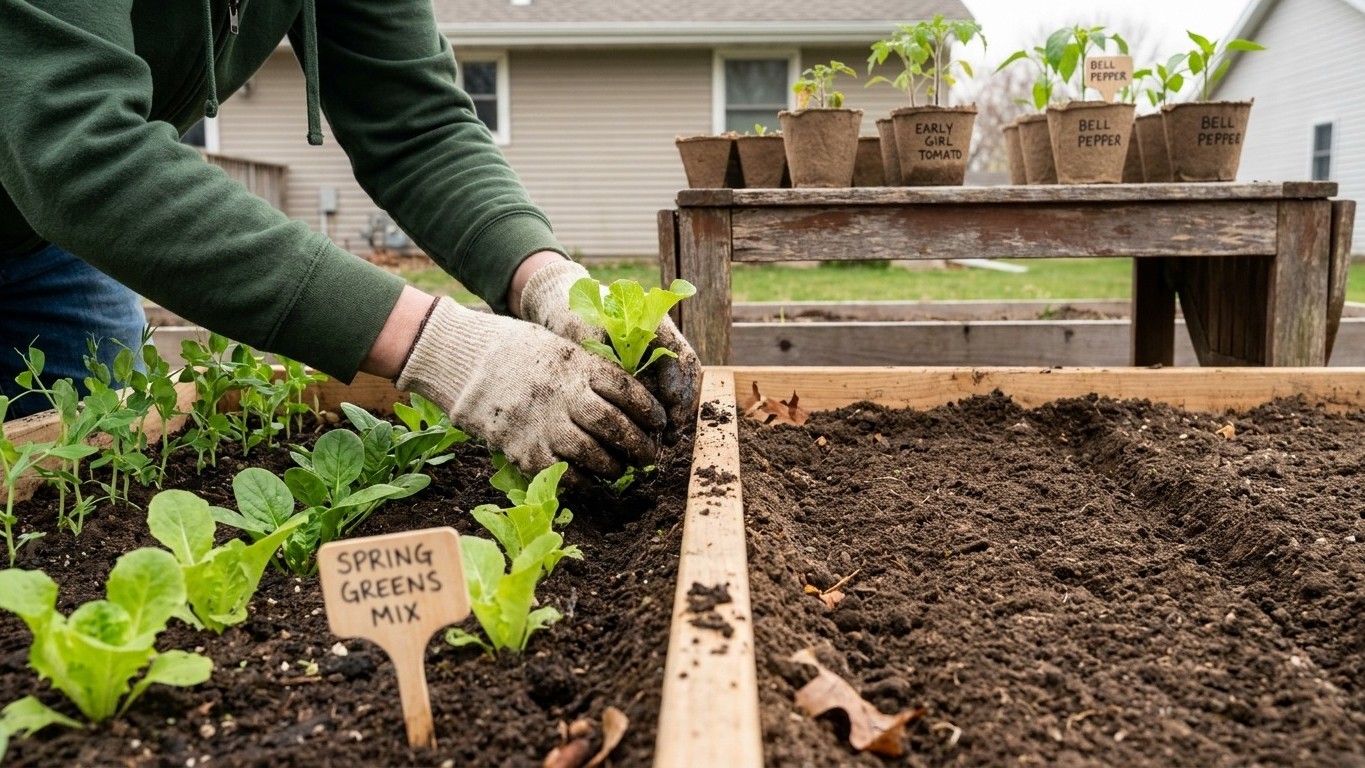

May is the month Minnesota gardeners split their beds in two: hardy crops go in the ground now, tender ones wait. Peas, onions, spinach, lettuce, and hardened brassica transplants can go outside through most of the month. Tomatoes, peppers, beans, squash, and other warm-season crops stay indoors or on a porch until the frost risk actually clears, which runs April 17 to April 30 in the Twin Cities and later the farther north you garden.
What goes in the ground in May

The calendar says May, but the soil doesn’t read calendars. What decides whether a seed or transplant survives this month is soil temperature and how far the local last-frost window has passed, not the date on the page. In the Twin Cities, NOAA’s 1991-2020 Climate Normals put the last spring freeze between April 17 and April 30. That’s the mild south of the state. Northern Minnesota runs two to three weeks tighter at both ends, which means a last frost that can push well into May.
That gap matters for what you plant and when. Early in the month, especially in the northern half of the state, treat the ground as still capable of a hard freeze. Hardy crops shrug this off: spinach, lettuce, kale, peas, radishes, and carrots can be direct-sown into workable soil without much drama. Onion sets and seedlings, along with shallots, tolerate a frost that would kill a tomato outright. Potatoes go in once the soil can be worked, even if a light frost is still possible, because the eyes sprout below ground where the cold doesn’t reach them the same way.
Cabbage-family transplants (broccoli, cabbage, cauliflower, Brussels sprouts) can go outside once they’ve been hardened off, even under a lingering frost risk, as long as they’ve spent a week or so adjusting to outdoor conditions first. What’s a gamble is anything in the tomato, pepper, cucumber, squash, bean, or corn family. These crops don’t just dislike frost, they stall in cold soil even without one, and a transplant set out too early often ends up smaller at harvest than one planted two weeks later into warmer ground. If you’re gardening in the northern third of the state, treat the entire month as a holding pattern for those crops and lean on the hardy list instead.
What to start under cover
Seed-starting math runs backward from the local last-frost window, not forward from today’s date. Tomatoes and peppers typically need roughly six to eight weeks indoors before they’re ready to go outside as sturdy transplants. Counted back from a Twin Cities last-frost window of April 17 to April 30, that start date lands in late February to mid-March, which means by May those seedlings should already be several inches tall and hardening off, not just germinating. If you haven’t started them yet, they’ll still produce, just later and smaller than a batch started on schedule.
Cucumbers, summer squash, and melons run on a shorter clock, usually three to four weeks indoors, since they resent root disturbance and grow fast once seeded. Started now, they’re timed to go outside right as the soil has had a few weeks to warm past the frost window. Basil and other tender herbs follow the same short runway.
The two failure modes here are opposite problems with the same result: a wasted spring. Start too early and you get leggy, rootbound plants stretching for light in a pot that’s too small, stressed before they ever see the garden. Start too late, particularly for northern Minnesota gardens where the frost-free season is already compressed, and slow-maturing crops like peppers or melons may not finish before fall frost arrives. If you’re unsure which side of that line you’re on, err toward starting a little later rather than earlier. A stocky three-week-old seedling outperforms a stretched eight-week-old one almost every time.
What is ready to pick
Harvest in May comes mostly from things planted in a previous season or pushed hard under cover, not from anything sown this spring. Asparagus beds that are established (three years or older) are in full production by mid-month, and rhubarb stalks are thick enough to pull by early May in most of the state. Both keep producing through the month if you harvest regularly rather than letting stalks get old and woody.
Overwintered greens are the other source. Kale, spinach, and mâche that survived under snow cover or a low tunnel resume growth as soon as the ground thaws, and they’re often the first fresh green harvest of the season, weeks ahead of anything newly sown. Chives and other perennial herbs come back reliably and can be cut as soon as they’re a few inches tall.
Cold-frame growers get an earlier jump on lettuce, radishes, and spinach sown a few weeks prior, since the frame buys enough warmth to move up germination and growth by a couple of weeks compared to open ground. Anything direct-sown in open soil this month (peas, lettuce, radishes) won’t be ready to harvest until late May or June depending on the crop and how quickly the soil warmed. If you’re storing winter squash, potatoes, or onions from the previous season, check them now: this is when soft spots, sprouting, or a sweet fermenting smell show up first, and pulling the affected ones early saves the rest of the bin.
The jobs that matter this month
Soil preparation done now sets up everything that follows. Working compost or aged manure into beds while they’re still workable and before the garden fills in is far easier than trying to amend around established plants later. If you haven’t tested your soil in a few seasons, May is a reasonable window to do it, since results come back in time to correct a pH or nutrient problem before the bulk of the season’s planting goes in.
Mulching pays off double this month: it holds soil moisture as temperatures climb, and it suppresses the first flush of weed seedlings before they get established. Apply it once soil has warmed rather than immediately after planting cold-tolerant crops, since a thick mulch layer too early can actually keep soil cooler than you want.
Staking and support structures belong in the ground before plants need them, not after. Peas and any climbing crop sown early in the month will be reaching for support within a few weeks, and installing a trellis after the vines have sprawled means damaged stems and lost yield. The same logic applies to tomato cages, best set in place at transplanting rather than wedged around a plant that’s already leaning.
Watering rhythm in May tends to swing between too much (spring rain) and too little (a dry, windy stretch), so check soil moisture by hand rather than by the calendar. Succession sowing of quick crops like radishes and lettuce every couple of weeks keeps a steady harvest instead of one big flush followed by a gap. And pest scouting matters now because early populations of flea beetles and cutworms are far easier to manage than a full infestation discovered in June.
What not to do in May
The most common mistake is planting warm-season crops into cold soil because the air finally felt warm on a sunny afternoon. Air temperature and soil temperature move on different schedules, and a 70-degree day doesn’t mean the ground six inches down has caught up. Tomatoes and peppers set into soil that’s still cold don’t die outright, but they sulk, stall, and often end up yielding less than a later, better-timed transplant. Wait until the soil itself has warmed, not just the air.
A close second is uncovering hardy crops or removing frost protection too early after a mild stretch, only to have a late frost move through and undo weeks of growth. Given that the last-frost window in the Twin Cities runs all the way to April 30, and northern Minnesota later still, treat any early-May warm spell as temporary rather than a signal that frost risk is over.
Nitrogen timing trips people up too. Heavy nitrogen applications early on push leafy growth at the expense of root and fruit development later, which matters most for crops like tomatoes and squash that you’ll want fruiting hard come midsummer. Save the heavier nitrogen feeding for once plants are established and flowering rather than the moment they go in the ground. For hardy greens grown for their leaves, that same nitrogen timing is actually less of a problem, since leaf growth is the whole point.
Checking this against your own county
A statewide month is a starting point, not an instruction. Minnesota’s hardiness zones run from 3a in the far north to 5a in parts of the south, under the USDA Plant Hardiness Zone Map, and that range alone shifts the safe planting window by weeks. Add elevation, lake effect off Superior, and local microclimates, and two gardens in the same county can differ by ten days or more. Before committing tender transplants to the ground, check your own frost history and local extension guidance through the University of Minnesota Extension, which keeps county-level planting information current.
Common questions
Is it safe to plant tomatoes outside in May in Minnesota?
Only after the local last-frost window has passed and soil has warmed. In the Twin Cities that window runs to April 30; in northern Minnesota it runs later, so early May transplanting there is a gamble.
Can I still direct-sow peas and lettuce in May?
Yes. Both tolerate the cool, sometimes frosty conditions common in May and are among the safest direct-sown crops for the month statewide.
Why did my early-planted seedlings stall instead of growing?
Cold soil is the usual cause. Warm-season transplants set into ground that hasn’t caught up to the air temperature often sit still for weeks rather than growing.
Should I fertilize with nitrogen when I plant in May?
For leafy hardy crops, moderate nitrogen at planting is fine. For fruiting crops like tomatoes and squash, hold heavier nitrogen until after flowering starts to avoid pushing leaf growth over fruit production.