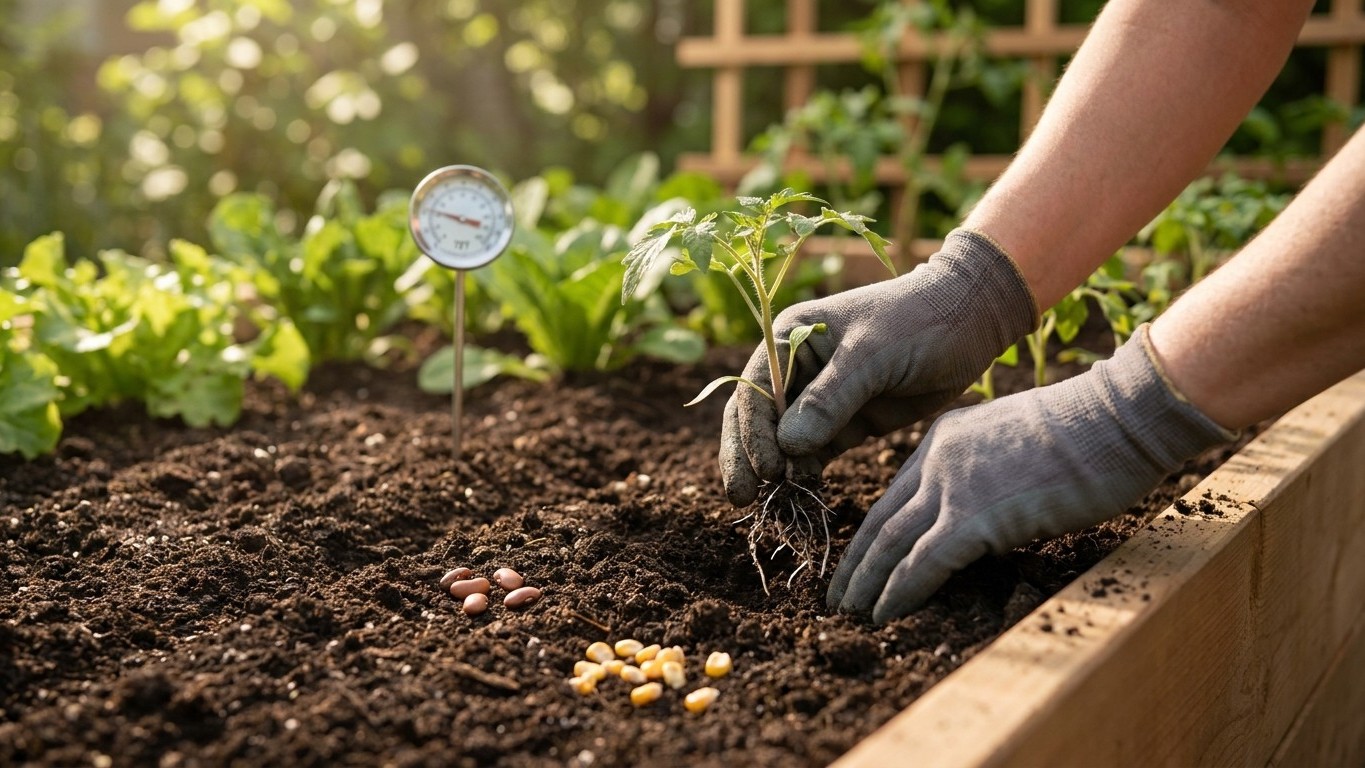

By June, Minnesota gardens are past the frost gamble and into the real growing season. Tomatoes, peppers, and squash transplants go in with confidence, beans and corn get direct-sown, and the last succession of quick greens still has time to mature before summer heat takes over.
What goes in the ground in June

The last spring frost across the Twin Cities area falls between April 17 and April 30, according to NOAA’s 1991-2020 climate normals. That means by the time June opens, the region is already four to six weeks clear of its typical freeze window. Northern Minnesota runs two to three weeks tighter on both ends of the season, so a gardener near Duluth or International Falls should treat early June with a bit more caution than someone in the metro. But for most of the state, June is the month when soil temperature, not frost risk, becomes the deciding factor.
Warm-season transplants, tomatoes, peppers, eggplant, and basil, go into the ground with little worry about cold snaps now. Soil that stayed cool and wet through a rainy spring can still stunt these plants even when the air feels warm, so a quick check with a soil thermometer before planting saves a lot of frustration. Direct-sown beans, sweet corn, cucumbers, summer squash, and melons all want soil in the 60- to 70-degree range to germinate reliably, and June usually delivers that across the southern two-thirds of the state.
Root crops still have room this month too. Carrots, beets, and a second round of radishes can go in through early June and still mature before the heat of midsummer slows them down. Potatoes planted earlier in spring benefit from a fresh hilling as the vines lengthen. And for gardeners who like to stagger their harvest, a final sowing of bush beans in the first half of June sets up a second picking window in late summer, well ahead of the October frost.
What to start under cover
Starting seeds indoors in June sounds late, but it has a real purpose: setting up a fall crop of brassicas. Broccoli, cabbage, and cauliflower need roughly 60 to 80 days from transplant to harvest, and the first fall frost across the Twin Cities area lands between October 11 and October 23. Counting backward from that window, a transplant date in late July or early August works, which means starting the seeds indoors or under a shaded cold frame in June, four to six weeks ahead of transplanting.
The arithmetic is worth doing on paper rather than trusting memory. Take the earliest expected frost date for your county, subtract the days-to-maturity listed on the seed packet, then subtract another four to six weeks for the indoor seedling stage. That backward count is what tells you whether a fall crop is realistic at all, and it’s more reliable than picking a date off a generic calendar.
Two mistakes show up every year with this kind of late-season sowing. Starting too early leaves plants sitting rootbound in small cells through the hottest part of summer, stressed and stunted by the time they finally go in the ground. Starting too late means the crop is still small when the first hard cold arrives, and brassicas that haven’t sized up don’t recover once growth stalls. A shaded spot out of direct afternoon sun helps seedlings started indoors in June avoid the leggy, weak stems that come from heat stress at the tray stage.
What is ready to pick
June is when the garden starts paying back the spring’s work. Asparagus, if the bed is established, is winding down its harvest window by midmonth, and cutting should stop to let the ferns grow and rebuild the crown for next season. Rhubarb stalks are at their thickest and most tender now, and regular harvesting through June actually encourages the plant rather than weakening it.
Spring-planted greens hit their stride here too. Lettuce, spinach, and arugula sown in April or early May are ready, though rising temperatures push lettuce and spinach toward bolting fast, so daily checking matters more than it did in cooler months. Radishes sown in early spring are long past ready and should be pulled before they turn woody and hot-tasting.
Garlic scapes, the curling flower stalks that hardneck garlic sends up, are worth cutting as they appear. Removing them redirects the plant’s energy into bulb growth and gives an early, edible bonus before the main garlic harvest later in summer. Strawberries planted in prior seasons often deliver their first flush of the year in June as well, and peas sown early can be coming in by the tail end of the month, especially in the milder southern counties.
The jobs that matter this month
Mulching earns its keep in June more than almost any other month. As temperatures climb, a two- to three-inch layer of straw or shredded leaves around tomatoes, peppers, and squash slows soil moisture loss and keeps root zones from swinging between soaked and bone-dry. That swing is exactly what causes blossom-end rot in tomatoes later in the season, so the mulching done now is really prevention for a problem that would otherwise show up in July.
Staking and caging need to happen before plants sprawl, not after. Tomatoes, peas, and vining cucumbers put on rapid growth once the weather warms, and trying to wrangle a sprawling, tangled plant into a cage two weeks late usually means broken stems and lost fruit. The same logic applies to peonies and tall perennials in the ornamental beds, which flop after a hard rain if they weren’t supported early.
Watering rhythm matters more than watering volume. Most vegetable gardens want roughly an inch to an inch and a half of water a week, delivered in fewer, deeper sessions rather than a light daily sprinkle that only wets the surface. Deep watering pushes roots downward, which pays off during any dry stretch later in summer.
Pest scouting deserves a walk through the garden every few days. Colorado potato beetle larvae show up on potato and eggplant foliage, squash bugs lay their bronze egg clusters on the undersides of squash leaves, and cutworms can still take down young transplants at the soil line. Catching any of these in the first week of an infestation, by hand-picking eggs or larvae, is far easier than dealing with a full-blown outbreak later. Thinning direct-sown carrots and beets to their proper spacing also can’t wait, since crowded roots stay small no matter how good the soil is.
What not to do in June
The most common mistake this month is trusting the air temperature over the soil temperature. A run of warm, sunny days can feel like a green light for tender transplants, but if the ground underneath is still cool from a wet spring, tomatoes and peppers set back into it will simply sit and sulk for weeks instead of growing. A soil thermometer pushed a few inches down gives a truer answer than a hand held over the dirt.
Heavy nitrogen feeding at the wrong moment is another recurring problem. Dousing tomatoes with a high-nitrogen fertilizer once they’re flowering pushes lush green foliage at the expense of fruit set. A balanced or lower-nitrogen feed suits fruiting crops better once blossoms appear; save the nitrogen-heavy applications for leafy greens and young transplants still building their frame.
Overwatering shows up just as often as underwatering in June, especially after a rainy stretch followed by gardeners who water out of habit rather than checking the soil first. Squash and cucumber roots in particular sit poorly in waterlogged soil and become far more susceptible to fungal problems. And skipping the thinning of crowded seedlings, out of reluctance to pull healthy-looking plants, just guarantees a bed of undersized carrots and beets come harvest. Better to thin hard once than to nurse a crowded row that never sizes up properly.
Checking this against your own county
A statewide planting month is a starting point, not an instruction. Minnesota’s hardiness zones run from 3a in the far north to 5a in the southeast, according to the USDA Plant Hardiness Zone Map, and that spread reflects real differences in winter extremes that carry through into how early the soil warms each spring. Elevation, distance from Lake Superior, and even which side of a river valley a garden sits on can shift planting windows by a week or two in either direction.
For a planting calendar built around your specific county, along with frost data and crop guides tailored to Minnesota conditions, the University of Minnesota Extension is the reliable source to check before finalizing a planting plan.
Common questions
Is it too late to plant tomatoes in Minnesota in June?
No. June transplanting is well within the normal window for the Twin Cities area, since the last spring frost typically falls between April 17 and April 30. Tomatoes set out in early to mid-June still have a full growing season ahead before the first fall frost arrives in October.
Can I still direct-sow sweet corn in June?
Yes, especially in the first half of the month. Sweet corn needs warm soil to germinate well, and June soil temperatures across most of Minnesota are reliably in that range, giving the crop enough time to mature before fall frost.
Why are my June-planted seedlings not growing?
Cold soil is the most likely cause, even if the air feels warm. A stretch of wet spring weather can leave the ground several degrees cooler than the air, and warm-season transplants set into that cold soil often stall for weeks rather than dying outright.
What’s different about planting in northern Minnesota versus the Twin Cities in June?
Northern counties run two to three weeks tighter on both the spring and fall frost windows compared with the Twin Cities normals. A crop that’s perfectly safe to plant in the metro in early June may still carry some frost risk farther north, so checking local extension data for your specific county is worth the extra step.