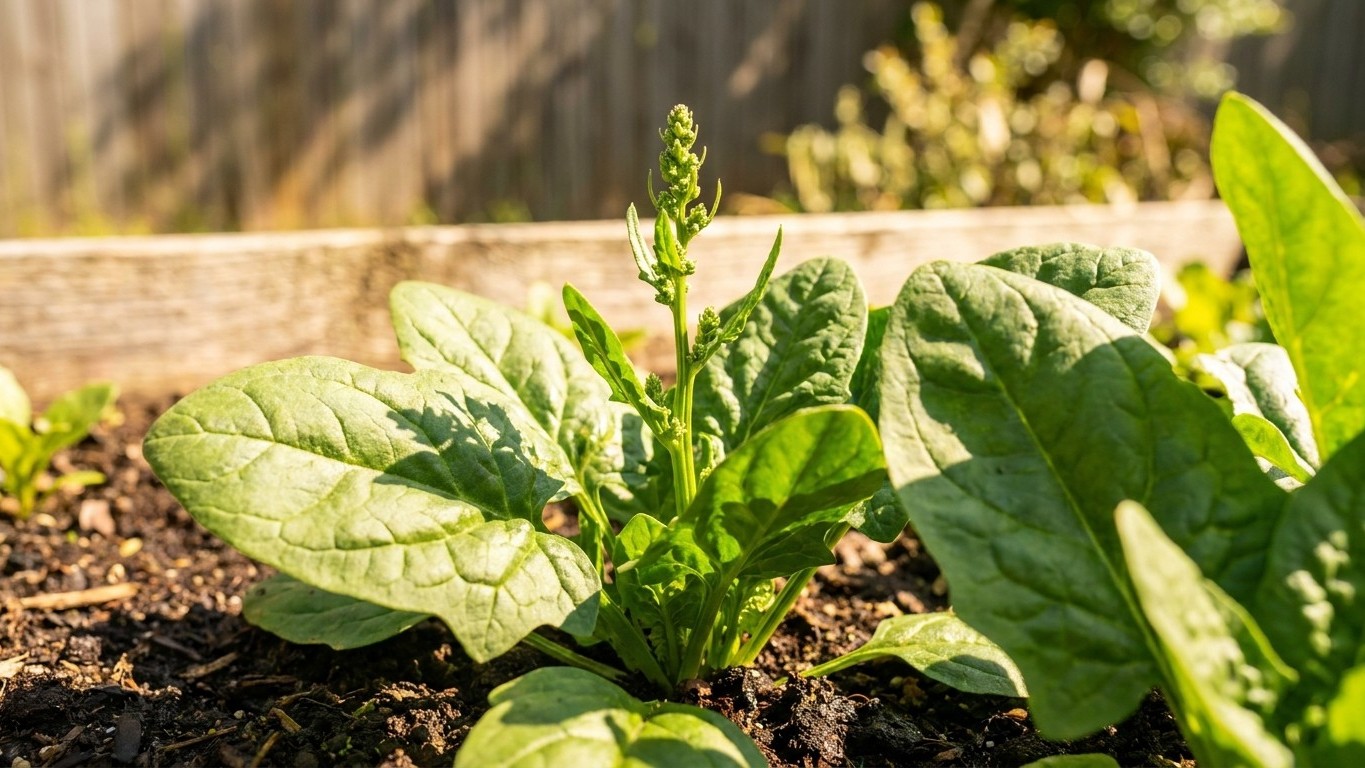

Cut spinach when the outer leaves are about the size of your hand and the center of the plant is still a flat, tight rosette. Spring sowings reach that point in May and early June, and late-summer sowings from late September into October. After cutting, the clock runs fast. UC Davis says spinach will not hold good quality beyond 2 weeks even at 32°F, and a home fridge is warmer than that.
When spinach is ready in Minnesota
The plant gives you the signal, and the calendar only gives you a range. Check the center of the rosette. A flat cluster of small leaves means you can keep cutting. A center that looks taller, narrower or pointed means a flower stalk is starting, and the leaves will turn bitter soon after.
For the range, start with frost. NOAA’s 30-year climate normals for the Twin Cities put the last spring freeze between April 17 and April 30, and the first fall freeze between October 11 and October 23. Northern Minnesota runs two to three weeks tighter at both ends, so push spring dates later and fall dates earlier as you go north. Spinach goes in the ground as soon as the soil can be worked, so the spring clock starts near the last-frost window instead of waiting for it to close.
Fall planning works backward from the harvest you want. Utah State University Extension advises timing the sowing so the crop matures before the long days and heat arrive. With first frost arriving in mid-October, that puts sowing between the end of July and early September. Packet counts for spinach run from sowing, since the seed goes straight into the ground. Ask your local county extension office which spinach varieties they recommend for your area.
Why does spinach turn bitter so quickly?
Two things push spinach toward flowering, and Minnesota supplies both. Utah State University Extension says spinach bolts during long days and warm temperatures, and grows best where temperatures stay at or below 75 F. That 75 F figure is a growth ceiling and also the point where flavor turns bitter. It is a temperature to watch, never a date on the calendar.
Day length is the surprising part. On the longest day of the year the Twin Cities get 15 h 25 of daylight. Long days alone can trigger flowering, so a cool summer buys no extra weeks. Days are already lengthening through April and May, which is why the spring crop is a race. The station in Minneapolis also averages 10.6 days a year at 90 F or hotter, and a warm afternoon in late May can cross 75 F well before then. The longer I wait to cut, the more bolting pressure the plants carry. For the full picture, see Will Spinach Bolt Early in Minnesota?
What changes for a fall crop?
Fall has the opposite problem. Days shorten after the solstice, which relaxes the pull toward flowering. The obstacle is warm soil, because seed germination drops once soil goes above 80 F. Late July and August ground in the upper Midwest can sit above that, so sow into soil you have watered and shaded, or wait for it to cool. The window opens when the soil falls, whatever the calendar says.
Whatever chews on the leaves, covered in What Eats Spinach in Minnesota, and When, gets a longer feast the longer a ready crop stands in the bed. Cutting on time helps there too.
Keeping it, and for how long
Spinach is one of the shortest-lived vegetables you can bring in from the garden. The UC Davis Postharvest Technology Center gives the optimum as 0°C (32°F) with 95 to 98% relative humidity. Its fact sheet calls spinach “highly perishable” and says it will not maintain good quality for more than 2 weeks.
How long does cut spinach last?
Two weeks is a ceiling under ideal conditions. It is not a plan. The same source says wilting, yellowing of the leaves and decay are likely to increase once storage runs past 10 to 14 days. That is the rate for spinach held at 32°F. Anything warmer shortens the time.
The source also notes that deterioration comes faster at common distribution conditions of 5 to 10°C (41 to 50°F). That is only 9 to 18 degrees above freezing. A fridge running in that band gives you days of good leaves, and the yellowing shows first at the edges and along the stems.
Why do temperature and humidity both matter?
Cold slows the leaf’s own breathing, which is what drives yellowing and breakdown. Humidity matters because leaves are mostly water and lose it quickly into dry air. At 95 to 98% humidity they stay crisp. Dry air pulls moisture out through the thin leaf surface within hours, and the leaf goes limp.
The two work together. Cold air in a household fridge is also dry air, since the cooling coils pull moisture out of it. So the 32°F figure only helps if you also give the leaves a damp, enclosed space. Without it, you get cold, wilted spinach.
This also explains why store spinach often looks tired by the time you open the bag. It has spent days in distribution at temperatures above the optimum before it reached your kitchen. Spinach you cut yourself starts the clock at harvest, so you control the whole chain. Cut in the morning while leaves are cool and full of water, and get them into cold storage quickly. Every hour spent in a warm kitchen or hot car comes out of the two-week ceiling.
Where in the house that actually is
A domestic fridge cannot match 32°F with 95 to 98% humidity. It runs warmer than that, and the door runs warmer still because it gets opened, closed and exposed to room air all day. Door shelves are fine for condiments. Spinach on the door sits in the temperature range where the source says it deteriorates fastest.
The closest spot is the back of the bottom shelf, where cold air settles and the door’s swings reach least. The crisper drawer is a second choice if it has a humidity slider, which you should close to the high-humidity setting. Without a slider, a drawer is usually just a box that holds cold air. Keep spinach away from the vents and the back wall when the fridge is running cold enough to freeze water, because frozen leaves go dark and slimy once thawed.
High humidity needs a physical setup. Shake the leaves free of surface water, but leave them slightly damp. Then put them in a bag or lidded container with a folded, damp paper towel. Soggy leaves rot faster than dry ones, and a thin film of moisture works better than standing water. If you cut whole plants with stems attached, you can stand them in a jar with a little water under the cut ends and cover the top loosely with a bag. That mimics the damp conditions the source describes. Spinach sealed in a loose bag with a damp towel at the back of the bottom shelf will last noticeably longer than a dry bunch left on the door, and skipping that step costs you days of usable leaves.
Check the bag every couple of days. Pull out any yellowing leaves, since decay spreads from one leaf to its neighbors. Slimy leaves go in the compost. Leaves that are only limp can be cooked in a pan right away, where wilting does not matter.
Common questions
Can you cut spinach more than once?
Yes, as long as the plant is still in its leafy stage. Cut the outer leaves and leave the center so it keeps producing. Once the center rises into a stalk, cut the whole plant at the base, because the leaves will not improve from there.
What temperature makes spinach bitter?
Utah State University Extension says spinach grows best where temperatures do not exceed 75 F, and that figure is also when flavor turns bitter. Warm weather combines with long days to trigger bolting. In the Twin Cities a typical year includes 10.6 days at 90 F or hotter, so summer cutting is a losing proposition.
How long does fresh-cut spinach keep in the fridge?
The best case is under 2 weeks at 32°F with high humidity, and a household fridge is warmer than that. Plan to use it well inside that window, and check for yellowing, wilting or slime before you eat it. Leaves that were chilled quickly and stored damp last longest.
Which spinach varieties should I plant?
Your local county extension office can name spinach varieties suited to your area. Local growing details, including sowing dates for your part of the state, are covered in Growing Spinach in Minnesota, and your county extension office can tell you what has done well nearby.