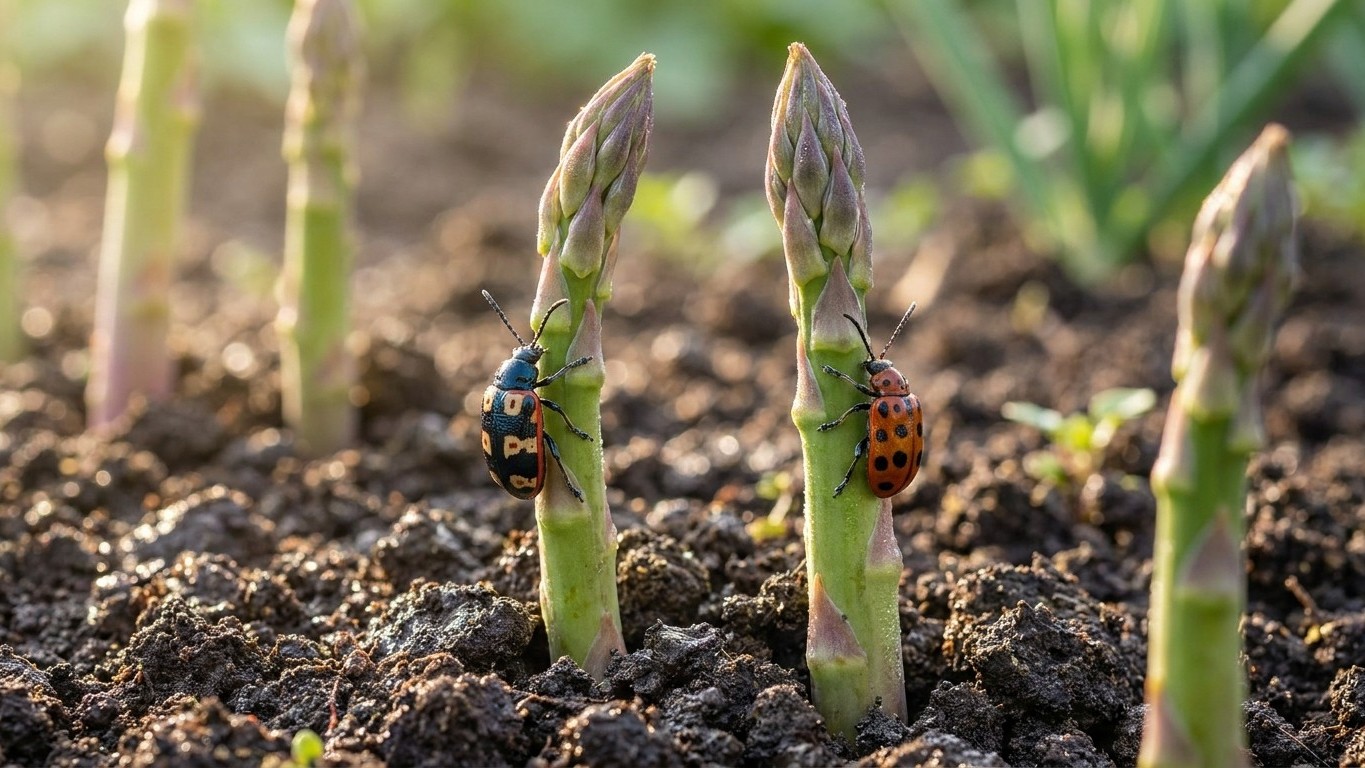

Most trouble in a Yukon asparagus bed shows up in two places: the spear tips in spring and the ferns through summer. The mean last spring frost at Whitehorse A is June 5, so frost, chewing insects and slugs all compete for attention in a short stretch of weeks. Where the damage sits on the plant tells you more than any insect name does.
Which pests attack asparagus in Yukon
Asparagus in a cold northern bed faces the same broad groups of feeders as asparagus anywhere, only on a compressed schedule. Four groups matter in a Yukon bed.
- Chewing insects that scar the tips and skin of spears as they emerge.
- Chewing insects and their larvae that strip the thin, feathery ferns later in the season.
- Slugs and snails, which rasp ragged holes and leave silvery trails wherever the ground stays damp.
- Small mammals that cut spears, dig at crowns or nibble stems at night.
Asparagus is a long-term crop, which raises the cost of a wrong diagnosis. Crowns go into 8-inch furrows in early spring, the bed is not harvested until year 3, and then it produces for 10 to 15 years. A pest that weakens the ferns in the first two summers is working against a plant that has nothing to feed its roots with except those ferns. Even modest chewing deserves a look rather than a shrug.
Timing helps sort suspects. The mean last spring frost at Whitehorse A, according to Environment and Climate Change Canada, falls on June 5. That is an average, so frost arrives later than that date in about one year out of two. Northern and upland districts run weeks behind the Whitehorse station, so a bed in a cold valley may still be dodging frost while a bed near town is already hosting insects.
When each one shows up, and what it does first
Count from your planting and from the last frost, not from a month on the calendar. Crowns go in early in spring (see When to Plant Asparagus Crowns in Yukon for how that lines up with your ground), and spears push up as the soil warms.
Spring: spears push up
The first thing you see is damage to the spear tips. Chewing insects leave notched or scarred tips, rough streaks on the skin or a bent, stunted spear. Slugs leave ragged holes with slime trails, mostly on cool, damp mornings. Small mammals leave spears cut off cleanly or missing altogether, sometimes with soil scratched away around the crown.
Frost can look similar at a glance. A spear nipped by a cold night turns dark and limp all at once, across the whole row. Insect damage is patchy, one spear hit and its neighbor untouched.
Summer: the ferns open
Once spears are left to grow into ferns, the first sign of insect feeding is ragged, thinned fern tissue, or ferns that look pale or tan earlier than they should. The ferns feed the crown for next year, so this is the damage that matters most for the bed’s future.
Dry weather muddies the picture. Whitehorse A averages about 107 mm (4.2 inches) of rain across June, July and August, with June the driest month at 33 mm (1.28 inches). July brings 38 mm (1.5 inches) and August 36 mm (1.41 inches). Those are normals for one station, so a rain gauge on your own plot settles what your bed receives. Dry spells yellow ferns on their own, so yellowing without chewing marks points away from insects.
Late summer: slugs and animals
Slugs and small mammals do not follow the insects’ schedule. Slugs are active whenever the surface is wet, which in a mulched or low-lying bed can be most of the season. Animals browse whenever other food is scarce or the bed is easy to reach.
Ten-minute bed check. Walk the rows early in the morning, when slugs are still out and frost damage is freshest. Turn a few ferns over to look at their undersides, and look at the soil around each crown. Write down where the damage sits (tip, skin, fern, crown), whether it is patchy or uniform, and how many days have passed since the last cold night. Take one close photo and one wide photo. That record is what a local adviser will ask for first.
Telling the damage apart from everything else
Several problems in a young bed look like pests but are not, and in a crop that takes three years to reach harvest, a wrong diagnosis can cost a year. Use the table to narrow things down, then confirm with the territory’s agriculture staff before you act.
| What you see | Possible cause | What settles it |
|---|---|---|
| Spears dark, limp and soft across the whole row | Frost | A cold night just before, and every spear affected, not just a few |
| Notched tips, ragged skin, patchy damage | Chewing insects | Insects, droppings or larvae visible on the plant when you look in the morning or evening |
| Ragged holes with silvery trails | Slugs or snails | Trails on the soil and leaves, and damage worst after wet nights |
| Spears snapped or cut cleanly, soil disturbed | Animals or mechanical damage | Scratched soil, droppings or tracks, or a spot where people or tools pass |
| Ferns yellowing evenly, no chewing marks | Water stress | Dry soil a few inches down, and improvement after a deep soaking |
| Yellowing, wilting, soft or hollow crowns in a wet spot | Poor drainage | Standing water or soggy soil around the crown after rain |
| Spears thin across the whole bed | Young or tired crowns | Even thinness, no chewing, and a bed in its first or second year or near the end of harvest |
The last row catches many first-time growers. In a bed that is in harvest, stop cutting when most spears are thinner than a pencil. In a bed younger than year 3, thin spears are normal because nothing should be harvested yet.
Drainage is hard to undo. The dominant soil across Yukon’s mapped farmland is a Brunisol (41 percent of the surface, followed by Gleysolic soils), a loam to silt that is imperfectly drained, so water can linger around a crown buried in a furrow. Your own plot may differ, so check Will Yukon Soil Hold an Asparagus Bed for Fifteen Years? and dig a test hole before you blame a pest for yellowing.
What actually works here, and what is a waste of time
On a short season, calendar and barriers do more than any spray. A physical barrier set at the right moment protects spears before the damage starts.
Cover young spears with a lightweight fabric cover or fine mesh in spring, once the crowns are in and before chewing begins. The same cover softens a frost, which is a live risk around the June 5 mean. Pull it back when spears are tall enough to cut or grow into ferns, so you can watch for what lives underneath.
For slugs, remove hiding places and water in the morning so the surface dries before night. For small mammals, fencing buried a few inches into the ground works better than any scare device, because animals get used to scarecrows and reflective tape within days. Clear old fern debris out of the bed in spring, since dead stems shelter overwintering insects.
Backfill the furrow gradually, two inches every other month, instead of all at once. In imperfectly drained ground, a trench that stays open can hold water around the crown.
What does not work is just as clear. Spraying at the first sign of damage, without knowing the cause, wastes effort and can harm helpful insects. A product aimed at a different crop or insect is not guaranteed to be labelled for asparagus. Harvesting early to “see if the bed is healthy” costs the crown the fern growth it needs to feed itself.
Where to check this for your own county
Yukon has no counties and no county extension offices, so the nearest equivalent is the territorial government’s agriculture staff. Ask them what is active in your district this season, and which pesticides are registered for use where you live. Local gardening groups can tell you what neighbors in your valley are seeing, though they should not replace the staff on questions about treatments.
Insect pressure shifts from one valley to another, and from a south-facing slope to a low pocket where cold air settles. The June 5 mean comes from a single station at Whitehorse A, and districts farther north or at higher elevation run weeks behind it. For the bigger picture on choosing a site, planting and long-term care, start at Growing Asparagus in Yukon.
The next step is simple. Photograph the damage this week, note how many days have passed since your last cold night, and send both to the territory’s agriculture office before you buy anything for the bed.
Common questions
When should I start checking for pests?
Start as soon as spears break the surface, and keep going through the fern stage. The mean last spring frost at Whitehorse A is June 5, so in a typical year you are watching for frost damage and insect damage at the same time. Colder districts will be later.
Are thin spears a sign of insect damage?
Usually not. Thin spears are normal in the first two years, when nothing should be harvested, and they signal the end of the cutting season in older beds.
Does a dry June mean fewer pests?
June is the driest summer month at Whitehorse A, at 33 mm (1.28 inches), but dry weather mostly changes how the plant looks, not what is eating it. Dry spells yellow ferns and stress the crown, and that can be mistaken for insect damage. Check soil moisture a few inches down before you decide.
What should I spray on chewed spears?
Ask the territory’s agriculture staff before spraying anything. They know what is registered for use in Yukon, and a barrier such as a fabric cover is often enough to protect spears without any product at all.