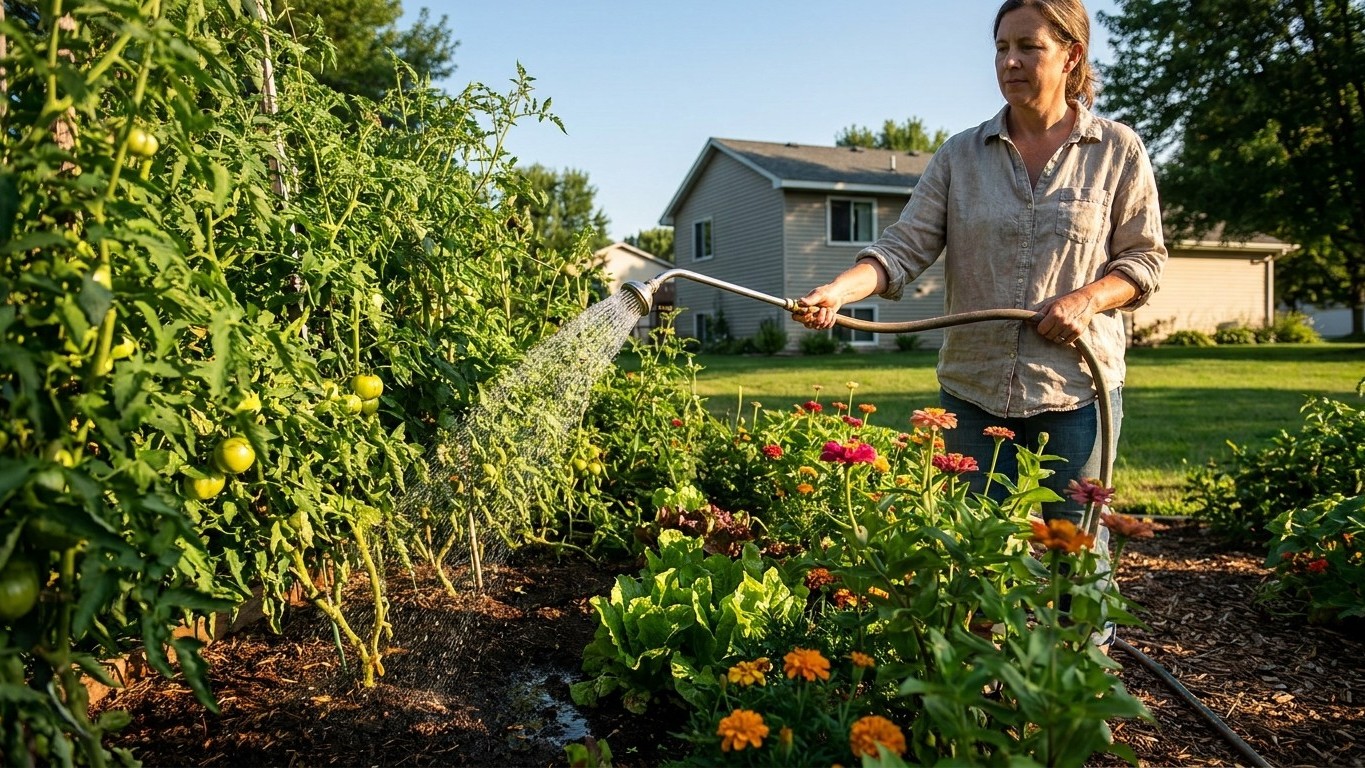

Minneapolis logs an average of just 10.6 days a year at 90F or hotter, and the frost-free window there runs from around April 17-30 to October 11-23. Those two numbers set the whole watering calendar: a short, intense heat season squeezed between two frost dates that shift by two to three weeks once you head toward the Iowa border or up toward International Falls.
What the climate asks of you

Start with the heat, because that’s the number we can pin down with confidence. At the reference station in Minneapolis, the 1991-2020 climate normals put the average at 10.6 days a year reaching 90F or higher. That’s not a brutal desert summer. It’s a handful of stretches, usually in July, where the garden goes from comfortable to stressed in the space of an afternoon. Compare that to a Southern state with forty or fifty days above 90, and you start to see why Minnesota gardeners can get away with a looser watering schedule for most of the season, then need to tighten it fast when one of those hot spells rolls in.
The rule of thumb for a vegetable or flower bed is about an inch of water a week, whether that comes from the sky or a hose. What I can’t hand you here is a single verified figure for how many of those inches Minnesota’s sky actually delivers in June, July, and August, because rainfall varies by station and by year, and the reliable numbers live with the National Weather Service and your local extension office, not in a single statewide average. The University of Minnesota Extension (extension.umn.edu) is the place to pull the current normals for your specific county, and it’s worth doing before you set a schedule, because a wet June in the Twin Cities can look nothing like a dry one two hours north.
Soil changes the math
Minnesota’s soils run from sandy outwash in the central lakes region to heavy clay loams in parts of the south and west. The same inch of rain behaves completely differently depending on which one you’re standing on. Sand drains fast, so a garden on sandy ground can dry out within a day or two even after a good soaking. Clay holds water far longer, which sounds like an advantage until you realize it also holds onto too much water and starves roots of oxygen if you keep adding more before it’s had a chance to dry. Knowing your own soil, more than any statewide average, is what actually tells you how often to water.
How much, how often
The short version: water deeply, and not very often. A quick daily sprinkle feels productive, but it trains roots to stay near the surface, where they’re the first thing to fry when one of those 90-degree days shows up. Deep, infrequent watering pushes roots down into cooler, more stable soil, which is exactly what you want going into a Minnesota July, and it’s the same principle behind Watering Through a Dry Spell in Minnesota when those hot stretches finally arrive.
The trick is knowing when the soil is actually dry where it counts, a couple inches below the surface, not just on top. This matters just as much for pots and raised beds as it does for in-ground plots, and if you’re gardening in containers, the rules shift enough that it’s worth reading up on Watering Pots and Containers in Minnesota before you settle on a schedule. Push a finger or a small trowel into the bed. If it’s dry at two inches down, it’s time to water. If it’s still cool and damp, leave it alone, even if the surface looks bone dry. That two-inch check is more reliable than any calendar schedule, because it accounts for whatever the week’s weather actually did.
Here’s a sequence that works across most of the state, adjusted for your own ground:
- Check soil moisture two inches down with a finger or trowel before watering at all, rather than watering on autopilot.
- Water early in the morning, so plants take up moisture before the day’s heat and any surface water has time to evaporate rather than soak in.
- Aim the water at the base of the plant, not overhead, since wet foliage overnight is an invitation to fungal disease in Minnesota’s humid summers.
- On sandy soil, water more often but in shorter sessions, since the ground can’t hold much at once and deep soaking just runs past the root zone.
- On clay soil, water less often but longer, and never work or soak the bed while it’s still wet from the last watering or a recent rain, since compacted wet clay squeezes out the air roots need.
- During any stretch pushing toward that 90F mark, check soil moisture daily instead of weekly, since a heat spell can dry out even well-mulched beds faster than the usual rhythm accounts for.
Because reliable summer rainfall figures for this state aren’t something to guess at, treat any week without a solid rain event as a week you’re likely watering, not waiting. Gardeners on sandy ground in a dry stretch are effectively on irrigation, full stop, regardless of what the calendar says the “average” summer looks like.
Restrictions and rules
Watering restrictions are common across Minnesota, particularly in cities and suburbs that draw from municipal groundwater supplies, and they change from year to year depending on drought conditions. Some water utilities run odd-even day schedules based on street address, others restrict watering to early morning or evening hours to cut down on evaporation loss, and a few move to stricter limits only when a drought is officially declared. None of this is uniform statewide, and a rule active in one city may not exist a few miles away in the next township.
Rather than guess at a rule that may or may not apply where you garden, the reliable move is to call or check the website of your local water utility or municipality before you set an automatic timer or sprinkler schedule. Many post current restrictions directly on their utility billing page, updated for the season.
Given how tight that summer window really is, with only about 10.6 days a year crossing 90F at the reference station, restrictions in Minnesota tend to be less aggressive than in states baking through months of extreme heat. Still, dry stretches happen, and a well or municipal supply under strain doesn’t care what the statewide average looks like. Checking before you assume you’re in the clear costs five minutes and saves a fine, or worse, a garden that dries out because you didn’t know watering was capped to certain hours.
Using less
Cutting water use in a Minnesota garden isn’t about giving anything up. It’s about not wasting what falls or what you carry out with a hose. A few techniques do most of the work, and they’re worth listing separately rather than blending together, because each one solves a different part of the problem.
- Mulch, two to three inches of shredded bark or straw over the root zone, cuts evaporation from the soil surface and keeps roots cooler during those 90-degree stretches, which means less frequent watering even without changing anything else.
- Drip irrigation or soaker hoses put water directly at the root zone instead of spraying it into the air, where wind and sun claim a share before it ever reaches the plant. This matters more on windy, open Minnesota lots than in a sheltered backyard.
- Grouping plants by water need means you’re not soaking a drought-tolerant native prairie planting just to keep a thirsty vegetable bed happy nearby. Separate zones, separate schedules.
- Working organic matter into the soil, compost especially, helps sandy soil hold more moisture and helps clay soil drain a little better, closing the gap between the two extremes found across the state.
- Rain barrels, where local code allows them, capture roof runoff that would otherwise just run into a storm drain. An inch of rain falling on a thousand square feet of roof works out to roughly 600 gallons of water, which gives a sense of scale, though how full a barrel actually gets, and how long it lasts, depends entirely on rainfall in a given month, something that varies enough across Minnesota that your local extension office or county water data is the better source than any statewide guess.
None of these techniques is dramatic on its own. Stacked together, mulch plus drip plus grouped plantings, they can cut the amount of water you’re hauling out by hand by a real margin, especially through whatever stretch of the season pushes past that 90F mark and puts the most pressure on a garden.
Common questions
How long is Minnesota’s growing season?
It runs from the last spring frost, April 17-30 depending on location, to the first fall frost, October 11-23. That’s the frost-free window at the reference station; northern Minnesota’s window closes two to three weeks tighter on both ends, so a garden near Duluth or International Falls should plan around an earlier fall frost and a later spring one.
Does Minnesota’s whole state share the same USDA hardiness zone?
No. The USDA Plant Hardiness Zone Map lists Minnesota across zones 3a to 5a, a wide range for a single state. The reference city, Minneapolis, sits toward the milder end of that range, but a garden in the far north or a low-lying frost pocket can be a full zone or more colder, which matters for what perennials survive winter, not just for summer watering.
Should I water my Minnesota lawn every day in summer?
No, and daily watering is usually counterproductive. Lawns, like garden beds, do better with deep infrequent watering that encourages roots to grow down rather than staying shallow. Watch for the grass to show early signs of drought stress, a slight graying or footprints that don’t spring back, before watering again.
Where do I find current watering restrictions for my city?
Check your municipal water utility’s website or call them directly, since rules vary by city and change with drought conditions. Your local University of Minnesota Extension office (extension.umn.edu) can also point you toward county-level resources and current guidance for your area.