
Minnesota gardeners get more rain in a typical summer than many parts of the country, but that rain doesn’t fall evenly, and a handful of hot days can undo a week’s worth of moisture fast. The short answer: water deeply once or twice a week rather than daily, check soil moisture with your finger instead of guessing, and treat July as the month to watch most closely.
What changes here

Two numbers set the terms for watering in Minnesota. July, the driest summer month, averages 4.06 inches of rain. And the state’s reference station records 10.6 days a year at or above 90F. Put together, that means Minnesota gardens get a decent baseline of moisture from the sky, but a stretch of hot days can pull water out of the soil faster than July’s rain replaces it.
Do the arithmetic and it gets more specific. A vegetable bed or a young perennial border generally wants about an inch of water a week. Spread July’s 4.06 inches evenly across that month’s roughly 4.4 weeks, and the sky delivers around 0.92 inch a week on average. That’s close to the target, which is the good news. The catch is that July rain in Minnesota rarely arrives evenly. It tends to come as a thunderstorm that drops half an inch in twenty minutes, followed by a stretch of ten or twelve dry days. During that dry stretch, with temperatures pushing past 90F on the state’s hottest days, evaporation from soil and transpiration from leaves can outpace what the ground is holding onto.
Soil texture decides how far that inch of rain actually goes. On sandy ground, water drains through within a day, so a July storm that drops a full inch might leave almost nothing by day three. On heavy clay, the same inch can sit in the root zone for a week, which softens the blow of a dry spell but raises a different risk: watering on top of soil that hasn’t drained yet, which suffocates roots rather than feeding them. Neither of the state’s typical soil types lets a gardener treat July rainfall as “enough” without checking. The 4.06-inch average and 10.6 hot days are useful for planning a watering schedule, but they describe a normal, not a promise. A gardener’s own plot, with its own drainage and its own patch of sun, is what actually decides the week.
How to water when it matters
The method that works in Minnesota is the same one that works almost everywhere the ground includes clay or a mix of clay and loam: water deeply, water infrequently, aim at the base of the plant, and do it in the morning. Each part of that has a reason behind it, not just a habit.
Deep watering pushes moisture several inches down, which pulls roots downward with it. Roots that chase water toward the surface are the ones that die first when a hot week hits, because the top inch of soil dries out within hours once temperatures cross 85F or so. Watering at the base rather than overhead keeps leaves dry, which matters in a state where summer humidity is high enough to make fungal disease a real risk on wet foliage. Morning watering gives the sun time to dry any leaves that do get splashed, before evening humidity settles in and gives fungus spores the damp window they need.
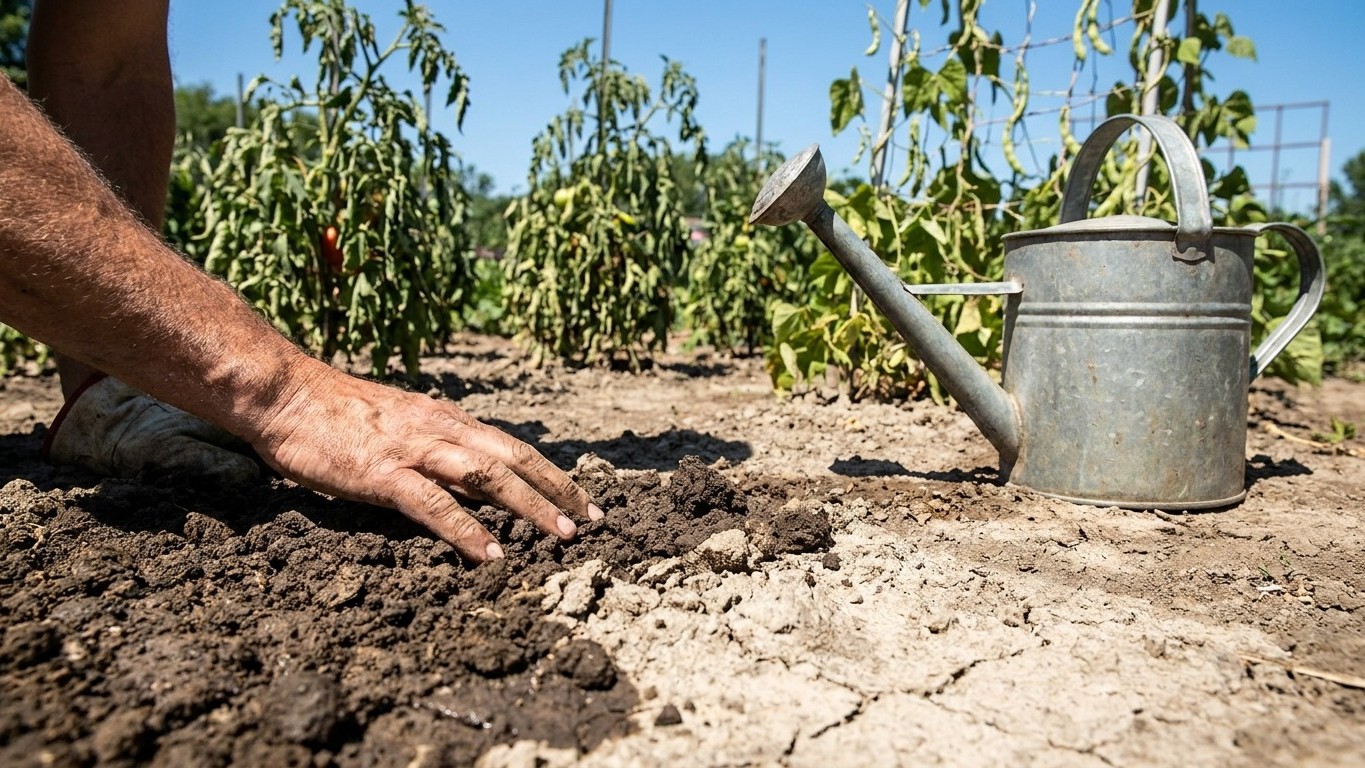
Knowing when to water matters as much as how. Surface soil can look dry and still have plenty of moisture two inches down, especially on Minnesota’s clay-heavy ground, and the reverse is also true on sandy stretches. The reliable check is a finger or a trowel pushed two inches into the bed near the base of the plant. If it’s dry at that depth, water. If it’s still damp, wait.
- Push a finger or trowel two inches into the soil near the plant’s base before deciding to water at all.
- On sandy soil, plan on shorter, more frequent soakings, roughly every two to three days during a hot stretch, since sand holds little water at root depth.
- On clay-heavy soil, water less often but more slowly, letting a single deep soak sit for five to seven days before checking again, since clay holds water far longer.
- Start with about one inch of water per week as a baseline, delivered in one or two sessions rather than daily sprinkles, and adjust up or down based on what the finger test shows.
- Apply a two- to three-inch layer of mulch around the base to slow evaporation between waterings, particularly through the driest stretch of July.
That one-inch starting point is exactly that: a starting point. A raised bed drains faster than garden soil, a container dries out faster than either, and a shaded bed under a tree needs less than one baking in full afternoon sun. Check the soil, not the calendar.
What goes wrong
“I water a little every evening, just to be safe”
A light daily sprinkle wets only the top inch or so of soil, which trains roots to stay shallow instead of growing down toward the moisture that persists deeper in the bed. Those shallow roots are the first to suffer once a run of 90F days hits, because the surface layer they depend on dries out within hours.
“I water the leaves in the evening because that’s when I have time”
Wet foliage overnight, combined with Minnesota’s summer humidity, gives fungal spores exactly the damp window they need to take hold. Powdery mildew and leaf spot both spread faster on leaves that stay wet from dusk until morning dew burns off.
“It rained yesterday, so I skipped watering”
A passing thunderstorm can look like a soaking and still leave the root zone dry. Many summer storms in Minnesota drop rain fast enough that a good share of it runs off the surface rather than soaking in, especially on compacted or clay soil. The only way to know is the same finger test: two inches down, dry or damp.
“I skipped mulch because the bed looked fine”
Bare soil loses moisture to evaporation far faster than mulched soil, particularly under direct sun during the hottest days of July. Skipping mulch effectively cancels out some of what a deep watering session just accomplished, since the sun pulls that moisture back out within a day or two.
Of these, the one that costs Minnesota gardeners the most is trusting a storm that never soaked the root zone. Given that the state’s summer rainfall is close to the one-inch weekly target on paper, it’s easy to assume the sky handled it. Checking the soil is the only way to know whether it actually did.
Local help
The University of Minnesota Extension publishes guidance on garden watering, soil types, and drought response tailored to conditions across the state. Watering restrictions during dry spells vary by city and water utility, and they can change with little notice. Check with your local water provider for current rules before setting a summer watering schedule.
Common questions
How much should I water a Minnesota vegetable garden in July?
Start with about one inch of water a week, delivered in one or two deep sessions rather than daily amounts, and adjust based on a finger check two inches into the soil.
Does Minnesota get enough summer rain to skip watering?
July averages 4.06 inches of rain, close to the one-inch weekly target on paper, but that rain often arrives in short storms that don’t fully soak clay or compacted soil. Checking soil moisture directly is more reliable than assuming rainfall covered it.
What time of day is best for watering in Minnesota?
Morning. It lets any water that lands on leaves dry before evening humidity sets in, which lowers the risk of fungal disease overnight.
How many really hot days does Minnesota get in a typical summer?
The state’s reference station averages 10.6 days a year at or above 90F, which is the main driver of extra water demand during a dry spell.