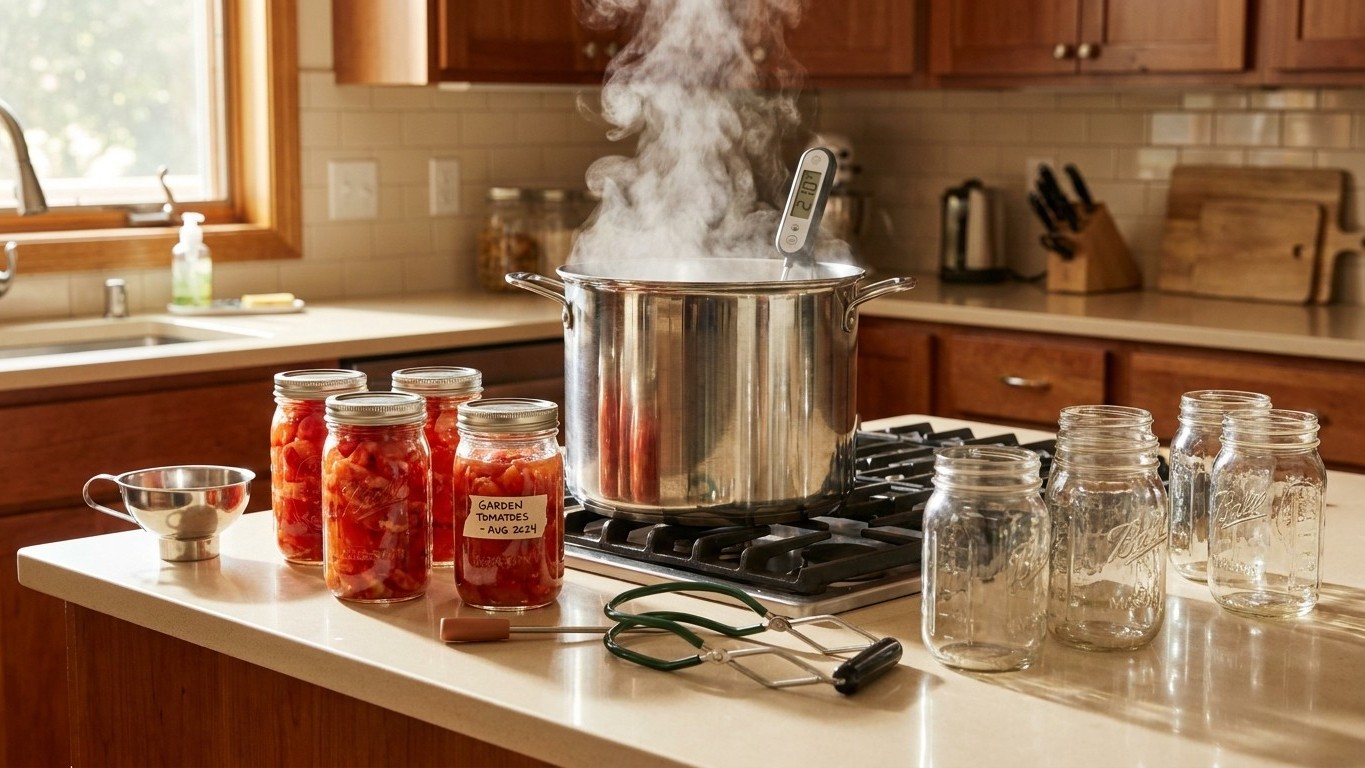

If you’re canning in Kansas City, Missouri’s most-cited reference point sits at 899 feet, and water there boils somewhere between 208°F and 212°F depending on the day’s barometric pressure. That’s low enough that it falls inside the lowest altitude band canning references use, the one running from 0 to 2,000 feet. For most tested recipes, this means little to no adjustment. But Kansas City is one city, not the whole state, and your own kitchen might sit somewhere else entirely.
The short answer

Kansas City, the reference city most often used for Missouri elevation figures, sits at 899 feet above sea level. Water at that elevation boils somewhere between 208°F and 212°F, according to the USDA’s Complete Guide to Home Canning as published by the National Center for Home Food Preservation. That’s a narrow window, and it lands well inside the first altitude band canning guides use for adjustments, the 0 to 2,000 foot band. For a home canner working at exactly that elevation, this is not a dramatic change. It’s the kind of altitude where a lot of tested recipes either require no adjustment at all or the smallest possible one.
Here’s the important caveat, and it matters more in Missouri than in a flatter state: 899 feet is Kansas City’s elevation, not Missouri’s. The state doesn’t have a single altitude any more than it has a single soil type. It stretches from river bottomland along the Mississippi and Missouri Rivers, sitting close to sea-level pressure, up through rolling plains and into the Ozark Plateau in the south, where ridges and hilltops climb well above that 899-foot figure. A canner working from a kitchen in the northern lowlands and one working from a kitchen on an Ozark ridge are not canning at the same elevation, even though both are in Missouri, and even though both might see “Missouri” listed as their location on a recipe card.
Why this figure, and why it’s not “the state’s altitude”
Canning altitude guidance is built around boiling temperature, not political geography. The number that matters is the elevation at your stove, because that’s what determines how hot your canner’s water actually gets when it boils. Kansas City gets used as a reference point because it’s a large, well-documented population center, and its elevation is precisely measured. But treating that number as if it applies statewide would be like assuming every kitchen in Colorado sits at Denver’s mile-high elevation. Missouri’s spread is smaller than Colorado’s, but it’s real, and for anyone canning outside the immediate Kansas City area, it’s worth confirming your own number before trusting the reference city’s.
Why a lower boil is a weaker process
The whole altitude issue comes down to one physical fact: water boils at a lower temperature as elevation increases. At sea level, water boils at 212°F. Climb higher and the atmospheric pressure pressing down on that water drops, so it takes less heat energy for water molecules to escape into vapor. The water boils, but it boils cooler. At 10,000 feet, for instance, water boils at around 194°F, nearly 20 degrees below the sea-level mark.
A cooler boil does less work. Canning relies on sustained heat to destroy microorganisms and enzymes inside sealed jars, and heat-based destruction is a function of both temperature and time. Drop the temperature and you need more time to get the same result, or in the case of pressure canning, more pressure to push the internal temperature back up to where it needs to be. This is the entire mechanism behind altitude adjustments. It isn’t about jars behaving differently at elevation, or lids sealing worse, or food spoiling faster in thinner air. It’s simply that the water surrounding those jars, or the steam building inside a pressure canner, is not as hot as it would be at sea level under the same “boiling” label.
This is also why cranking up the burner doesn’t fix anything. Once water is boiling, it has hit its maximum temperature for that elevation and pressure. Turning the heat higher makes it boil more vigorously, more bubbles, more visible motion, but it does not raise the temperature past that ceiling. A rolling boil at 6,000 feet is still capped at roughly 201°F, no matter how hard the burner works underneath it. Homeowners sometimes assume a more aggressive boil compensates for altitude. It doesn’t, and this misunderstanding is one of the more common reasons altitude adjustments get skipped by canners who genuinely believe their vigorous boil is “hot enough.”
What actually compensates is built into the two canning methods differently. In a boiling-water canner, the fix is more time, extending how long jars sit in that boiling water so the weaker heat still has enough duration to do its job. In a pressure canner, the fix is more pressure, because pressure raises the boiling point of water inside the sealed canner, effectively pushing the temperature back up toward what it would be at sea level. Neither fix is optional once you’re outside the lowest elevation band, and neither is something to estimate by feel.
Finding your own elevation
Kansas City’s 899 feet is a data point, not a substitute for your own address. Before you can know whether your recipe needs any adjustment at all, you need your own elevation, and the National Center for Home Food Preservation publishes a page specifically for this called “Find Your Elevation.” Here’s the order to work through it:
- Start with your home address or the zip code closest to where you’ll actually be processing jars, not a nearby city you happen to think of as your “area.”
- Go to the NCHFP’s Find Your Elevation page and enter that location into the tool provided there.
- Note the elevation figure it returns in feet, since canning references organize their adjustment tables by foot-based bands rather than meters.
- Compare that number against the altitude band listed in your specific tested recipe, whether it’s a boiling-water canning table or a pressure canning table, since the two methods use separate adjustment schedules.
- If your kitchen sits near the boundary between two bands, err toward the higher band rather than assuming the lower one applies, since a slightly longer process or slightly higher pressure carries no safety downside.
- Recheck this if you can, garden, or process at a second location, like a relative’s kitchen, a cabin, or a community canning kitchen, since that elevation may differ from your primary one.
This isn’t a one-time lookup you commit to memory and reuse forever, especially if you can in more than one place. A property in the river lowlands and a property up in the Ozarks can differ by hundreds of feet, and that difference is exactly what separates “no adjustment needed” from “adjustment required.”
What goes wrong
- An under-processed jar that looks perfectly normal. A jar canned at the sea-level time despite sitting at a higher elevation can seal, look clear, and show no spoilage signs at all, while still failing to reach a safe internal temperature during processing. The fix is straightforward: match your process time or pressure to your actual elevation band before you can, not after you notice a problem, because there’s usually nothing to notice.
- A recipe pulled from a sea-level source. Family recipe cards, older cookbooks, and recipes shared from friends in low-lying states often carry processing times calibrated for elevations near sea level. Using one of these without adjusting for your own elevation carries the process time straight into unsafe territory if you’re canning anywhere above the lowest band. The remedy is to treat every inherited or informal recipe as a starting point, then cross-check its process time against your elevation using a current tested source rather than assuming the card in front of you already accounts for where you live.
- A pressure gauge read as if elevation didn’t exist. Dial gauges and weighted gauges on pressure canners are calibrated to deliver specific pressures, but the pressure required to reach a safe temperature climbs as elevation climbs. Setting a gauge to the same pressure you’d use at sea level, out of habit or because that’s the number on an old recipe, undercooks the load at higher elevations. The fix is checking your canner’s gauge against your specific elevation band every time you can, not just the first time you learned to use the appliance.
Where the exact adjustment comes from
This page won’t hand you a processing time or a canner pressure, and that’s deliberate. The right adjustment depends on the specific food you’re canning, the size of your jars, and your exact elevation band, and that information lives inside tested recipes, not in a general explainer about altitude. Guessing at a number, or averaging one from two different sources, is how safe canning turns into a gamble.
For the actual figures, go to the National Center for Home Food Preservation’s tested recipes and processing guidelines, where adjustments are listed alongside the specific food and jar size they apply to. The reason this matters more than it might seem: botulinum toxin, the danger behind under-processed low-acid canned food, has no taste and no smell. A jar can look, smell, and taste completely normal and still be unsafe. There’s no way to catch the mistake by inspection, which is exactly why the tested time or pressure has to be right the first time.
Common questions
Does Kansas City’s elevation apply to my part of Missouri?
Not necessarily. Kansas City’s 899 feet is a reference point, but Missouri spans lowland river areas and higher Ozark terrain, so your own elevation could sit in a different band entirely. Look up your specific location rather than assuming the reference city’s figure covers you.
If my water is boiling hard, does that mean it’s hot enough?
No. Once water reaches boiling, it’s already at its maximum temperature for that elevation and pressure. Boiling harder makes it more vigorous, not hotter, so a rolling boil at higher elevation is still cooler than a gentle boil at sea level.
Do I need to adjust for altitude every single time I can?
You need to check your elevation against whatever tested recipe you’re using each time, particularly if you can in more than one location. A basement kitchen and a relative’s cabin at a different elevation can fall into different bands even within the same general area.
Where do the official adjustment numbers come from?
The National Center for Home Food Preservation, working from the USDA Complete Guide to Home Canning, publishes the tested adjustments by food type, jar size, and elevation band. Those are the only figures worth relying on for actual processing.