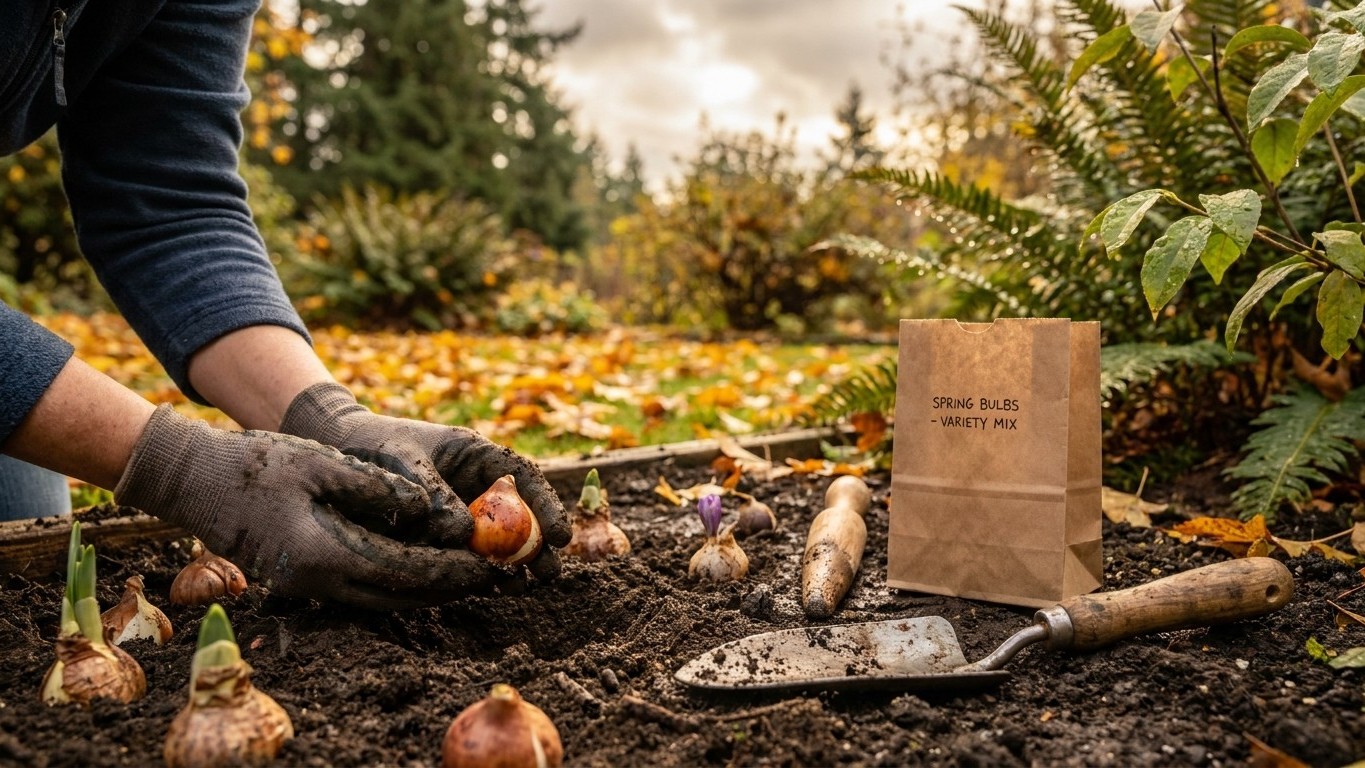

Western Washington’s cool, wet winters answer the two questions every bulb catalog assumes you already know: when to plant, and whether your ground gets cold enough to make flowers instead of leaves. Using Seattle as the reference point, the short version is yes, with room to spare, though the picture changes fast east of the Cascades and at higher elevations.
When to plant bulbs in Washington

The planting window for spring bulbs in western Washington runs through October and into early November, timed against a first fall frost that NOAA’s 1991-2020 climate normals place between November 13 and November 30 at the Seattle reference station. The rule of thumb gardeners lean on, roughly six weeks of rooting time before the ground turns cold, points to planting from early October through mid-November in most years. For gardeners weighing whether pots make more sense than open ground, Growing Spring Bulbs in Containers in Washington covers how that same timing applies when bulbs go into containers instead.
Plant too early and the bulb sits in soil still warm from summer. It responds the way any bulb would: it pushes soft top growth before winter arrives, and that growth gets killed back by the first hard cold snap, weakening the bulb for its actual bloom the following spring. Plant too late and the opposite problem shows up. The bulb goes into the ground without enough time to grow the root system it needs, and what comes up in spring is thin, short-stemmed, or absent altogether. Gardeners who’d rather sidestep these outdoor timing risks entirely can look into Forcing Spring Bulbs Indoors in Washington, which uses controlled refrigeration instead of the region’s unpredictable soil and frost conditions.
The frost date is an average, not a promise
That November 13 to November 30 window is a probability band, not a guarantee. It marks the range where the odds of a 32F freeze sit between 30 and 70 percent, which means in roughly half of all years, the first freeze lands earlier or later than this stretch. A gardener who plants right at the calendar deadline is gambling on an average holding true in a system that, by definition, misses that average constantly. Building in a buffer, aiming for the earlier half of the window rather than the tail end, costs nothing and protects against the years frost arrives ahead of schedule.
One more wrinkle specific to this region: a mild frost date does not translate into permission to plant early. Western Washington’s cold, wet soil and low fall light levels hold root development back even when the air temperature says there’s still time. The frost date sets the outer limit, not the ideal moment.
Whether your winter is cold enough
Every spring bulb needs a real stretch of cold to flower. Most varieties, tulips, daffodils, hyacinths, require somewhere between twelve and fourteen weeks with soil temperatures below about 45F. Skip that requirement and the bulb doesn’t die, but it doesn’t perform either: it puts out leaves with no flower, or a flower bud so short and buried it never clears the soil line. This is the number to hold onto no matter where you garden, because it’s the yardstick for judging any bulb you’re offered, in any catalog, in any climate.
Seattle’s coldest month has a mean daily minimum of 37.1F, well under that 45F threshold, and the region’s cool maritime winters keep soil in that cold range for an extended stretch, typically from mid-November well into March. That’s a wide margin over the twelve-to-fourteen-week minimum most bulbs ask for. The practical upshot: gardeners near Seattle and through most of western Washington’s lowlands can plant standard tulips, daffodils, hyacinths, crocus, and alliums straight into the ground with no pre-chilling step required. The cold arrives on its own, and it stays long enough to do the job.
That’s a real advantage over warmer-winter regions, where gardeners have to fake this cold spell artificially: twelve weeks in a refrigerator crisper drawer, kept well away from ripening apples, pears, or bananas, because the ethylene gas those fruits give off kills the flower bud forming inside a chilling bulb. Skip that precaution in a climate that needs it, and the bulb looks fine going into the ground but produces nothing worth the wait. Western Washington gardeners can skip the whole exercise. Eastern Washington’s colder, drier winters clear the same threshold just as easily, though the season there behaves differently in duration and timing, which is exactly why the county-level check in the last section of this article matters.
| Bulb | Cold required | What western WA delivers | Verdict |
|---|---|---|---|
| Tulips | 12-14 weeks below 45F | Roughly Nov-Mar below 45F | Meets requirement, no pre-chill needed |
| Daffodils | 12-14 weeks below 45F | Roughly Nov-Mar below 45F | Meets requirement, no pre-chill needed |
| Hyacinths | 12-14 weeks below 45F | Roughly Nov-Mar below 45F | Meets requirement, no pre-chill needed |
| Crocus | 12-14 weeks below 45F | Roughly Nov-Mar below 45F | Meets requirement, no pre-chill needed |
| Alliums | 12-14 weeks below 45F | Roughly Nov-Mar below 45F | Meets requirement, no pre-chill needed |
Which bulbs suit Washington
The USDA Plant Hardiness Zone Map places Washington across a wide range, zone 4a through zone 9a, built from average annual extreme minimum temperatures over the 1991-2020 period. Seattle itself sits toward the milder end of that range. Bulbs whose hardiness rating falls anywhere inside 4a-9a have a reasonable shot here, and combined with the cold-hours math above, several stand out as reliable choices:
- Daffodils (hardiness zones 3-9)
- Tulips (hardiness zones 3-8)
- Crocus (hardiness zones 3-8)
- Hyacinths (hardiness zones 4-8)
- Alliums (hardiness zones 3-9)
- Grape hyacinth, Muscari (hardiness zones 4-8)
- Snowdrops (hardiness zones 3-7)
- Fritillaria (hardiness zones 3-8)
A hardiness range is a rough guide, not a border wall. A bulb rated to zone 8 might sail through a mild winter in a sheltered spot near a south-facing wall and struggle in an exposed bed a few miles away where cold air pools. Microclimate matters as much as the map.
On the other side of the ledger, tender bulbs rated to zones 9 or 10, like freesia and ranunculus, run into two separate problems here. In the coldest pockets of the state, especially inland and at elevation, they simply fall outside their hardiness range and freeze out over winter. But even in mild coastal Washington where the temperature itself wouldn’t kill them, the region’s wet winter soil does the damage instead: these bulbs rot in standing moisture long before spring arrives. A gardener who plants freesia expecting a repeat performance the following year is usually disappointed by a bed that never comes back, or comes back as mush.
What digs them up here
Squirrels and voles aren’t random about what they dig up. It comes down to chemistry. Daffodils and every bulb in the allium family, including ornamental onions and chives, contain compounds that make them bitter or mildly toxic to rodents, so they get left alone in the ground. Tulips and crocus have no such defense. They’re essentially rodent food, and a freshly planted bed of either one is an open invitation.
- Bulbs squirrels and voles dig up: tulips, crocus
- Bulbs squirrels and voles leave alone: daffodils, alliums, hyacinths, muscari, fritillaria, snowdrops
For tulips and crocus, the one measure that consistently works is physical, not chemical: lay galvanized wire mesh flat over the planting area and pin it down, leaving it in place through the fall and winter months when digging pressure is highest. Because western Washington’s ground rarely freezes hard for long stretches, the mesh needs to stay down longer here than it would in a harder-freezing climate, essentially through the whole rodent-active season rather than just until the first freeze. Repellent sprays, by contrast, have a track record of failing here specifically because they wash off in the first heavy rain, and this region gets no shortage of those.
Where to check for your own county
Every figure in this article, the frost dates, the coldest-month minimum, the hardiness zone reference, traces back to Seattle as a single reporting station. Washington spans a huge amount of ground between the Puget Sound lowlands and the high desert east of the Cascades, and a planting calendar built around the state’s largest city can be off by two or three weeks once you’re gardening in Spokane, the Okanogan Valley, or up in the foothills. The mild, maritime pattern behind the Seattle numbers doesn’t hold once you cross the mountains into a shorter, colder, drier growing season.
Washington State University Extension maintains the land-grant service for the state, with county offices that track local frost dates, soil conditions, and planting windows specific to their own ground. Calling or checking in with the county office nearest your garden is the fastest way to confirm whether the six-week planting rule and the cold-hours math above apply to your yard as written, or need adjusting for your particular corner of the state.