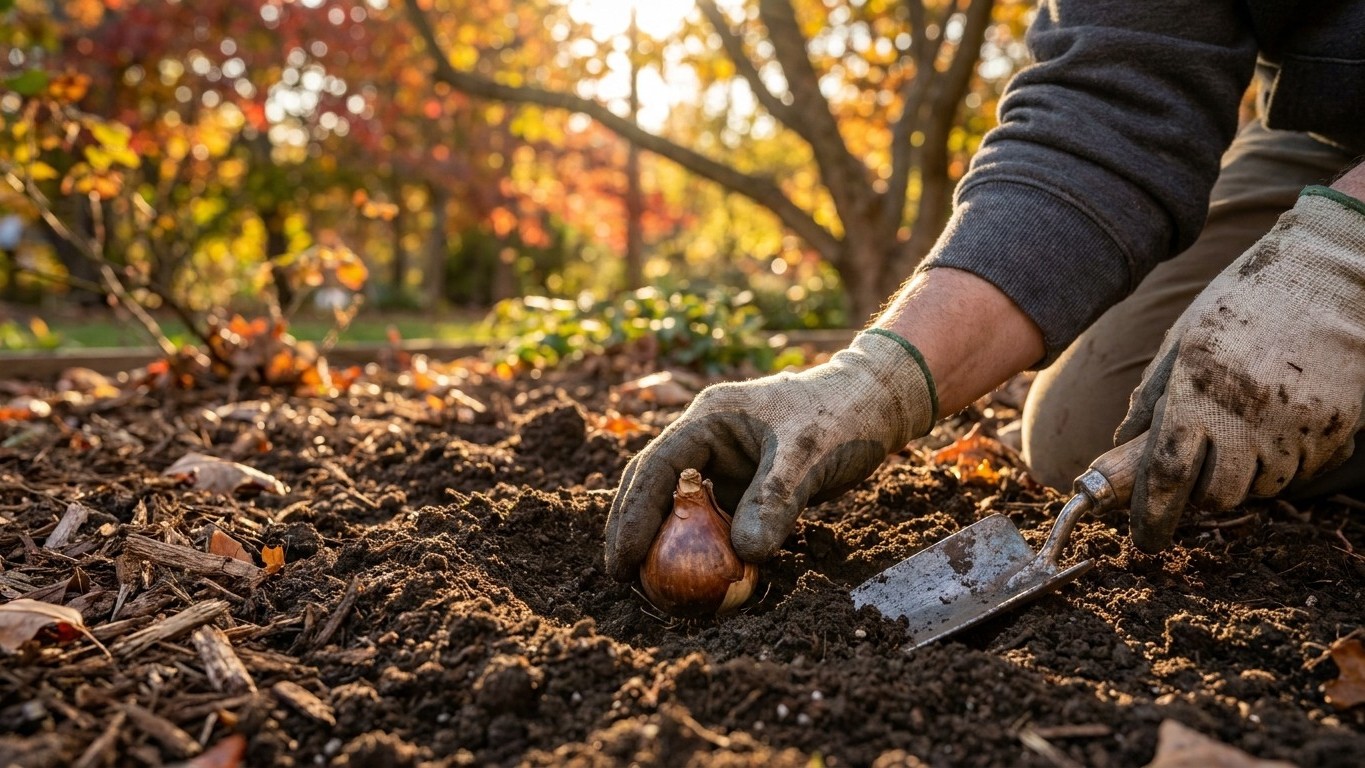

Spring bulbs go into Maryland soil once the ground has cooled but before it locks up hard, and the good news is simple: this state’s winters run cold enough, and long enough, to satisfy nearly every classic spring bulb without any extra work. The exception is narrow, and it’s worth knowing before you buy a single bag of tulips. If your soil situation makes in-ground planting tricky, Growing Spring Bulbs in Containers in Maryland offers an alternative worth considering, and Forcing Spring Bulbs Indoors in Maryland is another route for gardeners who want blooms without waiting on the ground at all.
When to plant bulbs in Maryland

The target date anchors on the first fall frost, which in Maryland’s reference station falls between October 26 and November 5, according to NOAA’s 1991-2020 Climate Normals. Work backward about six weeks from that window, and you land on the stretch that runs roughly from mid-September through mid-October as the safest planting period for daffodils, tulips, crocus, and hyacinths.
Plant too early and the soil is still warm enough to coax the bulb into pushing top growth. That green shoot has no defense against a hard freeze, and a gardener who plants in August often finds mush where a daffodil should be come January. Plant too late, on the other hand, and the bulb goes into ground that’s already cooling toward frozen. Roots need four to six weeks of relatively mild soil temperatures to establish before winter dormancy sets in fully. A bulb dropped in the ground in late November in Maryland has had almost no time to root, and it shows the following spring: shorter stems, fewer flowers, sometimes nothing at all.
The frost date is an average, not a promise
That October 26 to November 5 window is a statistical range built from thirty years of data. Half of all years in Maryland fall on one side of that band or the other. Some seasons bring frost in early October; others push it into mid-November. Treat the window as a planning guide, not a deadline etched in stone, and lean toward the earlier end if you’re working with heavy clay soil that holds warmth longer than sandy loam does.
Western Maryland, particularly Garrett and Allegany counties, sits at higher elevation and in the mountains, so frost typically arrives weeks earlier there than it does along the coast. The Eastern Shore runs milder and later. A planting calendar built around the Baltimore reference point can be genuinely wrong at either edge of the state, which is a theme worth keeping in mind as you read further.
Whether your winter is cold enough
Here’s the number that decides everything: a spring bulb needs roughly twelve to fourteen weeks with soil temperatures below about 45°F to complete the internal process that produces a flower. Skip that cold exposure, and the bulb still grows leaves, sometimes vigorously, but the flower bud inside never finishes developing. You get green foliage and no bloom, or a flower stalk so short it never clears the leaves. This is the single most useful figure in bulb gardening, because it lets you evaluate any variety a nursery or catalog offers, regardless of where you garden.
Maryland’s coldest month brings a mean daily minimum temperature of 25.4°F, measured at the Baltimore reference station over the 1991-2020 period. That’s more than 19 degrees below the 45°F threshold that matters for bulb chilling, and it holds for the bulk of the winter, not just a few isolated nights. In practical terms, Maryland soil stays cold enough, for long enough, to satisfy the chilling requirement of virtually every commonly sold spring bulb without any intervention from the gardener.
The chilling math, bulb by bulb
The table below lines up the usual suspects against their published chill requirements and Maryland’s actual winter conditions. The pattern is consistent: this state clears the bar with room to spare.
| Bulb | Chill weeks required | Maryland’s winter | Verdict |
|---|---|---|---|
| Tulip | 12-16 weeks below 45°F | Below 45°F for essentially the entire winter (coldest month mean min 25.4°F) | Clears requirement, no pre-chilling needed |
| Daffodil | 12-14 weeks below 45°F | Same | Clears requirement comfortably |
| Hyacinth | 12-15 weeks below 45°F | Same | Clears requirement |
| Crocus | 8-15 weeks below 45°F, depending on species | Same | Clears requirement across the board |
| Allium | 8-10 weeks below 45°F | Same | Clears requirement easily |
Because Maryland’s winter delivers so far beyond what any of these bulbs need, there’s no reason to pre-chill anything you plant directly in the garden. Pre-chilling, which means storing bulbs in a refrigerator for about twelve weeks before planting, matters in places where winter soil never gets cold enough on its own, typically warmer parts of the Deep South or coastal Southern California. That’s not Maryland’s problem. If you do force bulbs indoors for winter bloom, the same twelve-week refrigerator rule applies, and the bulbs need to sit away from apples, bananas, or any ripening fruit, because the ethylene gas those fruits release can kill the flower bud before it ever gets planted. A gardener who plants tulips in a climate that can’t deliver the chill wastes the bulb and the money. Maryland simply isn’t that climate.
Which bulbs suit Maryland
Maryland’s hardiness range spans USDA zones 5b to 8a, based on the 2023 Plant Hardiness Zone Map, which is built on one measurement: average annual extreme minimum temperature. That range covers nearly every spring bulb sold at garden centers, and combined with the chilling numbers above, it makes Maryland one of the more forgiving states in the mid-Atlantic for classic spring color.
Bulbs that thrive here
- Daffodil (Narcissus), hardy zones 3-8
- Tulip (Tulipa), hardy zones 3-8
- Crocus, hardy zones 3-8
- Hyacinth, hardy zones 4-8
- Allium, hardy zones 3-9
- Grape hyacinth (Muscari), hardy zones 4-8
- Snowdrop (Galanthus), hardy zones 3-7
All of these fall comfortably inside Maryland’s 5b-8a range, and none of them ask for more cold than the state’s winter already provides.
Bulbs that disappoint here
A handful of spring bulbs sold in national catalogs are bred for climates milder than Maryland’s, and they show their limits fast. True freesia and ranunculus, both rated for zones 8-10, tend to rot in a wet Maryland winter rather than survive it; gardeners who plant them in the ground as perennials usually lose the bulb by February. Some of the showier ranunculus and anemone varieties marketed for fall planting are really built for the Pacific Northwest or the Southeast coast, and in Maryland’s clay-heavy soils, standing winter moisture does more damage than the cold does.
Hardiness ranges aren’t hard lines, though. A tulip rated to zone 8a can still limp along in a protected, south-facing bed against a brick foundation in a borderline spot, while the same variety planted in an open, wind-exposed field a few miles away might fail outright. Microclimate matters as much as the map.
What digs them up here
Squirrels and voles don’t raid every bulb bed equally, and the reason comes down to chemistry rather than chance. Daffodils and other members of the amaryllis family contain lycorine, a compound that makes them bitter and mildly toxic, so most rodents leave them alone. Alliums, being onion relatives, carry a similarly unappealing chemical profile. Tulips and crocus have none of that protection. Their bulbs are starchy and, to a squirrel or a vole, genuinely tasty, which is why freshly planted tulip beds so often turn into a dig site by the next morning.
Bulbs squirrels and voles target
- Tulip
- Crocus
- Some lily species
Bulbs they generally leave alone
- Daffodil
- Allium
- Snowdrop
- Grape hyacinth (less consistently, but rarely a first choice)
The one physical barrier that consistently works is a layer of galvanized wire mesh laid directly over the planting area and pinned down until the ground freezes solid, at which point digging becomes too much work for most animals to bother. Repellent sprays and granules, by contrast, wash off with the first good rain and need constant reapplication to do anything at all. If you’re planting tulips or crocus in a yard with an active squirrel population, the mesh is the investment worth making, not the spray bottle.
Where to check for your own county
Every figure in this guide traces back to a single reference station in Baltimore, and Maryland is a bigger, more varied place than one city can represent. The state stretches from the mountains of Garrett County, where frost arrives weeks earlier than it does downtown, to the flat, moderating influence of the Chesapeake Bay on the Eastern Shore, where frost holds off later. A planting window built for the state’s population center can run three weeks off in either direction once you’re near the western border or out on the coastal plain.
The most reliable next step is checking with the University of Maryland Extension, the state’s land-grant extension service, and specifically with your county’s local office. County agents track soil temperatures and frost timing for their exact area, and they can tell you whether your particular yard, especially if it sits in a frost pocket or on an exposed hilltop, needs an earlier or later planting date than the general state guidance suggests.