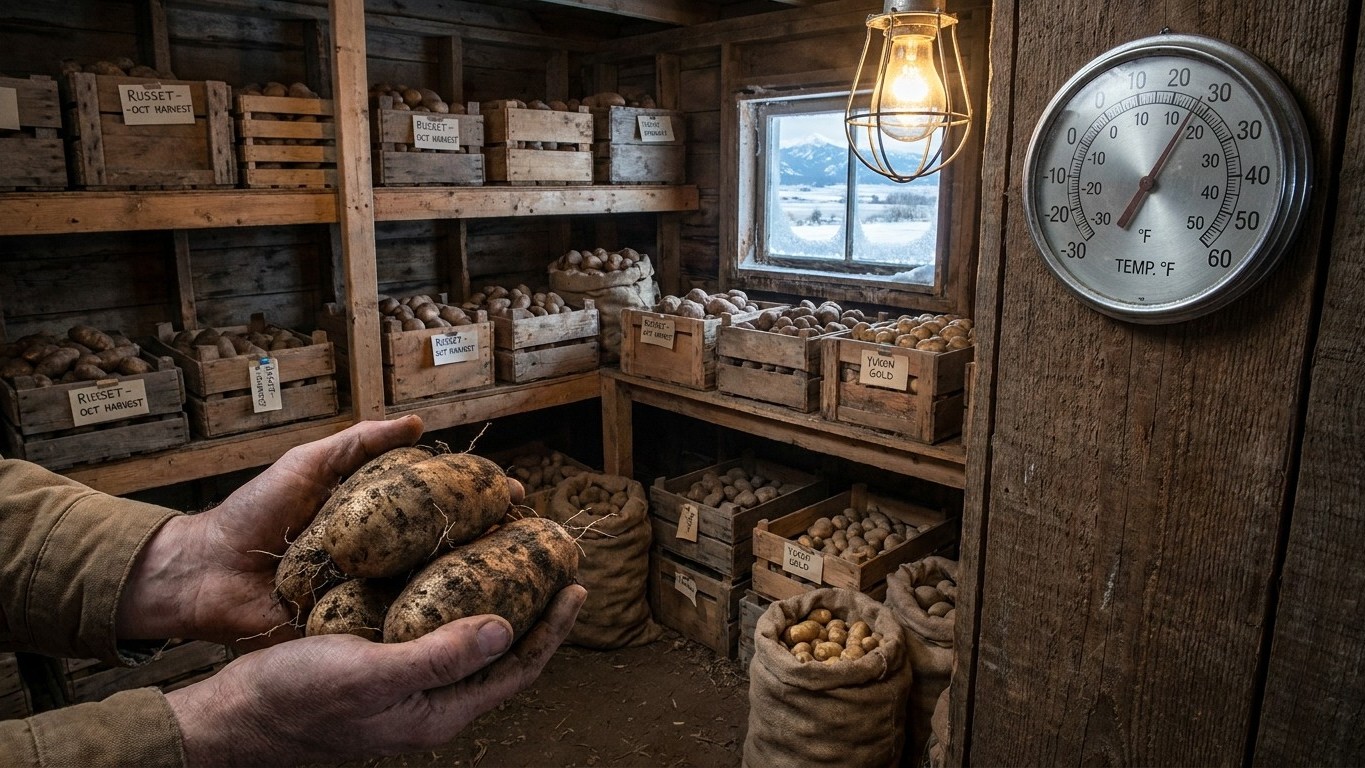

In Montana, dig potatoes before the first fall frost hits, typically between October 1 and October 14 in the milder valleys. Cure them at 55-60°F for two to three weeks, then move them to storage that holds steady at 40-45°F. Because the state’s coldest month averages a nightly minimum of just 17.9°F, an unheated shed or garage will freeze the crop solid. You need a basement, root cellar, or insulated space to get through winter.
The short answer
Two numbers decide everything about growing and keeping potatoes here. The first is the frost window: October 1 to October 14, based on NOAA NCEI 1991-2020 climate normals for the Billings area. The second is the coldest month’s mean minimum, 17.9°F, also from Billings. Neither number is a coincidence of timing. They’re the boundaries you work inside, whether you’re pulling tubers from the row or deciding where the sacks spend January.
The frost date tells you when to stop waiting and start digging. Potatoes left in the ground after a hard freeze suffer cell damage that shows up later as soft, discolored flesh in storage. So the harvest window closes fast once that October 1-14 range arrives. Growers who push past it, hoping for another week of bulking, are gambling against a date that NOAA has already mapped from three decades of data.
The second number, 17.9°F, is the one that ruins winters for anyone storing potatoes in an unheated outbuilding. That figure is a mean minimum, not a record low and not a monthly average. It means that on a typical night in the coldest month, temperatures in the Billings area drop to around 18°F, and colder nights are common on either side of that mean. A garage or shed with no heat source and no insulation will track close to outdoor air once the sun goes down. There is no scenario where such a space holds 40-45°F through a Montana winter. It will freeze, and freezing turns stored potatoes into a starchy, sweet, mushy mess as the starch converts to sugar and the cell walls rupture.
One caution matters here: Billings sits in one of Montana’s milder valleys. Higher and more remote valleys across the state can see frost in any month of the year, meaning the October 1-14 window doesn’t apply evenly statewide. If you’re gardening at elevation or in a mountain basin, your local frost risk runs earlier and harder than what the Billings reference station shows. Treat the state-level number as a starting point, not a guarantee for your particular yard.
Curing, and where
Utah State University Extension recommends curing freshly dug potatoes at 55-60°F with high humidity for two to three weeks before storage. That step matters because curing lets the skin thicken and heals over small nicks and bruises from digging, which is what keeps rot from taking hold later. The challenge in Montana is finding a spot that actually holds that temperature range in early-to-mid October, right when nighttime lows are already sliding toward freezing.
- Dig on a dry day, ahead of the frost window. Aim to have tubers out of the ground before October 1 if you’re in a valley prone to early cold, giving yourself margin before the October 1-14 frost date arrives.
- Brush off soil, but don’t wash the potatoes. Washing adds moisture that slows curing and invites rot; a dry brush-off is enough.
- Find an indoor space that reads 55-60°F. A shaded porch works only in early fall before nights turn cold; once temperatures start dropping toward the frost window, a porch in Montana is too unpredictable. A basement is usually the better bet, since below-grade spaces stay more insulated from swinging outdoor air. An attached garage can work if it’s insulated and not directly exposed to outside temperatures, but a detached, uninsulated garage will already be too cold most years by mid-October.
- Keep humidity high. Covering the tubers loosely with burlap or damp cloth in the curing space helps maintain the moisture level USU specifies, without letting them sit in standing water.
- Hold for two to three weeks. Resist moving potatoes into cold storage early. Skipping or shortening the cure is one of the most common reasons stored potatoes rot before winter even sets in.
The basement advantage in Montana isn’t small. Below-grade spaces are buffered by the surrounding soil, which means they lag behind outdoor temperature swings by days or weeks. That lag is exactly what lets a basement hold the 55-60°F curing range even as the yard outside is already flirting with frost.
Storing through this winter
Once cured, potatoes want dark storage at 40-45°F according to Utah State University Extension, or 38°F at 95 percent humidity according to the University of Maine Cooperative Extension. Both ranges sit well above freezing and well below room temperature, which is a narrower band than most Montana homes naturally offer without some adjustment.
Set that target against the coldest month’s mean minimum of 17.9°F, and the mismatch is obvious. Any storage space with no insulation and no supplemental heat will track close to outdoor temperatures overnight, meaning it can dip 20 degrees or more below the low end of the safe storage range. A root cellar dug into the ground, or a basement corner away from heating ducts, tends to fare far better because the earth itself moderates the swing. Concrete basements in particular hold a more stable, moderate temperature through winter than any above-ground outbuilding will in a Montana climate.
The flip side matters too. A heated basement or a spot too close to a furnace can easily creep above 45°F, and warmth is what triggers sprouting and speeds up the sugar-starch conversion that softens texture and dulls flavor. The goal isn’t just avoiding cold, it’s threading a narrow window between “cold enough to stay dormant” and “not so cold it freezes.” In practice, that usually means an unheated but insulated basement room, a cellar with some earth contact, or a chest built for root-cellar storage inside an otherwise heated structure. Wrapping storage containers or building a simple insulated box inside a basement can also help buffer against the coldest nights of January and February, when outdoor lows regularly approach or beat that 17.9°F mean.
Checking on stored potatoes periodically through winter isn’t just good practice, it’s a rough thermometer for your storage space. If you find sprouting, the space is running too warm. If you find a mushy, watery tuber, something in that batch likely froze. Either sign is worth investigating before the whole stock is affected.
What goes wrong here
- Digging after the first frost. Waiting past the October 1-14 window in hopes of bigger tubers risks freeze damage to the crop still in the ground. Dig ahead of the window, especially in higher or more exposed valleys where frost can arrive even earlier than the Billings reference date.
- Curing in a space that’s already too cold. An unheated porch or detached garage often can’t hold the 55-60°F range USU calls for once October’s colder nights set in. Move curing indoors to a basement or insulated room instead.
- Storing in an unheated shed or garage. With the coldest month averaging a 17.9°F mean minimum, any uninsulated outbuilding will freeze stored potatoes well before spring. Use a basement, root cellar, or insulated indoor space instead.
- Storage that runs too warm. A spot near a furnace or heating duct can push past 45°F, causing early sprouting and softer texture. Relocate storage away from heat sources, or add a layer of insulation between the containers and the warm air.
- Skipping the cure entirely. Moving freshly dug, uncured potatoes straight into cold storage leaves nicks and bruises unhealed, and those spots are where rot starts. Always allow the full two to three weeks USU recommends before moving tubers to their winter spot.
- Assuming every part of Montana matches Billings. Mountain valleys can see frost in any month, meaning the October 1-14 window is a starting reference, not a statewide guarantee. Gardeners at elevation should watch local conditions and dig earlier if frost threatens sooner.
Common questions
When should I dig potatoes in Montana?
Aim to have your crop out of the ground before the first fall frost, which falls between October 1 and October 14 in the Billings area according to NOAA NCEI climate normals. Gardeners in mountain valleys should watch local conditions closely, since those areas can frost earlier and in any month.
Will an unheated garage keep potatoes all winter?
No. With the coldest month’s mean minimum sitting at 17.9°F, an uninsulated, unheated garage or shed will track close to outdoor temperatures overnight and freeze stored potatoes. A basement, root cellar, or insulated indoor space is needed to hold the 40-45°F range Utah State University Extension recommends.
How long do potatoes need to cure before storage?
Utah State University Extension recommends curing at 55-60°F with high humidity for two to three weeks before moving potatoes into long-term storage. Skipping or shortening this step increases the risk of rot from unhealed nicks and bruises.
What’s the ideal storage temperature for potatoes?
Utah State University Extension lists 40-45°F, while the University of Maine Cooperative Extension specifies 38°F at 95 percent humidity. Both ranges call for dark, stable conditions well above freezing but below room temperature, which in Montana usually means a basement or root cellar rather than an outbuilding.