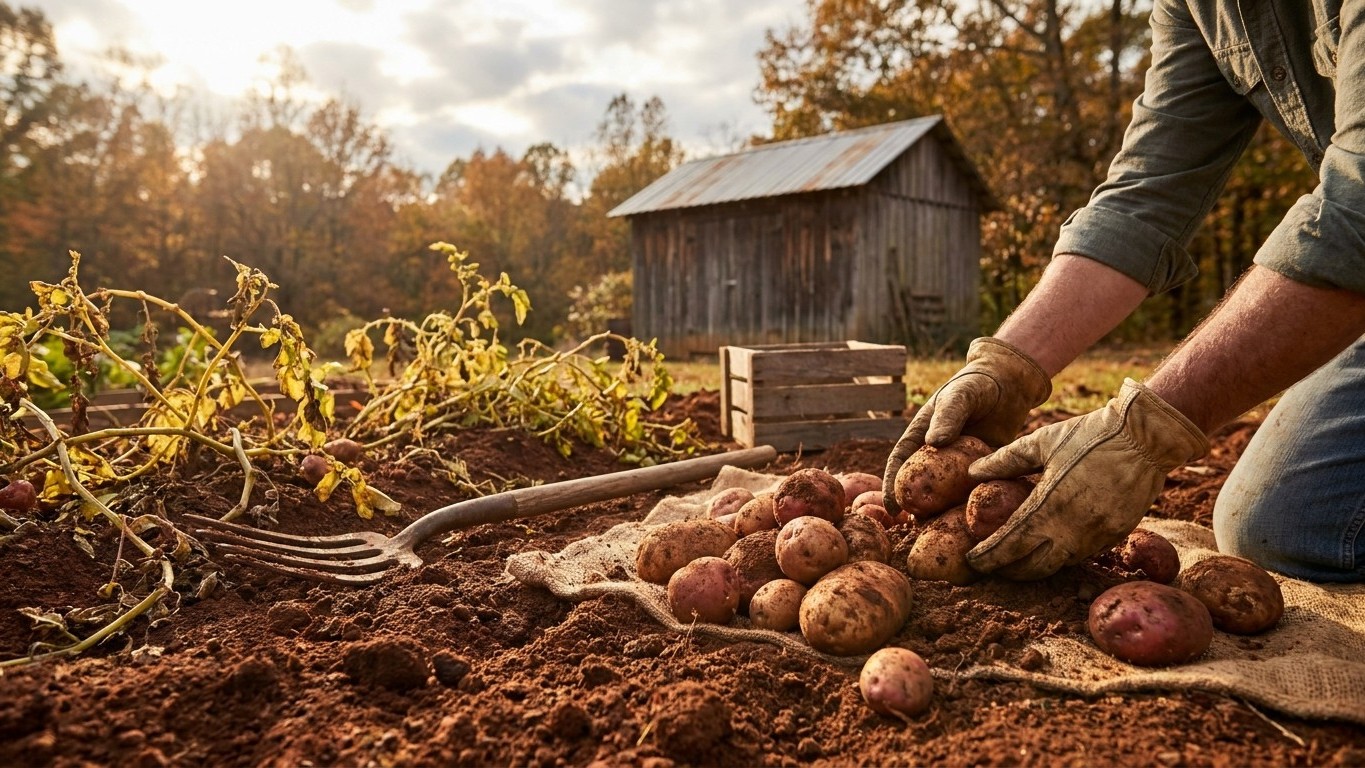

West Virginia growers dig potatoes ahead of the region’s first fall frost window, which lands October 18 to November 1 in the Charleston valley and comes noticeably sooner at higher elevations. After that, the crop needs two to three weeks of curing near 55-60 F before it goes into storage that holds 40-45 F. Most unheated sheds and garages in this state won’t hold that range once the coldest month settles in, so the storage spot matters as much as the harvest date.
The short answer
Two numbers drive everything here. The first is the fall frost window itself: October 18 to November 1, based on NOAA NCEI’s 1991-2020 Climate Normals for the Charleston station. The second is the mean minimum temperature of the coldest month, 26.1 F, also from NOAA NCEI’s Climate Normals for that same reference station. Neither number is a record low. Both describe what happens on an ordinary night, which is exactly what matters for a crop sitting in a bin all winter.
That frost window tells you when to get the crop out of the ground. Foliage dies back once temperatures drop into the low 30s, and tubers left in cooling soil after that point start to lose the storage life you’re trying to bank. In the Charleston valley, growers have until roughly the last week of October before that window opens. Away from the river valleys, at the elevations that make up much of the state’s potato-growing ground, frost typically arrives earlier, sometimes by a couple of weeks, so a harvest date that works in Charleston can leave a hillside crop caught in the ground.
The second number, that 26.1 F coldest-month minimum, answers a different question: will an unheated space keep potatoes at 40-45 F all winter? The answer, for most detached garages and uninsulated sheds in this state, is no. A structure with no thermal mass and no heat source tracks outdoor air closely, and outdoor air here regularly sits in the mid-20s on winter nights. That’s cold enough to freeze stored potatoes solid, which ruins the crop as completely as leaving it in the ground too long. A basement corner, a root cellar dug into a bank, or any storage space with some contact with the ground has a much better shot at staying in range, because soil temperature lags far behind air temperature and rarely drops anywhere near 26 F even in the depths of winter.
So the short version: harvest before the frost window closes, watch that window shift earlier as you climb in elevation, and don’t count on an unheated outbuilding to hold the 40-45 F storage target once the coldest month arrives.
Curing, and where
Utah State University Extension puts the curing target at 55-60 F with high humidity, held for two to three weeks before potatoes go into longer-term storage. That window matters because curing lets the skin thicken and small wounds from digging seal over, which is what keeps a stored potato from rotting from the inside out. The trick in West Virginia is finding a spot that sits in that band during the exact weeks you’re harvesting, which is mid-to-late October for most growers.
- Dig on a dry day, ahead of the frost window. Wet soil clinging to freshly dug tubers holds moisture against the skin and slows the whole curing process.
- Brush off soil without washing. Water on the skin at this stage encourages the rot that curing is meant to prevent.
- Move the crop to a shaded, ventilated spot out of direct sun. A covered porch or a basement stairwell landing works well in a Charleston-valley October, when daytime highs still commonly sit in the 55-60 F range and the space is naturally out of the sun.
- Check the actual temperature, don’t guess it. A garage with a north-facing door can run cooler than the porch, and at elevation, overnight temperatures can already be dipping close to freezing by the time harvest happens, which pulls a garage’s average well below the 55-60 F target.
- Keep humidity up. Loosely covering the crop with damp burlap, or curing in a space with some natural dampness like a basement, keeps skins from shriveling during the two-to-three-week window.
- Move to final storage once the two to three weeks are up. Don’t leave cured potatoes sitting in the curing spot waiting for a “better” storage day. Once cured, they’re ready.
For most West Virginia growers, a basement stairwell, an enclosed but unheated porch, or a similarly shaded interior space beats a garage for curing, simply because those spaces track more slowly with outdoor swings and are less likely to dip below the target as the season turns colder.
Storing through this winter
Storage asks for a different, colder band than curing. Utah State University Extension puts long-term storage at 40-45 F in the dark, while the University of Maine Cooperative Extension gives a tighter figure of 38 F at 95 percent humidity. Either target shares the same enemy in West Virginia: a coldest-month mean minimum of 26.1 F means an unheated space can swing well below both numbers on an average winter night, not just an unusually cold one.
That’s the cross to watch. A detached, uninsulated shed or garage has no buffer against outdoor air, so once nighttime lows settle into the mid-20s, which is normal for the state’s coldest month, stored potatoes in that kind of space are at real risk of freezing. A frozen potato turns soft and discolored once it thaws, and there’s no fixing that after the fact. On the other side of the problem, a heated basement or a mudroom that stays in the 60s all winter is too warm for either the USU or the Maine target, and potatoes held that warm sprout early and lose eating quality well before spring.
The sweet spot in most West Virginia homes is a basement space that isn’t actively heated but also isn’t exposed to outside air, or a true root cellar with earth contact on at least one side. Ground temperature a few feet down changes far more slowly than air temperature, so a cellar dug into a hillside or a basement corner away from ductwork and furnace heat tends to sit closer to the 38-45 F range through the winter, even when outdoor lows are sitting well below freezing. If you’re working with a garage or an outbuilding instead, insulating it and adding even a small heat source to prevent freezing becomes necessary once the coldest month arrives, because the space alone won’t hold the line.
Darkness matters as much as temperature for both authorities. Light exposure turns potato skins green and bitter regardless of how well the temperature is managed, so whatever space you choose, block light with a cover, a bin lid, or opaque curtains rather than relying on a dim corner alone.
What goes wrong here
- Frost catches the crop before it’s dug. This hits growers at elevation hardest, since frost arrives earlier there than the October 18 to November 1 window measured at the Charleston valley station. Track local conditions rather than assuming the valley date applies to a hillside garden, and dig early if in doubt.
- Curing happens in a space that’s too cold. A garage that tracks outdoor air can already be running below the 55-60 F curing target by the time harvest happens, especially in a cold fall. Move curing indoors to a basement stairwell or similar shaded interior space instead.
- Storage freezes in an unheated outbuilding. With a coldest-month mean minimum of 26.1 F, a detached shed or garage with no insulation and no heat source will dip well below the 40-45 F or 38 F storage targets on ordinary winter nights, not just extreme ones. A frozen batch can’t be saved once thawed; the fix is a root cellar, an insulated space, or a small supplemental heat source.
- Storage runs too warm in a heated basement. A finished, actively heated basement can sit well above 45 F all winter, which pushes early sprouting and softens quality faster than either authority’s target allows. Look for the coolest, least-heated corner of the space instead, ideally away from furnace ducts.
- Humidity drops too low during curing or storage. Dry indoor air, especially once household heating starts running for the season, can shrivel skins. Covering bins loosely with damp burlap or storing in a naturally damp basement corner helps hold humidity closer to the Maine Extension’s 95 percent storage target.
Common questions
How early should I dig potatoes at higher elevations in West Virginia?
The October 18 to November 1 frost window is measured at the Charleston valley station. Higher elevations across the state freeze noticeably earlier in fall, so growers above the valley floor should plan to dig well ahead of that window rather than using it as a firm date.
Can I cure and store potatoes in the same spot?
Not usually. Curing needs 55-60 F, per Utah State University Extension, while storage needs a colder 40-45 F, or 38 F at high humidity, per the University of Maine Cooperative Extension. Few spaces in a West Virginia home hold both bands, which is why the crop typically moves from a curing spot to a separate, colder storage space after two to three weeks.
Will an attached garage work for winter storage?
It depends on insulation and whether the garage shares a wall with heated living space. A fully detached, uninsulated garage will likely track close to outdoor air, and with a coldest-month mean minimum of 26.1 F, that puts stored potatoes at real risk of freezing. An insulated, attached garage that stays consistently above freezing has a better chance, but check its actual temperature rather than assuming.
What temperature ruins stored potatoes for good?
Freezing does. Once tubers freeze solid and then thaw, the texture and flavor break down permanently. That’s why the gap between the 40-45 F (or 38 F) storage target and this region’s 26.1 F coldest-month minimum matters so much: any storage space without some insulation or ground contact can cross that line on an ordinary winter night.