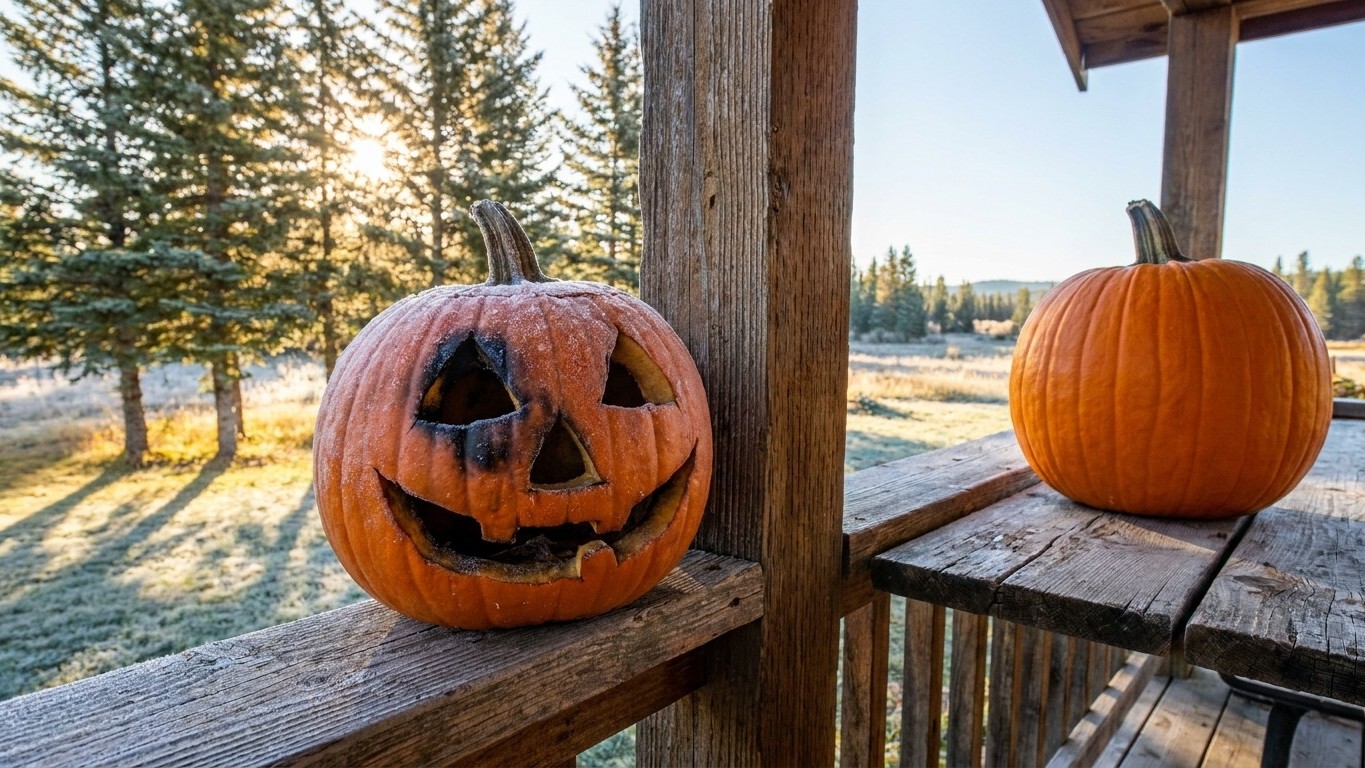

Around Billings, the mean first fall frost lands somewhere between October 1 and October 14, which puts it two to four weeks ahead of Halloween in most years. That’s the number that should shape your carving plan. A pumpkin left whole on a porch can ride out that stretch just fine, but a carved one exposed to a hard freeze that early won’t make it to trick-or-treat night looking presentable.
The short answer

The mean first fall frost for the Billings area falls somewhere in that October 1 to October 14 window, according to NOAA’s 1991-2020 Climate Normals. That’s an average built from three decades of freeze probabilities, not a date circled on a calendar, so treat it as a signal rather than a guarantee. In some years frost holds off longer. In others it arrives right on schedule or a bit earlier. Either way, the practical takeaway is the same: frost season in Montana typically starts well before Halloween, sometimes as much as thirty days ahead of it.
That gap matters more than most people realize. A whole, uncarved pumpkin sitting outside can tolerate a light frost without much visible damage, its thick skin acting as a buffer. A carved pumpkin has no such protection. Once the rind is cut, the exposed flesh reacts fast to cold, going soft and collapsing in on itself within a day or two of a hard freeze. So the window you’re really working with isn’t “how long until Halloween,” it’s “how long can a carved pumpkin sit outside once the freezes start.”
Given the mean frost date sits roughly two to four weeks before October 31, the safest approach in most of Montana is to hold off carving until close to Halloween itself, ideally within the final week. Buy your pumpkin early if you want, plenty of good ones show up at patches and stands in late September and early October, but keep it whole and stored properly until you’re ready to cut. Carving three weeks out and hoping the jack-o’-lantern survives an entire month of Montana fall nights is asking a lot of a vegetable that’s already been picked and is actively breaking down.
There’s no single date that works for every county here. Mountain valleys away from Billings can see frost in any month of the year, and elevation changes the picture fast. The mean date above is a reference point for the milder valley floor, not a promise for your specific yard. Treat it as a planning tool: expect frost risk to build through early October, and plan your carving for the days closest to Halloween rather than the days closest to when you bought the pumpkin.
Frost or heat: which one gets it here
The cold end
In Montana, the pumpkin’s enemy in late October is cold, not heat, and it’s not a close call. A whole pumpkin keeps best between 45 and 50 F in a cool, dark spot, according to University of Illinois Extension. That band sits comfortably above freezing, which is exactly the problem in this state once fall settles in. By the time you reach late October, Billings-area overnight lows are frequently dipping toward or below that 45-50 F range, and a freeze, temperatures at or below 32 F, is a real possibility given the mean first frost already falls in early-to-mid October.
The depth of Montana’s cold shows up clearly in another number: the coldest month’s mean daily minimum in Billings runs 17.9 F, per NOAA’s Climate Normals. That figure describes the heart of winter, not October, and it isn’t a frost date. But it tells you what kind of climate you’re dealing with. This is a place built for hard freezes, and the season arrives early relative to Halloween. A pumpkin stored somewhere that mimics that ideal 45-50 F band, rather than somewhere exposed to an actual freeze, is going to hold its shape and its stem far longer.
The warm end
Heat simply isn’t the concern here that it is in warmer states. Montana Octobers don’t typically deliver the kind of sustained warmth that softens a pumpkin from the outside in or speeds up rot through excess humidity. There’s the occasional mild afternoon, sometimes even an Indian-summer stretch, but overnight temperatures cool things back down fast enough that heat damage isn’t the risk profile for a pumpkin sitting on a Montana porch in October. The math here runs one direction: watch for cold, not warmth.
Where to keep it until you carve
Storage is where most of the real damage happens, long before a knife ever touches the pumpkin. Get this part right and the carving date becomes a lot more flexible.
- Pick a spot that’s cool but not freezing. An unheated garage, a mudroom, or an enclosed porch that stays above freezing overnight is closer to that 45-50 F target than an open porch exposed to Montana’s early frosts.
- Keep it dark. Direct sun through a window speeds up softening even when the air Temperature is fine. A closet shelf or a shaded corner of the garage works better than a sunny sill.
- Bring it inside once nightly lows approach freezing. Given the mean first frost arrives around early-to-mid October here, don’t assume the porch stays safe through the whole month. Check a forecast a few nights ahead and move the pumpkin somewhere protected before a freeze, not after.
- Store it away from ripening fruit. Apples, potatoes, and tomatoes give off ethylene gas as they ripen, and that gas speeds up a pumpkin’s aging. Keep the pumpkin on its own shelf, not in the produce bin.
- Leave the stem alone. Look for 1 to 2 inches of stem still attached, and never lift or carry the pumpkin by it. Once that stem breaks off, the spot where it was attached is exposed, and that’s an opening for rot to start early, before you’ve even picked up a knife.
No university extension publishes a fixed shelf life for a carved pumpkin, and none publishes a preservation method, bleach dips and petroleum jelly coatings are internet folklore, not research findings. What is documented is simpler and more useful: choose a pumpkin with an intact stem and no soft spots, keep it whole in conditions close to 45-50 F for as long as possible, and carve it as close to the day you’ll display it as you reasonably can. That combination does more for how it looks on Halloween night than any topical treatment claimed to work.
Checking this against your own county
Billings sits in one of Montana’s milder valleys, and the frost window described here reflects that specific location. Elsewhere in the state, especially in higher mountain valleys, frost can show up in any month, and local microclimates shift the picture more than a statewide average ever could. Before you lock in a carving date, check conditions for your own area with Montana State University Extension, which tracks local growing-season and frost data county by county. A quick call or visit to their site gives you a far more precise picture than a single mean date pulled from one reference station, and it’s the closest thing to a local forecast built specifically for gardeners and pumpkin growers in your part of the state.
Common questions
Does an early frost ruin a pumpkin that’s still whole and uncut?
A light frost usually leaves a whole pumpkin’s thick rind intact, though a hard freeze can damage the skin and speed up softening. The safest move is bringing pumpkins indoors once nightly lows approach freezing rather than waiting to see what happens.
Can I carve early and just refrigerate the pumpkin until Halloween?
Refrigeration can slow softening somewhat, but a full-size jack-o’-lantern rarely fits in a home fridge, and no extension source publishes a reliable timeline for how long a carved pumpkin holds up under any storage method. Carving closer to Halloween remains the more dependable approach.
How do I know if a pumpkin at the patch is a good candidate for carving?
Look for one that’s heavy for its size, free of blemishes and soft spots, with 1 to 2 inches of stem still attached. Shape doesn’t matter, but that stem is the seal protecting the top of the pumpkin, so handle it by the body, never by the stem.
Is Montana’s growing season a factor in when pumpkins show up at patches?
Yes, the same cool climate that brings an early frost also shapes the local harvest, with pumpkins typically ready by late September in the Billings area. That means a good selection is usually available well before Halloween, giving you plenty of time to pick a solid one and store it properly until carving day.