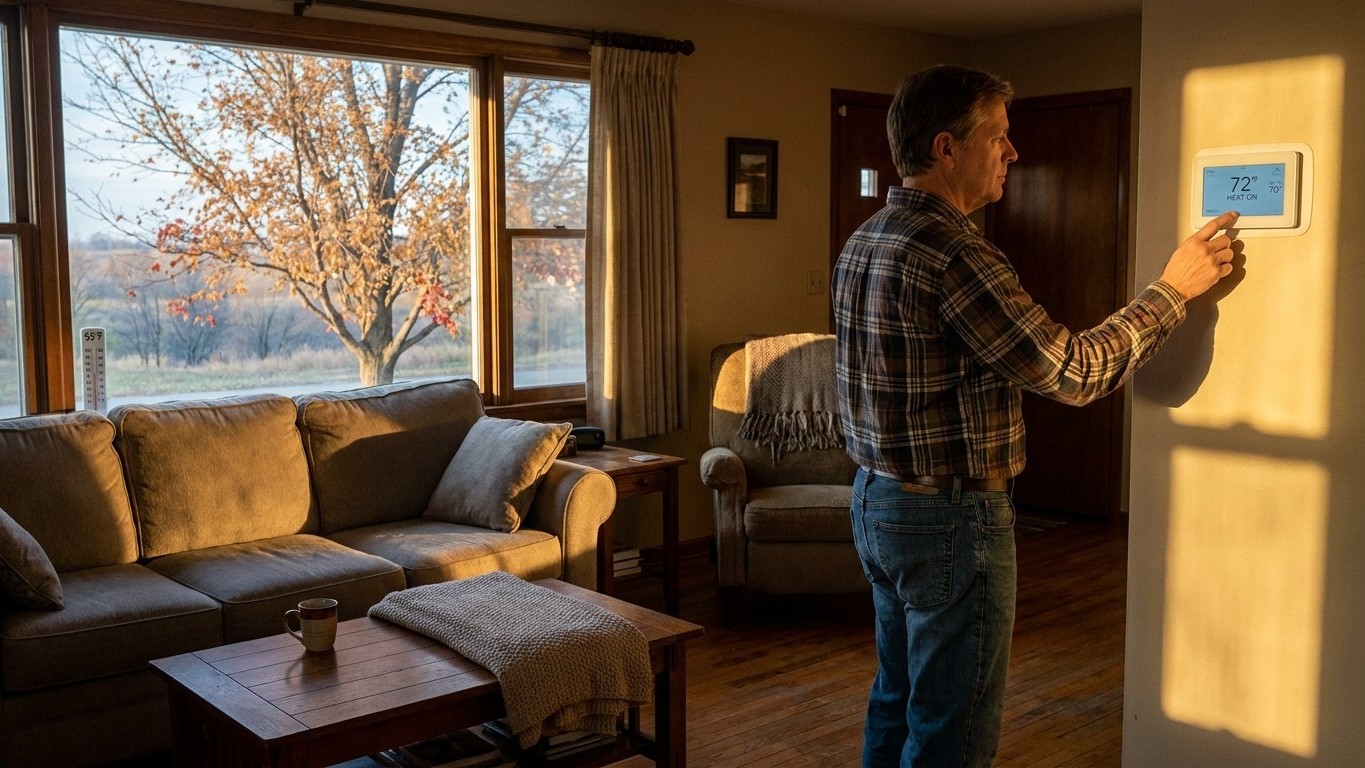

In Nebraska, heating demand typically kicks in during October, when average temperatures drop below the 65°F threshold that defines a heating degree day. The season stretches roughly eight months, peaking hard in January, before finally releasing its grip in June. But the calendar only tells part of the story.
When the heating season starts in Nebraska
At Omaha Eppley Airfield, the reference station for this region, October is the first month where the normal mean temperature (54.4°F) falls below the 65°F base used to calculate heating degree days. That’s the technical starting line. The season then runs about eight months, with demand climbing steadily until it peaks in January at 1,258 degree days, before finally easing off as the mean temperature climbs back above 65°F in June.
That October start date is a 30-year average, not a promise. Some years bring a cold snap in late September that has homeowners scrambling for the thermostat weeks before the “official” start. Others stay mild into November. The monthly normal smooths out three decades of data, but weather doesn’t care about smoothing.
The table below breaks down heating degree days month by month for this station. Notice the shape of it: this isn’t a flat, even season. It builds, peaks hard, and tapers.
| Month | Heating Degree Days |
|---|---|
| January | 1,258 |
| February | 1,009 |
| March | 745 |
| April | 386 |
| May | 132 |
| June | 11 |
| August | 3 |
| September | 70 |
| October | 351 |
| November | 743 |
| December | 1,124 |
No figure is listed for July. That’s the one month where heating demand at this station effectively disappears, sitting below the threshold NOAA tracks for this product.
How hard the winter works here
Omaha Eppley Airfield logs about 5,833 heating degree days a year on the 65°F base, against roughly 1,294 cooling degree days. Heating degree days work like a fuel meter: a home in a location with twice the annual total will burn roughly twice the fuel to stay comfortable, all else being equal. That’s what makes this number more useful than “average winter temperature” when you’re trying to picture what a season actually costs a household in energy.
What the annual total doesn’t tell you is whether that heat load arrives all at once or spreads out gently. Two places can post the same yearly figure while one endures a short, vicious cold stretch and the other spreads a milder chill across most of the year. The monthly table above answers that question here directly: Nebraska’s heating degree days concentrate heavily in December, January, and February, with a sharp climb in fall and a slower fade in spring. That’s a winter that hits hard and fast rather than a long, low simmer.
This pattern matters for how a home is built and maintained here. Insulation and duct sealing pay off disproportionately in a climate where three or four months carry the bulk of the annual heating load, because that’s when a poorly performing system gets tested the most.
What most homes in Nebraska actually heat with
According to the U.S. Energy Information Administration’s Residential Energy Consumption Survey, the equipment mix in Nebraska homes looks like this:
| System | Share of Homes |
|---|---|
| Furnace | 83% |
| Central heat pump | 6% |
| Steam or hot-water boiler | not reported |
On the fuel side, natural gas powers 69% of homes, electricity accounts for 24%, and fuel oil or kerosene shows no reported use. Propane figures were suppressed as unreliable in the survey data.
That dominant share for furnaces reflects what got built and what fuel was cheap decades ago, not a verdict on what’s best for any particular house today. A furnace paired with natural gas is common here because it was the economical, widely available option when much of the housing stock went up. It doesn’t mean it’s the right call for every home now.
What a furnace-dominated market means day to day
Furnaces heat air quickly and evenly through a duct system, which suits Nebraska’s sharp winter swings well. Where they struggle is efficiency loss through the ductwork itself, and through neglected maintenance. The single item that gets skipped most often, and punishes homeowners for it, is the air filter. A clogged filter restricts airflow, forces the blower motor to work harder, and can shorten the life of the whole system. It’s the cheapest fix in the house and the most commonly ignored one.
Run it once before you need it
A heating system that hasn’t run since spring tends to reveal its problems on the first genuinely cold night, which in this region often lands sometime in October or November. That’s exactly when every HVAC technician in the area is fielding the same emergency call. Testing the system weeks ahead, before the cold actually arrives, means any repair happens on a normal schedule instead of an emergency one.
- Turn the thermostat down, then back up above room temperature, and listen for the system to kick on within a minute or two. Let it run a full short cycle and listen for grinding, rattling, or unusual clicking.
- Expect a faint burnt-dust smell the first time it fires after months of dormancy. That’s dust burning off the heat exchanger and is normal; it should fade within a few minutes. A smell that lingers or smells like something else warrants a closer look.
- Replace or check the air filter. This is the cheapest, fastest maintenance step in the entire house and directly affects both efficiency and equipment lifespan.
- Clear the space around vents, registers, radiators, or the outdoor unit if there’s a heat pump involved. Furniture, curtains, and stored boxes block airflow and force the system to work harder for less output.
- Test the carbon monoxide alarm. A furnace that isn’t venting properly can introduce a real risk, so confirming the alarm works and has fresh batteries is a five-minute task worth doing every fall.
- If the system doesn’t respond, makes persistent unusual noises, or the CO alarm shows any sign of malfunction, stop and call a professional rather than troubleshooting further.
Even a furnace in perfect working order can lose a significant share of its output before heat ever reaches a room. According to the U.S. Department of Energy, “in a typical house, about 20%-30% of the air that moves through the duct system is lost due to leaks, holes, and poorly connected ducts.” That’s air, and the energy used to heat it, leaking out somewhere between the furnace and the vent. It’s a strong argument for having ductwork inspected, not just the furnace itself.
What turning it down is actually worth
The Department of Energy states it plainly: “You can save as much as 10% a year on heating and cooling by simply turning your thermostat back 7-10°F for 8 hours a day from its normal setting.” That’s a yearly figure tied to a specific setback range held for a specific number of hours daily, covering both heating and cooling combined, not a per-degree formula.
In a region where the heating season runs roughly eight months, from October through May, that 8-hour daily setback has a lot more hours to work with than it would somewhere with a short, mild winter. A thermostat set back overnight or during work hours here is quietly logging savings across a long stretch of the year, simply because there’s more heating season for the strategy to apply to.