
Yes. Nebraska sits entirely inside IECC climate zone 5A, and the 2021 International Residential Code requires a vapor retarder on the interior side of frame walls in that zone. The exception that removes the requirement applies only to Climate Zones 1, 2 and 3, nowhere in Nebraska. The remaining question isn’t whether, but which class, and that’s where most confusion actually starts.
What the code asks for in Nebraska

Section R702.7 of the 2021 International Residential Code states it plainly: a vapor retarder of the class given by Table R702.7(2) shall be provided on the interior side of frame walls. That’s the baseline rule for the whole country, and Nebraska doesn’t get an exception from it because the state’s entire land area falls into a single IECC zone: 5A, listed in the code table as “5A (all)” with no county carve-outs. That last part is worth pausing on, because it’s rare. Most states straddle two or three zones, and a reader has to look up their own county before they know which rule applies. Nebraska residents skip that step. Whether you’re building in Scottsbluff, Lincoln, or a farmhouse outside Norfolk, the zone is the same, and so is the baseline answer: a vapor retarder is required on the interior side of frame walls.
That single-zone status matters because it also fixes which row of the ENERGY STAR insulation table applies statewide, and it means the vapor retarder question doesn’t shift as you cross county lines the way it does in, say, a state split between zones 3 and 5. In Nebraska, the code’s default answer holds from the Missouri River to the Panhandle.
Required does not mean one specific product
Here’s where a lot of homeowners and even some contractors get tripped up. “A vapor retarder is required” doesn’t mean “install sheet plastic.” The code allows three classes, and which one is appropriate depends on the wall assembly, the insulation, and the exterior cladding, among other things. Zone 5A tells you a retarder belongs in the wall. It doesn’t, by itself, tell you which class, and getting that wrong is exactly how walls end up trapping moisture instead of managing it.
This is also why the rule is not something to guess at from a blog post, even this one. The 2021 IRC is a model code. States and municipalities adopt it, sometimes with amendments, sometimes years after it’s published, sometimes with a different edition altogether. The code in force on your project is the one your local building department has adopted, not necessarily the model code cited here. A wall built with the wrong vapor control doesn’t announce the mistake with a leak or a stain the next week. It rots quietly behind the drywall, and the damage often isn’t found until years later, when someone opens the wall for an unrelated repair.
Why the answer is the opposite in a warm climate
The reason Nebraska’s rule differs from a rule you’d read for Florida or coastal Texas comes down to which direction the moisture is traveling, not to arbitrary regional preference.
In a cold climate like Nebraska’s, the warm, moisture-laden air lives inside the house. In winter, that indoor air is far more humid, relative to its temperature, than the freezing air outside. If that warm indoor air migrates into the wall cavity and reaches the cold sheathing near the exterior, the water vapor it carries can condense there. A vapor retarder placed on the interior side of the insulation stops that migration before it starts. That’s the entire logic behind R702.7 as applied in zone 5A: keep the indoor humidity from ever reaching the cold surface.
Flip the climate, and the physics flips with it. In a warm-humid zone, the moisture-loaded air is arriving from outside, not from inside the house, especially in summer when air conditioning keeps interior air cool and relatively dry. If a wall in that climate has a Class I vapor retarder, the kind with a permeance of 0.1 perm or less, on its interior side, that impermeable layer becomes the coolest surface the humid exterior air can reach. The U.S. Department of Energy’s Building America program describes exactly what happens next: “If the wall contains a vapor retarder on the interior side of the insulation, the water vapor will condense on this cool, impermeable surface.” The result, in the DOE’s own words, is “ruined insulation, mold, and structural rot of framing members.”
That’s not a minor caveat. It’s the reason the code writes opposite instructions for opposite climates. It isn’t bureaucratic inconsistency, it’s water following the temperature gradient, and the code trying to keep the retarder on whichever side actually needs it. In Nebraska’s zone 5A, the water is moving outward through the wall in winter, so an interior retarder helps. In zones 1 through 3, it’s often moving inward, so the same material in the same location can cause the damage it’s meant to prevent.
The three classes, and why the word matters
The code doesn’t ask for “a vapor barrier.” It asks for one of three classes, distinguished by how much moisture they let pass, measured in perms. Confusing the classes is where most kitchen-table arguments between builders from different regions actually come from, one is picturing Class I, the other Class III, and neither realizes it.
| Class | Example materials | Permeance range |
|---|---|---|
| Class I | Sheet polyethylene, nonperforated aluminum foil | 0.1 perm or less |
| Class II | Kraft-faced fiberglass batts, vapor retarder paint | Above 0.1 up to 1.0 perm |
| Class III | Latex or enamel paint | Above 1.0 up to 10.0 perm |
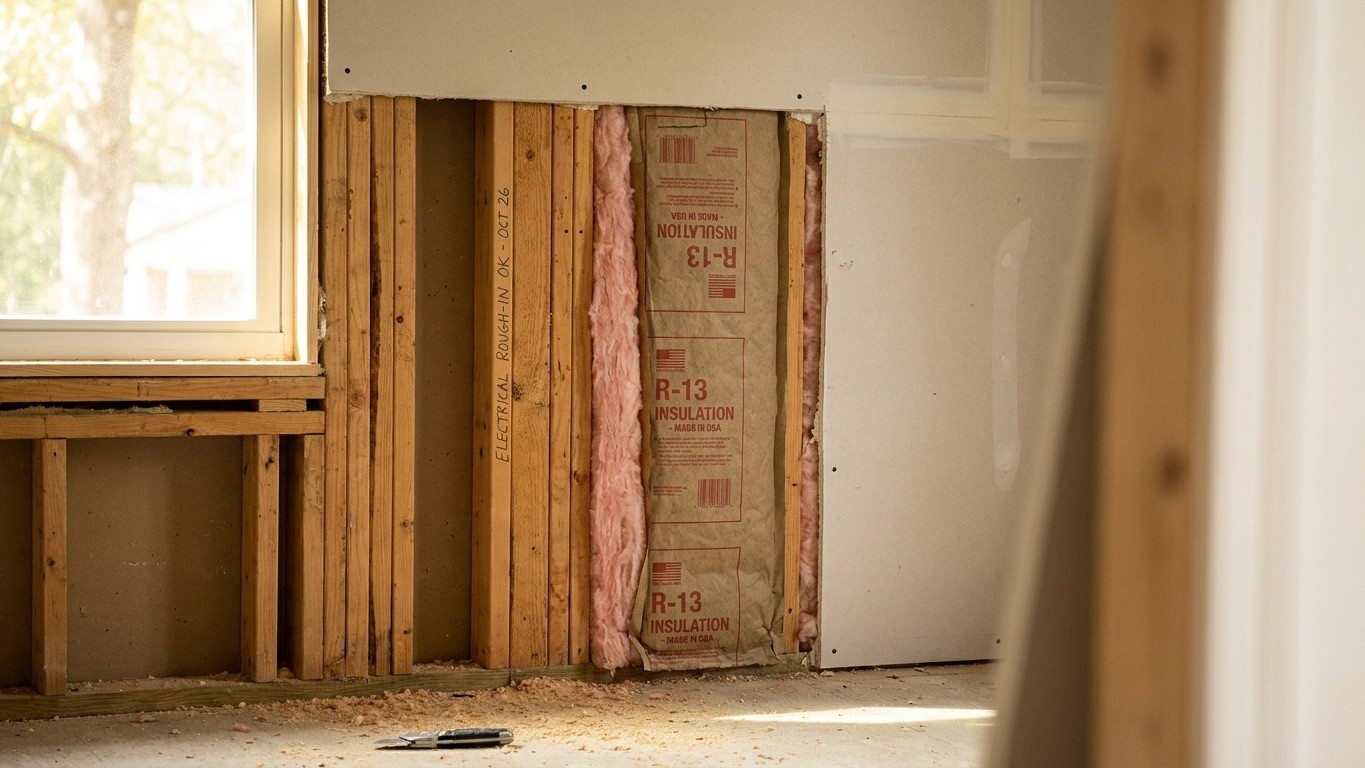
Notice what’s in that third row. Ordinary latex or enamel wall paint qualifies as a Class III vapor retarder. Most homeowners have one on their walls right now and have never thought of it that way. That matters in zone 5A, because depending on the rest of the wall assembly, the insulation type, and the cladding, a Class II or even Class III retarder may satisfy R702.7 without any polyethylene sheeting at all. Sheet polyethylene is Class I, and it’s the tightest of the three, which is exactly why it’s the one that causes damage when it ends up on the wrong side of a wall in the wrong climate. Never assume “vapor retarder” means plastic sheeting; the code gives three options precisely because one size doesn’t fit every assembly.
One more distinction worth keeping straight: a vapor retarder is not an air barrier. They do different jobs. Controlling water vapor diffusion through a material is not the same as stopping bulk air movement through gaps and penetrations, even though a single product, like some foil-faced foams, can sometimes do both at once.
Where the rule stops
R702.7 lists four situations where the interior vapor retarder requirement doesn’t apply. Two of them are geographic (they don’t touch Nebraska), and two are about the wall assembly itself:
- Basement walls
- The below-grade portion of any wall
- Construction where accumulation, condensation, or freezing of moisture will not damage the materials
- Climate Zones 1, 2 and 3 (not applicable in Nebraska, since the entire state is zone 5A)
The basement exception is the one Nebraska homeowners actually run into, since basements are common across the state. A poured concrete or masonry foundation wall behaves nothing like a wood-framed wall. Concrete holds moisture from the ground and from the curing process itself for years, releasing it slowly, and that assembly needs to be able to dry toward the interior. Seal an impermeable sheet against the interior face of a basement wall and you trap that moisture against the concrete indefinitely, which is the same condensation problem described above, just moved underground. That’s why basement walls get their own set of rules rather than following R702.7’s above-grade logic. For the specifics of how a basement assembly should be built to manage that moisture, see the basement wall guide elsewhere on this site.
The third exception, “construction where accumulation, condensation or freezing of moisture will not damage the materials,” is the broadest and the vaguest. It exists for assemblies, sometimes unconventional ones, engineered specifically so that incidental moisture doesn’t cause harm even without a dedicated retarder. It’s a case-by-case call, not a blanket pass.
Who actually decides, in Nebraska
Everything above describes the 2021 model code’s default position for zone 5A. It is not a substitute for checking with the building department that has jurisdiction over your project. Nebraska’s cities and counties adopt building codes individually, sometimes on the current edition, sometimes on an older one, sometimes with local amendments layered on top. The code your inspector applies is the one your jurisdiction has actually adopted, not whichever edition happens to be cited online.
This matters more in a place like Nebraska than in a mild climate, because the stakes of getting it wrong are higher. At Omaha Eppley Airfield, the National Weather Service’s climate normal station for the area, the annual average runs about 5,833 heating degree days against roughly 1,294 cooling degree days. Heating degree days measure demand, not temperature, adding up how far below 65°F the average day sits, cumulatively, across the year. A number that size means Nebraska homes spend far more of the year fighting cold than fighting heat, which is exactly the condition under which an interior vapor retarder does its job: keeping warm, humid indoor air from reaching a cold sheathing for months at a stretch.
None of that changes the basic advice, though: this page describes what the code asks for and why, not what belongs in any specific reader’s wall. That decision, and the class of retarder appropriate to a particular assembly, insulation type, and cladding, belongs to the local building department reviewing the actual plans. A wall built with the wrong vapor control in the wrong direction doesn’t fail on inspection day. It fails quietly, over years, and the owner usually finds out only when the drywall comes off for some unrelated reason.