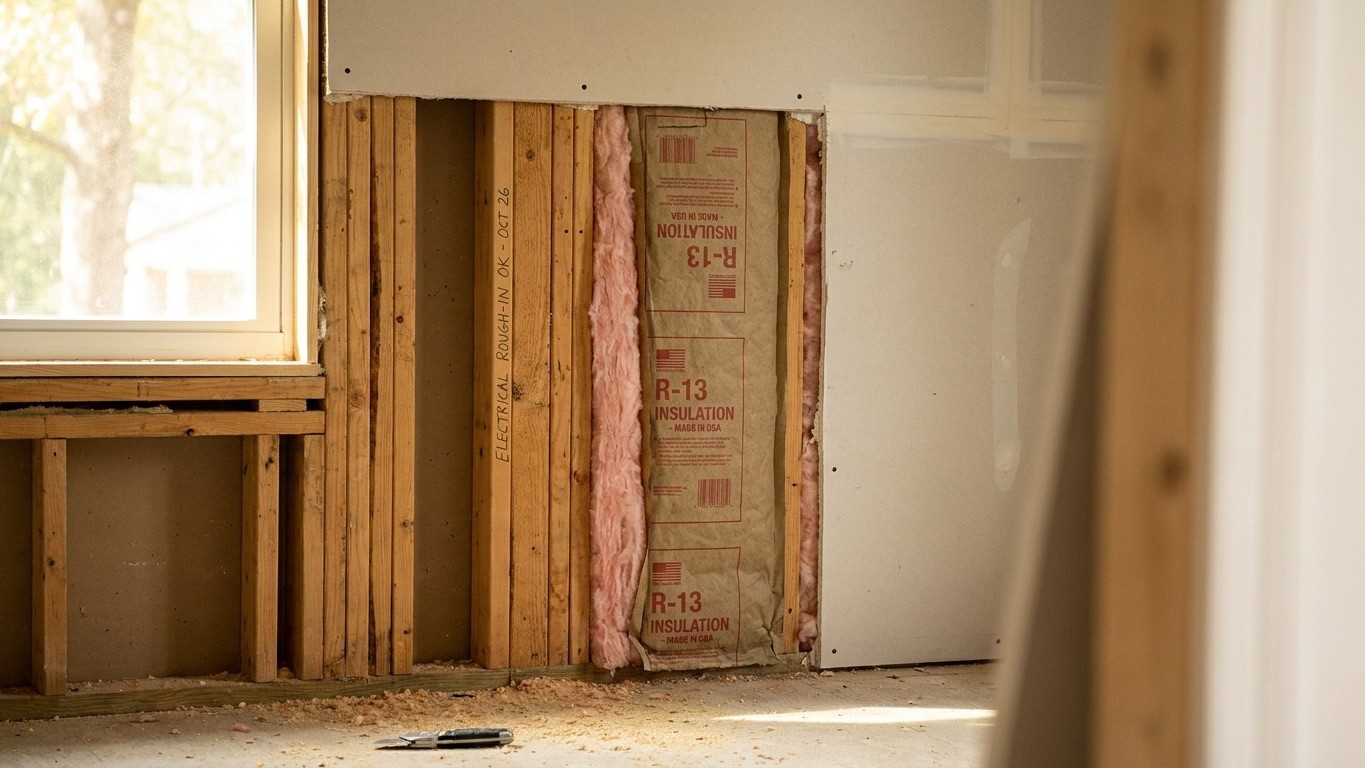

Yes. Wisconsin’s 72 counties fall into IECC Climate Zones 6A (42 counties) and 5A (30 counties), and the 2021 International Residential Code exempts only Climate Zones 1, 2 and 3 from the interior vapor retarder requirement. Neither Wisconsin zone qualifies for that exemption, so the baseline rule in R702.7 applies statewide, though the specific class required can vary by wall assembly.
What the code asks for in Wisconsin

The 2021 International Residential Code, Section R702.7, states plainly: a vapor retarder of the class given by Table R702.7(2) shall be provided on the interior side of frame walls. That’s the rule, and it isn’t optional language, it’s a “shall.” The code then carves out four exceptions, one of which lifts the requirement entirely for Climate Zones 1, 2 and 3, mostly the Gulf Coast, Florida, southern Texas and similar warm territory.
Wisconsin doesn’t touch any of those zones. Table R301.1 of the 2021 IECC places 42 of the state’s 72 counties in Zone 6A and the remaining 30 in Zone 5A. Both are cold, moist zones. That means the exception carved out for warm climates simply doesn’t reach Wisconsin, in either its northern reaches or its southern counties along the Illinois border. A homeowner in a 6A county and one in a 5A county are both under the base requirement, even though they sit in different zones.
That’s worth pausing on, because plenty of states genuinely do split down the middle on this question, with one part exempt and the other not. Wisconsin isn’t one of them. The two-zone split here changes other things, like how much Insulation the ENERGY STAR tables recommend for a given wall or attic, but it doesn’t change whether a vapor retarder is required. Both 5A and 6A sit outside the 1-2-3 exemption, so the retarder requirement holds from Superior to Kenosha.
What “required” actually governs
The code language governs class, not brand or thickness. Table R702.7(2) sorts assemblies by which class of vapor retarder pairs with which wall construction, siding type and Insulation arrangement. That’s a detail for the wall assembly, not for this page. What matters here is the baseline: Wisconsin framed walls need an interior vapor retarder of some class, full stop, before anyone gets into which class fits a particular assembly.
None of this is a ban on other approaches, and it isn’t a suggestion either. It’s a code minimum, and code minimums get enforced at the point of inspection, not years later when nobody remembers what went into the wall cavity. A wall built without the retarder the assembly requires doesn’t announce the problem with a crack in the drywall. It shows up as trapped moisture, and trapped moisture works slowly. That’s precisely why this is a building-department question, not a paint-aisle question, and the last section of this page comes back to that.
Why the answer is the opposite in a warm climate
Wisconsin’s answer only makes sense once you see which direction the water vapor is traveling. In a cold climate, the warm, moisture-laden air is inside the house, generated by cooking, showering, breathing, and it pushes outward through the wall assembly toward the cold sheathing. An interior vapor retarder stops that indoor moisture before it reaches a surface cold enough to condense it. That’s the entire logic of R702.7 as written for zones like Wisconsin’s 5A and 6A.
Flip the climate, and the physics flips with it. In a warm, humid climate, the damp air is arriving from outside the wall, not from inside the house, especially in an air-conditioned home where the interior stays cooler and drier than the exterior. Put an impermeable Class I retarder on the interior side of that wall, and you’ve built the cool surface the incoming vapor condenses against, from the wrong side. The U.S. Department of Energy’s Building America program spells out what happens next: “If the wall contains a vapor retarder on the interior side of the Insulation, the water vapor will condense on this cool, impermeable surface,” resulting in “ruined insulation, mold, and structural rot of framing members.”
That single sentence is the reason the code writes different rules for different zones. It isn’t bureaucratic inconsistency, it’s the code tracking which way the water is moving through the assembly. In Wisconsin’s zones, an interior retarder blocks moisture headed outward. In Zones 1, 2 and 3, that same material would trap moisture headed inward. Same material, opposite outcome, because the climate reversed the direction of travel. That’s also why this page can’t simply say “install a vapor barrier” as a universal instruction; it depends entirely on which side of that line a given wall sits on, and Wisconsin sits on the cold side.
The three classes, and why the word matters
The code doesn’t talk about “vapor barriers” as a single category. It defines three classes by how much moisture they let through, measured in perms, and the class matters more than the label. Calling a sheet of polyethylene “a vapor barrier” without saying it’s Class I skips the exact detail the code cares about.
| Class | Example materials | Perm range |
|---|---|---|
| Class I | Sheet polyethylene, nonperforated aluminum foil | 0.1 perm or less |
| Class II | Kraft-faced fiberglass batts, vapor retarder paint | above 0.1 up to 1.0 perm |
| Class III | Latex or enamel paint | above 1.0 up to 10.0 perm |
That third row surprises most people. Ordinary latex or enamel paint on interior drywall already functions as a Class III vapor retarder. Millions of Wisconsin walls have one without anyone ever buying a product labeled as such. Whether that’s sufficient for a given assembly, or whether Table R702.7(2) calls for Class I or Class II instead, depends on the wall’s construction, not on this page.
One more distinction worth keeping straight: a vapor retarder is not an air barrier. A vapor retarder slows the diffusion of water vapor through a material. An air barrier stops bulk air movement, which carries far more moisture, far faster, through gaps and penetrations. Some products do both jobs on the same sheet, but they’re answering two different questions, and the code treats them separately.
Where the rule stops
R702.7 lists four situations where the interior vapor retarder requirement doesn’t apply, and Wisconsin’s exemption from Zones 1-3 already ruled out one of those. The other three still matter statewide:
- Basement walls
- The below-grade portion of any wall
- Construction where accumulation, condensation or freezing of moisture will not damage the materials
The basement exception is the one most Wisconsin homeowners actually run into, because so many homes here have basements built into cold, wet ground for a good part of the year. A concrete or masonry foundation wall holds moisture and releases it slowly, sometimes over years, as groundwater conditions shift with the seasons. That assembly needs to be able to dry toward the interior. Seal it behind an impermeable interior sheet, the way you might on an above-grade frame wall, and the moisture has nowhere to go. It stays trapped against the concrete and the framing built against it, which is the opposite of what a vapor retarder is supposed to accomplish.
This is a large enough topic on its own that it deserves separate treatment; see the basement wall guide on this site for the detail on how that assembly differs from an above-grade frame wall. The short version for this page: “not required” here doesn’t mean basements are unregulated, it means the vapor control strategy for a below-grade wall is a different problem than the one R702.7 is solving for framed walls above grade.
Who actually decides, in Wisconsin
The 2021 IRC is a model code. States and municipalities adopt it, sometimes with amendments, sometimes years behind the national publication cycle, sometimes with local provisions layered on top. Nothing on this page can tell you which edition your county or city has adopted, whether it’s amended R702.7, or how a local inspector reads Table R702.7(2) for a specific wall assembly. That question belongs to your local building department, and it’s the only office that can answer it for your address.
That matters more here than it might in a milder state. Milwaukee Mitchell Airport, the reference station for southeastern Wisconsin, averages about 6,450 heating degree days a year against a 65°F base, plus roughly 780 cooling degree days. Heating degree days measure demand, not temperature, they add up how far below 65°F the average day sits, across the whole year, and 6,450 is a serious number. A house in a milder zone might see half that. Wisconsin’s long, cold heating season is exactly the condition R702.7’s base rule was written to address, and it’s the reason this isn’t an academic distinction for a state that spans two cold IECC zones.
None of that changes the answer this page can give: contact your local building department, ask which code edition and amendments apply to your jurisdiction, and let them tell you which class of vapor retarder your specific wall assembly requires under Table R702.7(2). A wall built with the wrong vapor control doesn’t fail at inspection and it doesn’t fail the week after either. It fails quietly, inside the cavity, and the owner usually finds out only when the drywall is already stained or the framing is already soft.