
Yes, you can grow apples in North Dakota, but only cold-hardy cultivars survive the winter minimums this state sees. NOAA’s 1991-2020 climate normals put Fargo’s coldest month at a mean minimum of just 0.1°F, and the USDA Plant Hardiness Zone Map (2023 edition, 1991-2020 normals) places the state at zone 3a to 4b. Check your own county against that map rather than assuming your garden matches Fargo’s number, then pick a cultivar rated hardy to at least zone 3 before you order a tree.
Can you grow apples in North Dakota
Zone 4a-4b is as good as it gets for North Dakota apple growing, and that’s only around Fargo and the Red River Valley. Push north or west and you’re often into zone 3a, sometimes colder, where the mean minimum can flirt with 0.1°F on the worst nights. That single number decides more than soil or sun ever will: it narrows the variety list to a short roster of Minnesota- and North Dakota-bred cultivars built to survive exactly this kind of winter.
Why the zone range varies across the state
The zone range itself tells you the state is not one climate. Fargo, in the Red River Valley, sits toward the milder end of that span at zone 4a-4b. Farther north and west, where elevation rises and the landscape offers less shelter, gardens commonly run colder, into zone 3a or lower. If you garden outside the Fargo area, check your own county against the USDA map before you buy, because a tree rated hardy at zone 4 can still fail in a colder pocket forty miles away.
None of this makes apple growing a lost cause anywhere in the state. It means the variety list is short and non-negotiable. Growers who succeed here choose cultivars bred specifically for northern prairie winters, most originating from Minnesota or North Dakota breeding programs built for exactly this kind of cold. See The Best Apple Varieties for North Dakota for a rundown of cultivars proven to handle these winters. Skip a cultivar because a catalog photo looks good and you are gambling three years of growth on one hard January.
Site selection helps at the margins. A south-facing slope that sheds cold air, a windbreak on the north and west sides, and distance from low frost pockets all shave a degree or two off the worst nights. Site work is a supplement to hardy variety choice, not a substitute for it.
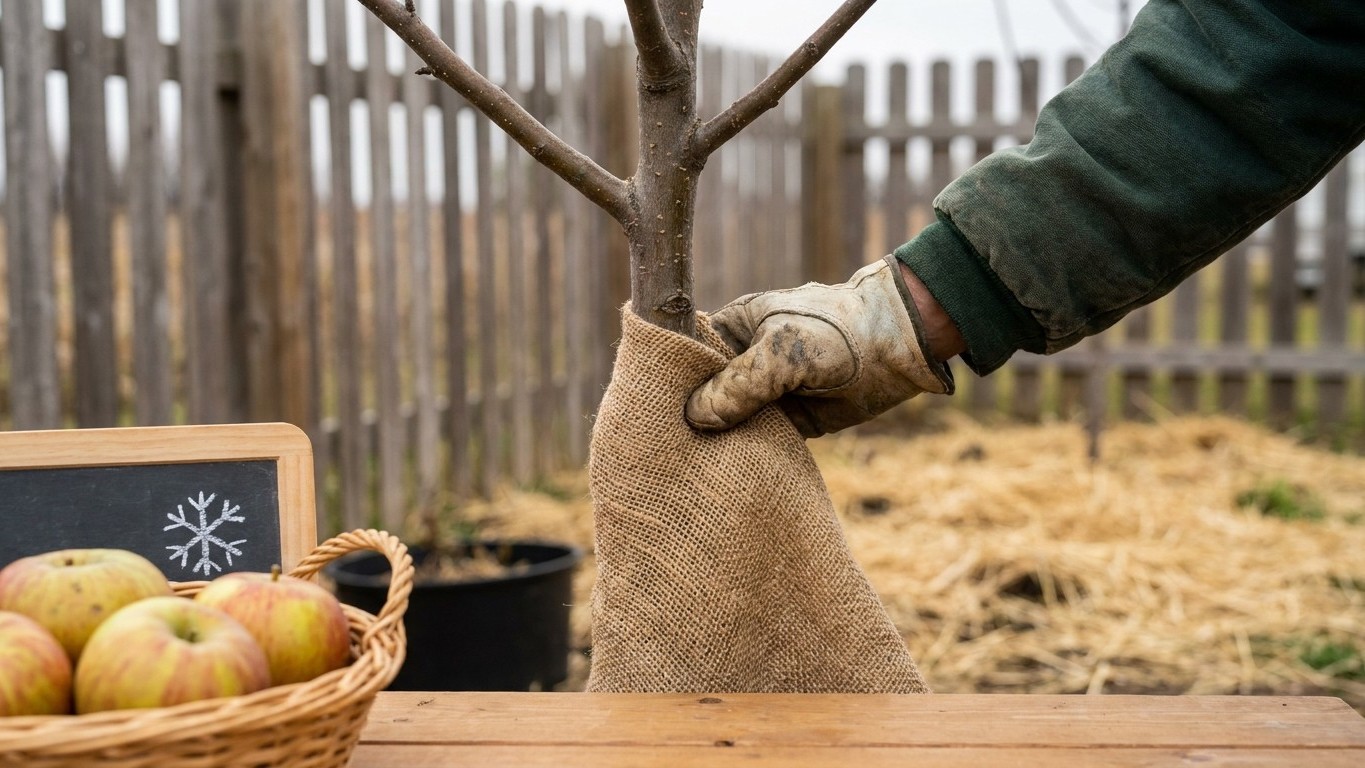
The 0.1°F figure also matters for trunk protection, not just cultivar survival. A mean minimum near zero for the coldest month means winter sun on a dark trunk can cause sunscald and splitting even when the wood itself is hardy enough to take the cold. Wrapping the trunk of a young tree for its first few winters, or choosing a site with some afternoon shade in the cold months, reduces that risk regardless of which cultivar you plant. For a season-by-season breakdown of what to watch for, see The North Dakota Apple Calendar, Stage by Stage.
Which varieties suit this climate

Hardiness first
Every cultivar below is documented in nursery and university trial catalogs as hardy to USDA zone 3, which covers both the coldest parts of North Dakota and the milder Fargo end of the state’s range. Most trace back to breeding programs on the northern prairie, built specifically for winters like this one.
| Cultivar | Published hardiness | Bloom season | Harvest window (catalog) |
|---|---|---|---|
| Haralson | Zone 3 | Mid-season | Mid to late fall |
| Honeycrisp | Zone 3 | Mid-season | Early fall |
| Zestar! | Zone 3 | Early to mid-season | Late summer |
| State Fair | Zone 3 | Early to mid-season | Late summer |
| Norland | Zone 3 | Early-season | Late summer |
| Sweet Sixteen | Zone 3 | Mid-season | Early fall |
| Wealthy | Zone 3 | Mid-season | Early to mid fall |
| Dolgo (crabapple) | Zone 2 | Early-season | Late summer, mainly a pollinizer |
Catalog harvest windows are counted from bloom and shift by a week or two depending on the season, so treat them as a guide rather than a fixed date.
Winter chill second
Hardiness answers whether the wood survives January. Winter chill, the number of cold hours a tree needs before it will break dormancy and flower properly, is a separate question, and it points the opposite direction here. North Dakota’s long winters supply chill in surplus, so the risk here is never a chill shortfall. That risk runs the other way in warmer climates: in a milder state like Ohio, growers work down a longer list of moderate-chill cultivars, and in Florida, growers hunt specifically for low-chill cultivars bred for winters that barely register as cold. North Dakota growers can set chill-hour ratings aside and let hardiness alone decide the shortlist.
No state extension trial specific to North Dakota apple varieties turned up a published list for this piece. Where the North Dakota State University Extension Service does publish current variety recommendations and spray schedules for your county, use that list over a generic nursery catalog, since it reflects trials run on North Dakota soil and winters rather than a national average.
Planting a pair that works here
Apples do not pollinate themselves reliably. Plant two cultivars that flower in the same window, and confirm neither one is a pollen-sterile variety, or you will get blossoms and no fruit.
Matching bloom groups
Among the cultivars that suit this climate, bloom timing sorts into rough groups rather than a single date, since exact bloom depends on the spring you get. Early to mid-season bloomers such as Norland, Zestar! and State Fair overlap well with each other. Mid-season bloomers such as Haralson, Honeycrisp, Sweet Sixteen and Wealthy overlap with each other, but not reliably with the earliest group in a compressed spring. A practical pairing for most Fargo-area gardens is Haralson with Honeycrisp, or Zestar! with State Fair, since each pair shares a bloom group on the catalog record.
If you already have a mismatched pair, or only have room for one named cultivar, an ornamental crabapple such as Dolgo blooms early and produces abundant, fertile pollen across a wide window. That makes it a reliable third tree, or a street-side pollinizer where a second full-size apple will not fit.
Cold, wet spring weather also limits the bees that carry pollen between trees, so a pair blooming in the same narrow window matters more here than in a longer, milder season where stray overlap still gets covered.
Sterile-pollen cultivars are the trap to watch for. A handful of widely sold apples, mostly bred for other regions, produce pollen that will not fertilize any other apple tree, so pairing the wrong two can leave both trees blossoming and both bearing nothing. None of the cold-hardy cultivars listed above are known sterile-pollen types, but if you add a cultivar from outside that list, check its pollination class before committing two tree slots to it.
The frost that costs a crop here

NOAA’s NCEI 1991-2020 climate normals put the last spring freeze at the reference city of Fargo in the window of May 4 to May 15, based on the 30-70% probability band for a 32°F freeze. That is a range, not a date. Gardens outside Fargo, especially rural and suburban sites away from the airport weather station, commonly see their last frost later still, sometimes by one to two weeks.
Why the timing matters more than the temperature
A frost that lands before bloom does little damage to an apple tree, since dormant wood and even green-tip growth tolerate a light freeze. Once the buds show pink, though, and especially once they open into full bloom, the same freeze kills the flowers rather than the tree. The wood survives untouched. The crop for that year does not. A grower can walk out in June to a healthy, leafing tree that will not set a single apple, because the freeze that mattered came three weeks earlier and nobody checked the thermometer that night.
There is not much a home grower can do to protect a full-size tree from a hard freeze at bloom, but a few things narrow the odds. Covering a young, low-branched tree overnight with a frost blanket when a freeze is forecast during bloom can save that year’s crop on a small tree, though it is not practical on a mature standard. Delaying pruning until late winter, and skipping heavy nitrogen fertilizer in early spring, both slow bud development slightly and can buy a few days of margin.
The more durable fix is variety choice. A cultivar that blooms later in its group, such as Haralson relative to an early bloomer like Norland, pushes the vulnerable bloom window closer to the safer end of the frost range. In a state where the last freeze date itself runs a two-week spread, that margin is worth planning around rather than hoping for.
Because this figure comes from a single airport station, treat it as a starting estimate rather than your garden’s actual date. Keep a simple log of your own last spring frost for a few years, and use that instead once you have it.
The apple year in North Dakota
Stage by stage
Apple trees move through the same sequence of stages every year, but the calendar date each stage lands on shifts with the weather. Track the stage on your own tree rather than a fixed month.
- Dormancy (late fall through winter): the tree is leafless and cold-hardy. This is the window for structural pruning, ideally toward the end of dormancy, since late cuts heal faster and expose less wood to the coldest nights.
- Green tip (as temperatures climb toward the last-frost window): buds swell and show the first green. Frost at this stage rarely does serious damage.
- Pink bud (typically close to or just before Fargo’s last-frost window of May 4 to May 15, per NOAA’s NCEI normals): the buds show color but have not opened. This is the stage to start watching the overnight forecast closely, since the next freeze is the one that can cost the crop.
- Bloom: flowers open and pollinators move pollen between the two cultivars you planted. A freeze here is the most damaging of the whole year.
- Petal fall and fruit set: petals drop and pollinated flowers begin swelling into fruit. Thin the heaviest clusters down to one or two apples each to size the remaining fruit better.
- Harvest (from late summer for early cultivars like Norland through mid fall for later ones like Wealthy): pick when fruit separates from the spur with a gentle twist, ahead of the first fall frost window of September 25 to October 5 that NOAA’s NCEI normals record for Fargo, since a hard freeze on the tree can soften and spoil fruit still hanging.
Rural and outlying gardens should expect both ends of the season to run a little later in spring and a little earlier in fall than the Fargo airport figures above, which narrows the safe window a bit beyond what the raw dates suggest.
Local help
For a current list of cultivars trialed for North Dakota conditions and a spray calendar tuned to local pest and disease pressure, contact your county office of the North Dakota State University Extension Service. Extension staff can also confirm your county’s frost dates and hardiness zone against the Fargo figures used in this piece, since both shift somewhat as you move away from that reference station.
Common questions
Can I grow a full-size apple tree or do I need a dwarf variety?
Standard and semi-dwarf trees both work if the cultivar itself is hardy to zone 3, and hardiness matters more than tree size for winter survival. Dwarfing rootstocks can be somewhat less cold-hardy at the roots, so mulch the root zone well on a dwarf tree regardless of which cultivar sits on top of it.
Do I really need two trees, or will one bear fruit alone?
Most apple cultivars need a second, compatible tree flowering at the same time to set fruit, since very few are reliably self-fertile. A crabapple such as Dolgo can serve as that second tree where space is tight.
My tree bloomed heavily but set almost no fruit. What happened?
The likeliest causes are a frost during or just after bloom, a pollination partner that flowers in a different window, or a cold, wet spring that kept bees from working the blossoms. Check your bloom dates against your pollinizer’s bloom dates before assuming disease or nutrition is the problem.
How do I find frost dates for my own county instead of Fargo’s?
Ask your county office of the North Dakota State University Extension Service, or look up the nearest NOAA NCEI climate normals station to your address, since normals are calculated per station and Fargo’s figures apply most directly to gardens near that airport.
Can I grow apples in containers and bring them indoors for winter?
It is possible but harder than it sounds, since roots in an above-ground pot freeze more severely than roots in open ground, even on a cultivar rated hardy to zone 3. Most home growers get better, more reliable results planting a hardy cultivar directly in the ground with normal winter mulch rather than managing a container tree through a prairie winter.