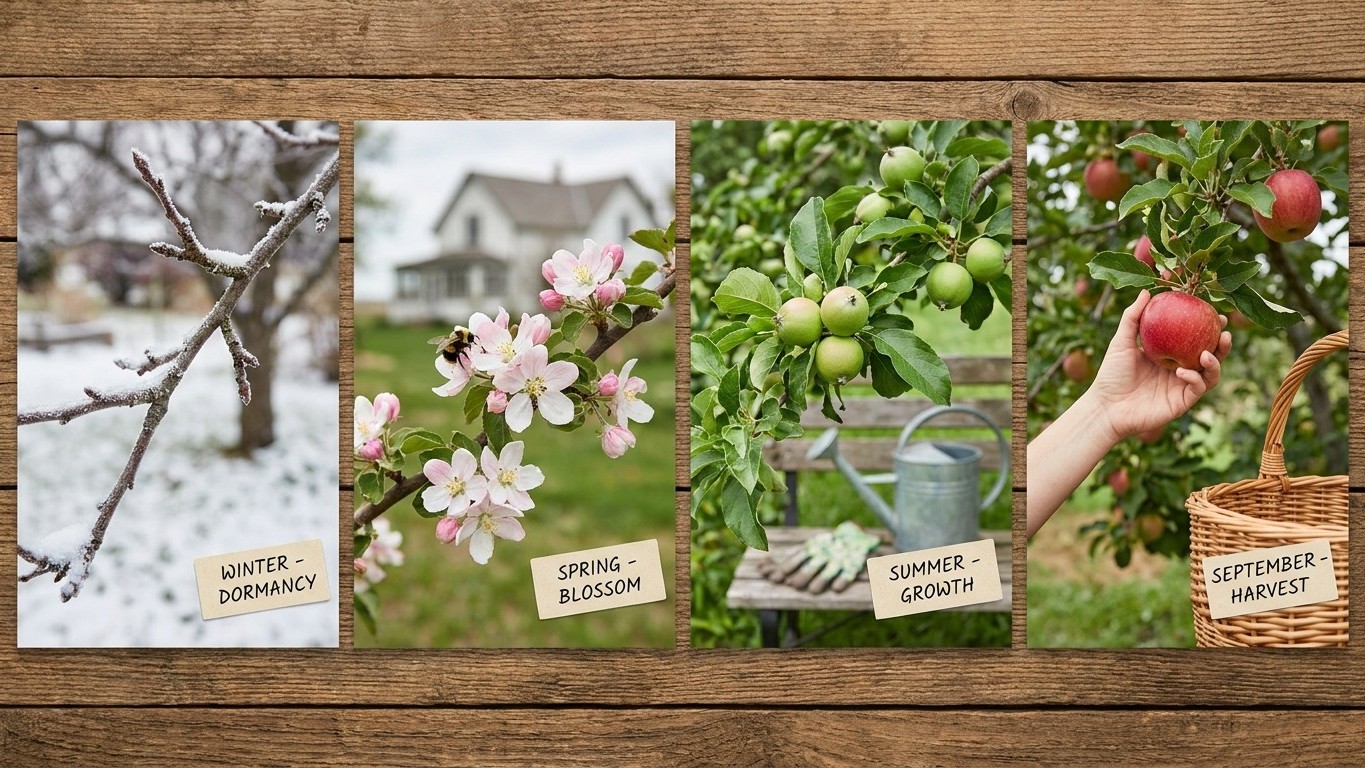

North Dakota’s apple calendar runs on tree stage, not the month printed on a calendar: dormancy, green tip, pink bud, bloom, petal fall, fruit set, and harvest, each one timed against the local frost window. NOAA’s 1991-2020 climate normals for the Fargo station put the last spring freeze at May 4 to May 15 and the first fall freeze at September 25 to October 5. Check your own county’s frost record against those Fargo figures before you plan a spray, a thinning pass, or a pick date, since most yards outside town run later in spring and earlier in fall.
The short answer for North Dakota
Fixing an apple’s timing to the calendar on your wall is the mistake that costs a crop. What matters is the tree’s stage — dormancy, green tip, pink bud, bloom, fruit set, harvest — measured against your own frost window, not a printed date. Fargo’s last spring freeze normally falls between May 4 and May 15, and the first fall freeze between September 25 and October 5, so start by checking how your county’s frost record sits against those two dates before you touch a sprayer, a thinning shear, or a picking basket.
What the answer depends on
The answer depends on where in the state you’re standing and which cultivar is in the ground. A cold-hardy, early-to-mid-season apple such as ‘Zestar!’ or ‘State Fair’ moves through bloom and fruit set fast enough to finish inside a Fargo-length season. A cultivar bred for a longer, milder fall may still be carrying unripe fruit when the first freeze normal arrives. Cultivar choice and the frost window are really the same decision seen from two ends, and The Best Apple Varieties for North Dakota is where to check a specific cultivar’s ripening season before you plant. If you haven’t chosen a planting site or rootstock yet, Growing Apples in North Dakota covers that groundwork first.
Winter cold is the other variable, and it decides whether the tree survives at all before bloom timing ever matters. NOAA’s 1991-2020 normals put Fargo’s coldest month at a mean daily minimum of 0.1°F, cold enough to rule out apple rootstocks and cultivars not rated for that kind of winter low. Hardiness answers whether the tree lives through January. The frost window answers whether it flowers and finishes on time. Both filters apply here, and skipping either one is how a tree ends up planted, then lost or unproductive a few years later.
Working through it

Move through these stages by what the buds and blossoms actually look like, not by the date on the wall. A warm March pulls green tip forward. A cool, wet May can hold pink bud back for weeks. The frost window from NOAA’s Fargo normals is the fixed point every stage gets measured against, but the stage itself is what tells you what to do next.
Dormancy

The tree is bare, buds are small and tight, and this is the window for structural pruning while there’s no sap movement and no foliage in the way. It’s also the season when Fargo’s coldest-month mean minimum of 0.1°F, per NOAA’s 1991-2020 normals, is doing its work underground and in the wood. A tree that isn’t hardy enough for that cold shows the damage here, even though the symptoms often don’t show until growth starts in spring.
Green tip

Buds swell and split, showing the first sliver of green leaf tissue. This usually arrives while the ground is still cool and well ahead of the May 4 to May 15 frost window NOAA’s Fargo normals report, so a light freeze at this stage rarely does serious damage. Dormant oil sprays and early fungicide applications, if you use them, go on now, before the tissue opens further and becomes easier to injure.
Pink bud

Flower buds show color before the petals separate, and this is the stage where frost risk starts to matter directly to the crop. A freeze hitting pink buds can damage the flowers before they ever open. Since Fargo’s last spring frost normal runs through May 15, a tree that reaches pink bud early in that window is gambling on the back half of it staying frost-free.
Bloom

Full flower opening is the single most frost-sensitive stage in the whole calendar. NOAA’s 1991-2020 normals describe May 4 to May 15 as the 30 to 70 percent probability band for a freeze at Fargo, which means blossoms open inside that window carry real risk, while blossoms that open after it closes are safer. This is exactly why an early warm spell is not automatically good news. It can push bloom into the part of the frost window where the odds are still against you.
Petal fall

Petals drop and scatter under the tree as pollination finishes. The worst of the frost risk to the flowers themselves has passed, but the young fruitlets are still tender and leaves are expanding fast, which is when apple scab and other early-season fungal pressure typically starts showing on foliage.
Fruit set

Fruit begins to swell to marble size. This is when thinning decisions get made, cutting clusters back to one fruit spaced along the branch, which sizes the remaining apples better and cuts down on limb breakage from an overloaded branch later in summer. How far along fruit set is by early summer depends heavily on how close bloom landed to the last frost date that year.
Harvest
Ripening timing depends on the cultivar and on how much frost-free season is left before the first fall frost normal, which NOAA’s Fargo data puts at September 25 to October 5. A late-ripening cultivar is racing that window every year. Apple wood itself tolerates a light frost far better than the fruit’s eating quality does, so picking ahead of a hard freeze protects flavor and storage life even if the tree would survive the cold itself.
What changes across North Dakota
The Fargo figures above come from a single station in the Red River Valley, and the valley’s own geography is part of the reason those numbers look the way they do. It’s flat and low-lying, and cold air drains into it and pools overnight, which is a big part of why frost risk lingers into May there in the first place.
Regions that run colder or warmer
| Region | What shifts the timing | Effect relative to Fargo |
|---|---|---|
| Red River Valley (Fargo, Grand Forks) | Flat, low elevation, cold air pools overnight | Reference figures above; frost lingers into spring and returns early in fall |
| Missouri River valley near Bismarck | River moderates the immediate valley floor | Slightly softened frost swings right along the river, sharper away from it |
| Turtle Mountains, north-central ND | Higher elevation, more tree cover | Spring stages typically run later, fall frost typically arrives earlier |
| Badlands and western ND highlands | Higher elevation, strong continental swings | Wider day-to-night temperature swings through bloom and fruit set |
None of these regional shifts have their own published NOAA frost-date figures the way Fargo does, so treat the table as direction, not a number to plan around. A grower in the Turtle Mountains or along the western Badlands escarpment should expect green tip and bloom to run behind the Fargo normals and the first fall frost to arrive sooner, simply from elevation and terrain, and should build in extra margin on both ends of the season rather than borrowing Fargo’s dates directly.
The mistakes this climate punishes
Hardiness mismatches
Planting a cultivar or rootstock rated for a milder winter than Fargo’s coldest-month mean minimum of 0.1°F, per NOAA’s 1991-2020 normals, is the mistake that shows up as dead wood or a dead tree, not a bad crop. It often doesn’t show the first winter. A borderline-hardy tree can limp through one mild year and then die back hard the next time a normal cold spell arrives, which is why one good winter isn’t proof a cultivar is suited to the site.
Timing mismatches
An early-blooming cultivar planted where spring frosts run true to the May 4 to May 15 NOAA normal is gambling every year that bloom lands on the safe side of that window. A late-ripening cultivar planted for a longer growing season than the region actually has is the mirror image of that mistake, racing the September 25 to October 5 fall frost normal and sometimes losing.
- Bloom landing inside the frost window: shows up as a thin or absent crop the same season, with the tree itself otherwise healthy.
- Late-summer nitrogen feeding: pushes soft new growth that hasn’t hardened by the first fall frost, showing up as dieback the following spring.
- Skipping winter pruning until growth has started: wounds heal slower and invite disease once sap is moving.
- Assuming one mild winter proves hardiness: the damage from an unsuited cultivar often waits for the next normal cold winter to show.
Feeding a tree late in the season is a slower version of the same problem. New growth pushed by a midsummer fertilizer application is still soft when the first fall frost normal arrives in late September, and soft wood is exactly what winter injury targets first. Growth this climate wants hardened off well before that date, not still extending.
Checking this against your county
Everything above is measured at or near Fargo, and other parts of North Dakota run on their own frost timing that a single airport station can’t capture. Before you commit a planting or a spray schedule to these dates, check them against local extension guidance through North Dakota State University Extension, which can point you to county-level frost records and cultivar performance notes closer to your own site.
A county agent is also the fastest way to find out whether a particular block of your land runs a frost pocket, something Fargo’s own station-level normals simply can’t tell you.
Common questions
Do apple trees need a second variety nearby to fruit?
Most apple cultivars need pollen from a different, compatible cultivar blooming at the same time, since the tree can’t reliably pollinate itself. A single isolated tree with no other apple or flowering crabapple nearby often blooms well and sets little to no fruit.
What happens if a hard frost hits right at bloom?
Open blossoms are the most frost-sensitive stage in the whole calendar, and a hard freeze at full bloom can damage or kill a large share of the open flowers outright. Buds that were still at pink or green tip when the frost hit usually come through in better shape, which is why bloom timing across a tree, and across an orchard, is worth tracking rather than assuming it’s uniform.
Can I still plant a bare-root apple tree once it’s already at green tip?
You can, but it’s harder on the tree than planting while it’s still fully dormant, since roots disturbed after growth has started have less stored energy to recover with. If a nursery tree arrives already showing green tip, get it in the ground quickly and water it in well rather than waiting.
My tree bloomed heavily but most of the fruit dropped later, why?
Some early fruit drop after a heavy bloom is normal thinning the tree does on its own, usually within a few weeks of petal fall. A near-total drop instead usually points to poor pollination, often because a compatible pollinizer wasn’t blooming at the same time, or because a late frost damaged the flowers before you noticed.