
Pull carrots about 65 to 75 days after planting, according to Clemson Cooperative Extension. Carrots are sown in place and never transplanted, so the clock starts at seeding. Cut the tops off before storage, because leaves keep drawing moisture out of the root. Store the roots at 33 °F with high humidity. Bunched carrots with tops on last about 10 to 14 days, while trimmed ones keep for months. How good the harvest is depends on the ground, which is where Nebraska gets interesting.
The short answer
What the state soil looks like
Nebraska’s official state soil is the Holdrege series, named by state law. It is a Mollisol, the deep, dark prairie soil that made the Corn Belt what it is. USDA NRCS Soil Data Access records representative surface-layer values for the major components of the series (248 of them): 11 percent sand, 22 percent clay and 67 percent silt, which lands in the loam-to-silt texture range. Surface pH runs about 6.2, slightly acid. Organic matter sits around 2.0 percent. The drainage class is well drained.
Silt dominates. That matters more than the clay number, because fine silt particles are the ones that tend to pack down when the ground is walked on or worked while wet.
Will a carrot fork in it?
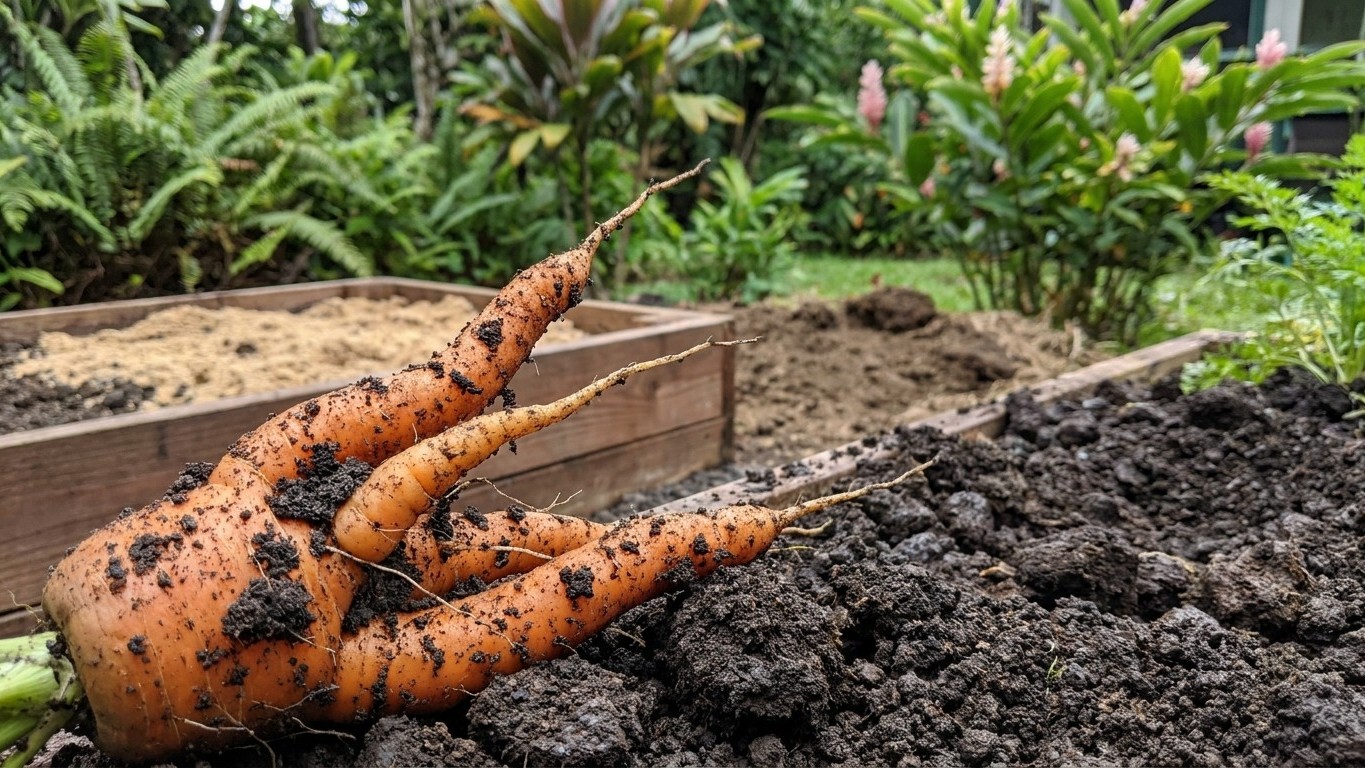
Utah State University Extension describes the ideal carrot ground as deep, sandy, well-drained soil rich in organic matter. It also says heavy or rocky soil makes the root fork. Hold Holdrege up against that list. Drainage passes. Clay at 22 percent is well short of the heavy, sticky profile that splits a root into legs. Sand at 11 percent means the soil is far from the sandy ideal, though, and 2.0 percent organic matter is modest.
So a carrot is unlikely to fork badly in ground like this, but it will not grow in perfect conditions either. Compost worked in ahead of sowing closes most of the gap. Where the bed turns out heavier than the state average, the answer from Utah State is plenty of compost plus double digging. If drainage is poor or clay runs high, build a raised bed. Swapping to a different variety does not fix it, and the source names no variety that would.
One limit on all of this: a state spans hundreds of soil series, and this is a starting point, not a diagnosis. River bottoms, hill country and any lot a builder has scraped or filled can look nothing like Holdrege. The figures above are USDA’s representative values for the mapped surface layer, not a measurement of a worked garden bed, and that 6.2 is not your pH. For the longer look at this question, see Will Carrots Fork in Nebraska Soil?, and for the crop from seed to table, Growing Carrots in Nebraska.
The test that settles it in your own garden
Your soil is not the state’s. An hour with a spade tells you more than any map, and it costs nothing. Do it in the spot where the carrots will actually go.
- Dig a hole deeper than you think you need. A carrot root needs loose ground all the way down, so go past the depth of the spade blade if you can. Set the soil on a tarp in layers so you can see what came from where.
- Look at the walls of the hole. You want to see the dark topsoil give way gradually. A sudden change to pale, dense material, a hard layer that resists the spade, or a scatter of stones and building debris all point toward forked roots.
- Sort through what you dug out. Pick out stones and count how many you find. Rocks in the path of a growing tip are exactly what the extension warning about rocky soil describes.
- Feel the texture. Take a moist handful (not dripping, not dusty) and rub it between your fingers. Gritty means sand. Smooth and floury means silt. Sticky, and rolling into a long ribbon that holds together when you squeeze it out between thumb and finger, means clay.
- Test the drainage. Fill the hole with water and let it soak away. Fill it a second time and watch. Water that vanishes steadily says the ground drains. Water still standing hours later says it does not, and that bed needs raising.
- Get a real number. Texture by feel is a guess. A lab soil test returns your actual pH and organic matter, which this page cannot supply for your yard.
Read the results together. Loose, stone-free, draining ground needs compost and little else. A hard layer or a high clay feel calls for double digging. Water that will not drain calls for a raised bed.
What goes wrong here
Good soil on paper still produces disappointing carrots when something in the season goes sideways. These are the failures Nebraska ground and weather tend to cause.
- Forked or stubby roots in heavy or stony ground. Wherever the tip hits clay, compaction or a rock, it splits or stalls. Remedy: add plenty of compost and double dig, pull out the stones, or move to a raised bed filled with loose, stone-free mix. Silty ground that has been stepped on or worked wet should be loosened before sowing.
- Poor germination in a hot spell. Carrot seed is slow, and a bed that bakes dry after sowing can leave gaps. Nebraska summers can turn hot fast. Remedy: keep the seedbed evenly moist until sprouts show, and lay a light cover over the row while you wait. Since the crop is sown in place, there is no transplant to fall back on, so re-sow the bare stretches instead.
- Splitting from uneven water. A dry stretch followed by a soaking rain or a heavy watering can crack roots lengthwise. Remedy: water on a steady schedule, mulch to hold moisture between waterings, and avoid letting the bed cycle between bone dry and flooded.
- Pulling on the wrong date. Counting from a transplant date, which carrots do not have, leads to harvesting early. Remedy: count from the day the seed went in, use the 65 to 75 days from Clemson as a guide, and pull one root to check before you pull the row. The wider 70 to 100 day window also applies, so do not panic if the row is slow.
- Soft, sprouting or wilted carrots in storage. Tops left on keep pulling moisture from the root. A 50 °F cellar loses carrots to sprouting and softening in a fraction of the time that 33 °F does. Remedy: cut the tops first, then store at 33 °F with high humidity. Clemson’s 10 to 14 days applies only to bunched carrots with the leaves still attached.
- Damage before you even harvest. Chewed or tunneled roots are not a soil problem at all. See What Eats Carrot in Nebraska, and When for what to look for.
Common questions
When do I start counting days to harvest?
From seeding. Carrots are sown directly in the bed, so there is no transplant date to use. Clemson Extension puts harvest at about 65 to 75 days after planting, and the broader count for carrots runs 70 to 100 days from seeding. Frost dates differ by county and are not published here, so check local records for yours.
How do I know a carrot is ready?
Pull one. The day count is a guide, and the root tells you the rest. If it has filled out and looks like a finished carrot, pull the row. If it is thin, give the bed a little longer. No single size figure is carried here, so trust your own eyes over a number.
Why cut the tops before storing carrots?
The leaves keep drawing moisture out of the root, and the carrot wilts as a result. That is the reason bunched carrots with tops on keep only about 10 to 14 days, while trimmed ones keep for months. Cut the tops first, then chill the roots.
Is a root cellar cold enough for carrots?
Only if it actually holds 33 °F, which is just above freezing and colder than most cellars in a mild fall. At 50 °F, carrots sprout and soften in a fraction of the time. Clemson calls for 33 °F and high humidity to prevent wilting, so measure the space with a thermometer before you commit the harvest to it.