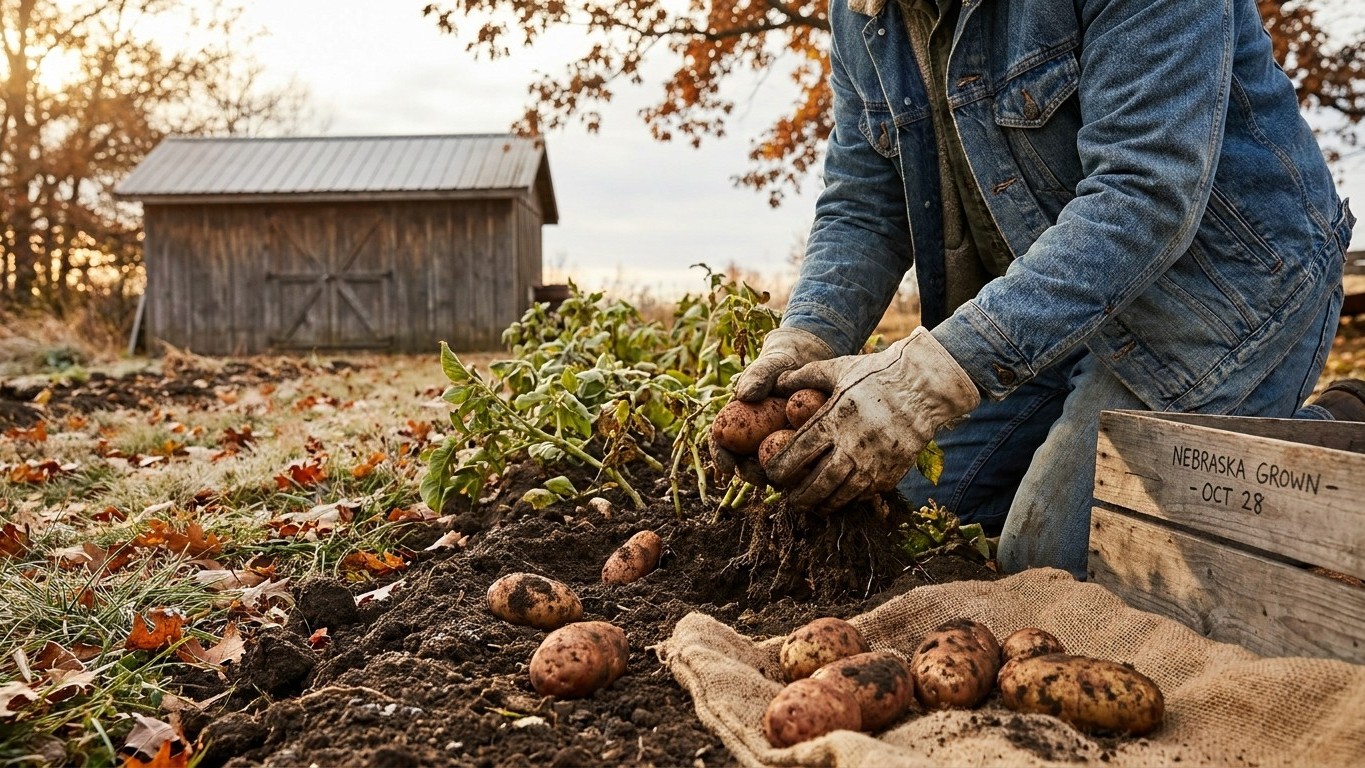

Dig Nebraska potatoes before the ground freezes hard, working around the first fall freeze window of October 15 to October 26 for the Omaha area, then cure them near 55-60°F for two to three weeks before moving them into permanent storage. An unheated garage or shed will not hold potatoes safely all winter here: this state’s coldest month averages a nightly low of just 15.2°F, cold enough to freeze tubers solid if they’re left somewhere without a heat source.
The short answer
Two numbers frame everything about growing and keeping potatoes in Nebraska. The first is the fall frost window recorded at the Omaha reference station: October 15 to October 26, based on NOAA NCEI Climate Normals covering 1991-2020. The second is the mean minimum temperature of the coldest month, which sits at 15.2°F. That second figure matters more than most gardeners realize, because it’s not the record low from some unusual cold snap. It’s the average nightly low across the coldest month of the year, the number that tells you what your storage space deals with night after night, week after week.
Those two figures together decide the whole calendar. Vines are typically killed back by that first fall freeze, and the tubers underground need to come out within a reasonably short stretch afterward, before the soil itself starts to freeze at depth. Gardeners farther out in rural counties or at higher ground often see that first freeze arrive a week or two earlier than the airport-station date suggests, so treat October 15 as the point to start watching your own thermometer, not a fixed deadline.
The mean minimum of 15.2°F is the number that answers the storage question directly. An unheated structure in this state, be it a detached garage, a garden shed, or an uninsulated porch, will track outdoor air temperature closely enough that it drops well below freezing for extended stretches once the coldest month sets in. Potatoes held in a space like that don’t just get chilly. They freeze, and a frozen potato turns soft, discolored, and inedible once it thaws. That rules out casual outdoor storage as a winter-long solution anywhere in the state, even though it might work for a few weeks in early fall before the deep cold arrives.
What this means practically is that curing and storage need two different environments, and neither one is the unheated outbuilding many gardeners default to. Curing needs warmth. Storage needs cold, but not that cold. Finding both inside a Nebraska property, especially at the exact time of year the frost window and the cold season overlap, is the real logistical puzzle this state presents.
Curing, and where
Utah State University Extension recommends curing potatoes at 55-60°F with high humidity for two to three weeks before storage. That range sits comfortably above outdoor air temperatures during a typical Nebraska harvest window in mid-to-late October, when nighttime lows are already sliding toward freezing. Finding 55-60°F outdoors, even in a sheltered spot, gets harder by the day once you’re past the first week of the frost window. The practical answer is almost always indoors, in a space that isn’t actively heated for living but stays buffered from outdoor swings.
- Dig on a dry day. Wet tubers carry more soil-borne organisms into curing and store poorly regardless of temperature. Let the soil dry on the surface for an hour or two before bagging or boxing.
- Move tubers straight to a basement, root cellar, or interior utility room. These spaces in Nebraska homes typically sit in the 55-65°F range through October even without supplemental heat, which puts them close to the USU target without adjustment.
- Avoid the garage and the porch at this time of year. Once the frost window opens, both spaces swing with outdoor temperatures overnight, often dropping well below the 55°F floor USU recommends, especially in the second half of the window.
- Add humidity if the space feels dry. A basement heated by a forced-air furnace can drop humidity noticeably. Covering bins loosely with burlap or damp cloth helps hold moisture around the tubers during the two-to-three-week cure.
- Check airflow. Curing needs humidity, not stagnant, wet air. A space with some ventilation, even a cracked door or a small fan on low, keeps mold from taking hold on damaged tubers.
- Sort before curing, not after. Set aside anything cut, bruised, or soft. Curing helps skins toughen and small wounds heal over, but it does not fix damage that’s already advanced.
A basement is the most reliable answer for most Nebraska households simply because it holds a stable temperature range close to what USU specifies without any active management. Garages and porches can work for the earliest harvests in a warm fall, but they become unreliable fast as the frost window progresses.
Storing through this winter
Once cured, potatoes need a different environment entirely. Utah State University Extension recommends a dark space at 40-45°F for winter storage, while the University of Maine Cooperative Extension gives a slightly cooler figure of 38°F at 95 percent humidity. Both ranges sit well above the 15.2°F mean minimum of Nebraska’s coldest month, and that gap is exactly the problem. A space that simply mirrors outdoor conditions here will run far colder than either recommendation calls for, freezing the crop rather than preserving it.
This is where the difference between a basement and an unheated outbuilding becomes critical. A basement, especially one below frost depth and adjacent to a heated portion of the house, tends to stay in the 45-55°F range through the coldest months even without deliberate climate control, which puts it near the warmer edge of USU’s recommended band. That’s usable, though it trends warmer than ideal, which can nudge sprouting earlier in late winter. A detached garage or shed, on the other hand, will regularly sit near or below that 15.2°F mean minimum on cold nights, freezing anything stored there solid.
Root cellars built into a hillside or an unheated corner of a basement, insulated from the living space but still buffered by surrounding soil, come closer to the 40-45°F target and are the traditional solution for exactly this climate problem. Where one isn’t available, an insulated cooler or a well-insulated storage bin placed in a consistently cool but not freezing basement corner can approximate the range, particularly if a simple min-max thermometer is used to check it periodically through the season.
The humidity side matters just as much as temperature. The University of Maine’s 95 percent figure is a reminder that dry storage air, common in Nebraska basements once furnaces run through the winter, shrivels tubers even at the right temperature. Loosely covered bins, slightly damp sand or peat layered around tubers, or a humidity tray nearby all help close that gap without letting the space get so wet that rot sets in.
What goes wrong here
- Frozen tubers from outbuilding storage. Garages and sheds track outdoor temperature closely enough that they drop well below the 40-45°F target during Nebraska’s coldest month, freezing potatoes solid. Move storage into a basement or insulated cellar before the first hard cold snap of the season.
- Digging too late. Waiting past the first fall freeze to dig risks tubers sitting in soil that’s starting to freeze at depth, damaging skins and interiors. Watch local forecasts as October 15 approaches and dig on the next dry day once vines have died back.
- Curing in a space that’s already too cold. A garage or porch used for curing in late October often sits below the 55-60°F floor USU recommends, slowing the skin-toughening process and leaving tubers more vulnerable to storage rot. Shift curing indoors to a basement or utility room once nighttime lows start approaching freezing.
- Dry storage air from furnace heat. Once home heating systems run steadily through winter, basement humidity can drop well below the 95 percent the University of Maine recommends, shriveling stored tubers by midwinter. Cover bins loosely and add a damp layer of sand or peat around the potatoes.
- Sprouting from a too-warm storage spot. A basement corner near a furnace or water heater can run warmer than the 40-45°F band, pushing tubers to sprout well before spring. Relocate storage bins to the coolest, darkest corner of the basement, away from any heat source.
- Disease pressure from wet harvest conditions. Digging in damp soil or during a wet stretch increases the risk of storage rot regardless of temperature control. An appropriate fungicide applied during the growing season, following label directions, reduces this risk before harvest even begins.
Common questions
How early should I start checking for frost in fall?
Begin watching nightly forecasts as October arrives, since the reference window for this state’s first fall freeze runs from October 15 to October 26. Gardens outside city centers, especially at higher elevation or in low-lying rural spots, often see frost arrive earlier than that airport-based window, so treat the date as a starting point for vigilance rather than a fixed deadline.
Can I store potatoes in an unheated garage for a short time in fall?
For a brief stretch right after harvest, before the deep cold of the coldest month sets in, an unheated garage may stay within a workable range on milder nights. But once temperatures settle into that 15.2°F mean minimum territory, the same space will freeze stored tubers, so it’s not a viable long-term solution here.
What’s the difference between the two storage temperature recommendations?
Utah State University Extension recommends 40-45°F for winter storage, while the University of Maine Cooperative Extension specifies 38°F at 95 percent humidity. Both are workable targets; the Maine figure emphasizes humidity control more explicitly, which matters in a Nebraska basement where furnace-dried air is a common issue.
Does curing really matter if I’m just eating the potatoes over a few months?
Yes. The two-to-three-week cure at 55-60°F that USU recommends toughens skins and helps minor cuts heal over, which directly reduces rot during the months the tubers sit in storage. Skipping it doesn’t ruin a crop overnight, but it shortens how long that crop keeps before spoilage sets in.