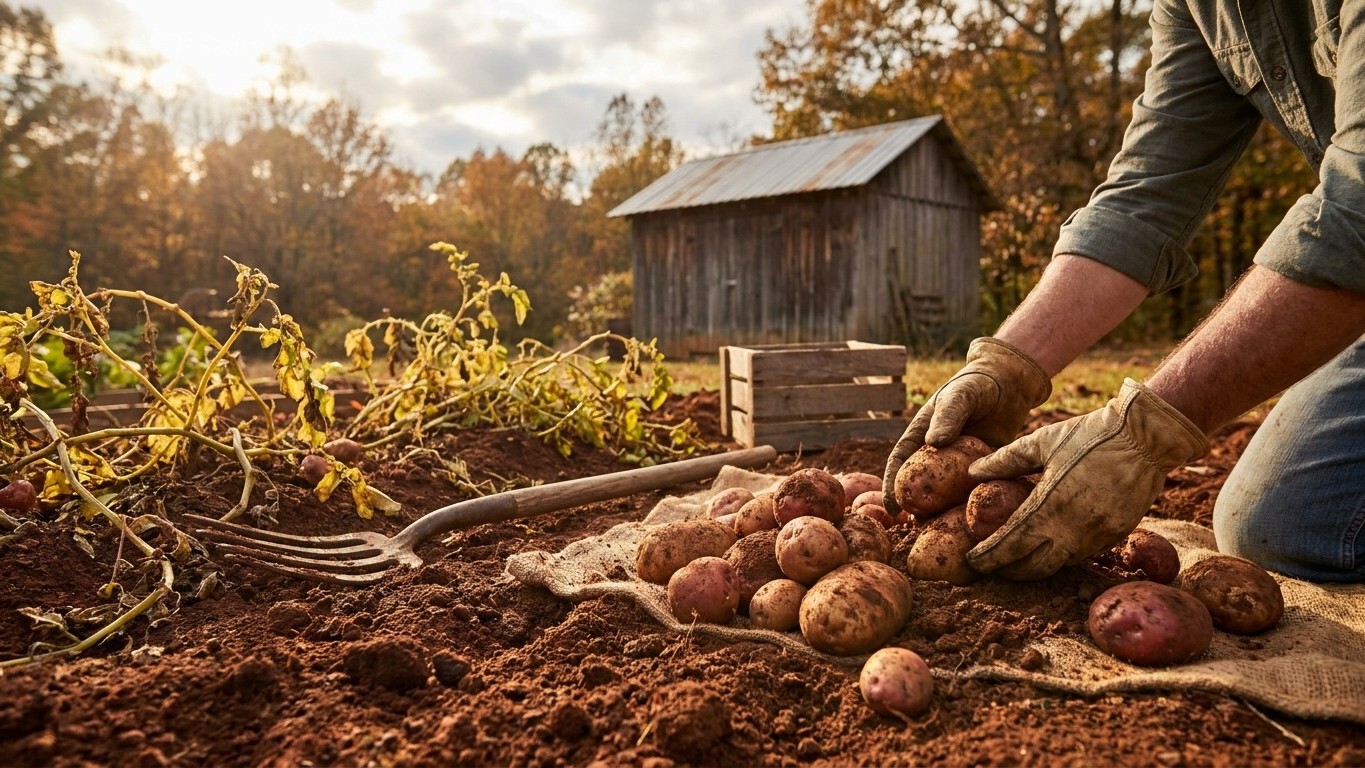

Wisconsin gardeners should dig their potatoes before the first fall frost hits, which lands anywhere from October 17 to October 29 depending on where in the state you garden. Curing takes 2 to 3 weeks at 55-60 F. Winter storage needs 40-45 F and darkness, but Wisconsin’s coldest month averages a nightly low of just 17.2 F, cold enough to freeze anything left in an unheated garage or shed.
The short answer
Two numbers set the calendar and the storage strategy here. The first is the frost window itself: October 17 to October 29, based on NOAA’s 1991-2020 Climate Normals for the reference station used in this data set. The second is the mean minimum of the coldest month, which sits at 17.2 F. That’s not a record low or a one-night event. It’s the average nightly temperature the state settles into for weeks at a stretch during deep winter.
Those two figures point in different directions, and both matter. The frost date tells you when to get the crop out of the ground. Main-season potatoes should come out before that first freeze reaches the tubers, since frozen soil can damage or discolor them even if the vines above ground died back naturally. Gardeners along the Lake Michigan shoreline get a reprieve, since the lake delays that first freeze compared to inland areas. Inland southern Wisconsin typically sees its first freeze arrive earlier, in the first days of October, and the northern part of the state freezes earlier still. If you garden away from the lakeshore, don’t count on the later end of that window.
The second number, 17.2 F, answers a different question: what happens to your harvest after it’s dug. An unheated detached garage, a garden shed, or an open porch will track outdoor air temperature closely once the season turns. When the coldest month is averaging nightly lows in the high teens, any structure without insulation or a heat source spends weeks below freezing, not just the occasional cold snap. That’s fatal to stored potatoes, which need to stay in the 40-45 F range all winter, not slip below 32 F.
The practical takeaway: an unheated, uninsulated space in Wisconsin will not hold 40-45 F through the winter. It will freeze. A basement, an insulated root cellar, or a similarly buffered space is what this climate requires for a crop that needs to last from October through the following spring.
Curing, and where
Curing is the step between digging and storage, and it matters more than most gardeners expect. Utah State University Extension recommends curing at 55-60 F with high humidity for 2 to 3 weeks. That process heals small cuts and bruises from digging and thickens the skin, which is what allows the crop to survive months in storage instead of rotting within weeks. Skip it, or do it somewhere too cold, and you’ll lose potatoes to soft rot well before spring.
Finding 55-60 F outdoors in Wisconsin at harvest time is not simple. By the time potatoes come out of the ground, in that mid-to-late October window before the first frost, nighttime air temperatures are already sliding toward the 30s and 40s in much of the state. A shaded porch might work for a few days early in the digging season, but as October wears on it becomes too cold and too exposed to wind for a reliable 2-to-3-week cure. That leaves indoor spaces as the more dependable option.
- Dig potatoes on a dry day, before the first frost date for your part of the state, and let them sit on the soil surface for an hour or two to dry off any surface moisture. Don’t wash them.
- Move them promptly out of direct sun and into a space that holds 55-60 F. In most Wisconsin homes at this time of year, that’s a basement rather than a garage, since an attached or unheated garage can already be swinging closer to outdoor temperatures by late October.
- Spread the tubers in a single layer, or in shallow crates, so air reaches all sides. Stacking them deep traps moisture and invites rot.
- Hold them at that temperature and high humidity for 2 to 3 weeks, checking periodically for any tuber that’s gone soft and removing it so it doesn’t affect the rest.
- Once the skins have set, meaning they no longer scuff or peel easily under a thumbnail, the cure is done and the crop is ready to move into longer-term storage.
Storing through this winter
Once cured, potatoes want two things: darkness and cold, but not too cold. Utah State University Extension puts the target at 40-45 F, and the University of Maine Cooperative Extension gives a tighter figure of 38 F at 95% humidity for longer-term storage. Both sources agree on the same basic principle: potatoes need to be cold enough to stay dormant and slow their moisture loss, but never cold enough to freeze.
That’s where Wisconsin’s coldest-month average of 17.2 F becomes the deciding factor for where you store the crop. A finished basement with some distance from the furnace often runs warmer than 45 F all winter, which risks sprouting before spring. An unfinished basement, particularly a corner near the foundation wall away from heating ducts, tends to run closer to that 40-45 F range because the surrounding earth buffers it from the extremes happening outside. An attached garage is a gamble: if it’s insulated and shares a wall with the heated house, it may hold up, but if it’s a detached, uninsulated structure, it will follow outdoor air down into the teens and destroy the crop by mid-winter.
A root cellar, whether a dedicated dug space or simply the coolest, most stable corner of a basement, is the traditional answer for a reason: it uses the ground itself to keep temperatures inside that 38-45 F band regardless of what’s happening at 17.2 F outside. If your storage space runs warmer than that range, the fix is finding a cooler spot, not propping a window or door open to outside air, since that risks swinging straight through the target range into a hard freeze on the coldest nights. Wrapping the storage container in an old blanket or burlap, and keeping it away from any heat source, helps hold steady conditions through the coldest stretch of the year.
What goes wrong here
- Digging after the ground has already frozen. Waiting past the frost window risks frozen soil damaging or discoloring tubers before they’re even out of the ground. Dig within days of vine die-back and before the frost date for your part of the state, especially if you’re inland rather than near Lake Michigan.
- Curing in a space that’s already too cold. A garage or porch that’s dropped into the 30s or low 40s by late October won’t cure potatoes properly; the skins stay thin and the crop rots early in storage. Move the cure indoors to a basement once outdoor nights start falling below the 50s.
- Storing in an unheated, uninsulated structure. With the coldest month averaging 17.2 F, a detached garage or garden shed will freeze stored potatoes solid for weeks at a time. Move winter storage to a basement or a genuine root cellar space.
- Storing too close to a furnace or heat duct. A basement corner that runs warm sprouts potatoes well before spring. Find the coolest, most stable spot in the space, typically along an exterior foundation wall, away from any heat source.
- Low humidity in a heated basement. Dry indoor air in winter shrivels potatoes even at the right temperature. Cover the storage container with damp burlap or store in a slightly humid corner, such as near a laundry area, to approach the 95% humidity the University of Maine recommends.
- Insects and disease carried in from the field. Tubers with feeding damage or fungal spotting should be set aside and used first rather than stored long-term; an appropriate insecticide or appropriate fungicide applied during the growing season reduces how much of this shows up at harvest.
Common questions
How do I know if my potatoes have frozen in storage?
Frozen tubers turn soft and watery once they thaw, often with a grayish or translucent look to the flesh, and they’ll have a distinctly sweet smell from converted starches. Any tuber like that should be discarded rather than stored alongside the rest, since it will rot and can affect neighboring potatoes.
Can I store potatoes in an unheated garage if I insulate the container heavily?
Heavy insulation slows temperature swings but doesn’t stop them indefinitely. With the coldest month averaging 17.2 F, an unheated garage will eventually pull even a well-insulated container below freezing during a sustained cold stretch. A basement or root cellar remains the more reliable choice for the full winter.
Does the exact frost date matter if I garden near Lake Michigan?
Yes. The lake delays the first fall freeze at the shoreline compared to inland Wisconsin, so shoreline gardeners often see frost arrive later within, or even after, the October 17 to October 29 window, while inland and northern gardeners should plan on the earlier end.
Is 45 F too warm for long-term storage?
It’s the upper end of the range Utah State University Extension recommends, and it works for shorter storage periods. For potatoes meant to last deep into the following spring, the tighter 38 F at 95% humidity figure from the University of Maine Cooperative Extension is the more conservative target if your storage space can hold it.