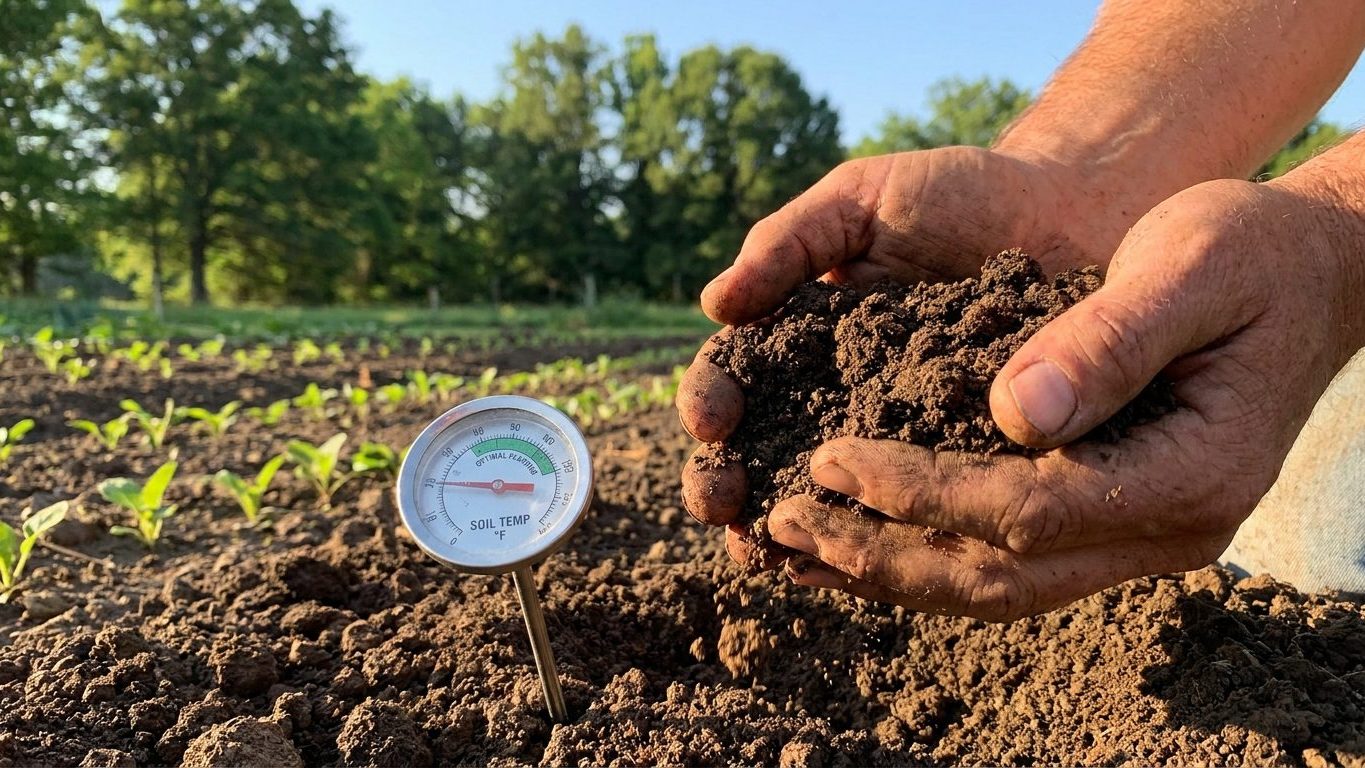

Winter Squash in Wisconsin goes into the ground once soil temperatures climb reliably above 60°F, typically in late May to early June across most of the state. With a growing window running roughly from mid-April to late October, the state’s shorter season and cool, humid summers make timing and squash type the two decisions that matter most.
When the soil is warm enough in Wisconsin
Gardeners asking “when do I plant” usually mean the last frost date, and for Wisconsin that’s April 16 to April 29, according to NOAA NCEI’s 1991-2020 Climate Normals for the 30-70% freeze probability band, measured at station USW00014839. But that date answers the wrong question for winter squash. Frost tells you when the air stops threatening to kill a seedling. It says nothing about whether the soil is warm enough to let a squash seed germinate at all.
Winter squash seeds are lazy in cold dirt. They sit, they rot, they occasionally sprout weak and stunted. The soil needs to hold steady warmth, not just avoid freezing, and that warmth typically arrives two to three weeks after the last frost date has passed. So while April 16-29 marks the end of frost risk on paper, most Wisconsin gardeners aren’t planting squash seed directly until well into May, sometimes pushing into early June in the cooler northern counties.
That frost window itself is a probability, not a guarantee. It describes a 30 to 70 percent chance of a 32°F freeze around those dates at the reference station, which means a late cold snap after April 29 is entirely plausible, especially away from the moderating influence of Lake Michigan. The lakeshore counties run milder in both directions; inland southern Wisconsin tends to freeze earlier in fall, and the north freezes earlier still, sometimes by weeks.
What the hardiness zone tells you (and doesn’t)
Wisconsin spans USDA Hardiness Zones 3b to 6a, based on the USDA Plant Hardiness Zone Map (2023 edition, using 1991-2020 normals). That’s a wide range for one state, built entirely on one number: the average annual extreme minimum winter temperature. It has nothing to do with spring soil warming or summer growing conditions, and it says nothing about frost dates. It’s useful for deciding whether a perennial will survive winter, not for deciding when to sow squash. Since the range runs from cold Zone 3b in the north to milder Zone 6a near the lake, a planting calendar built for one part of the state can be two or three weeks off for another.
The practical move: don’t plant by the calendar date alone. Check soil temperature directly, and if in doubt, wait an extra week rather than gambling on a seed that won’t germinate in cold ground. Wisconsin’s growing season is short enough that a failed first sowing is a real setback, not a minor inconvenience.
How long the season lasts here
Running the two NOAA frost windows together gives the outer boundary of the frost-free season: from the last spring frost (April 16 to April 29) to the first fall frost (October 17 to October 29), both from the same 1991-2020 Climate Normals at station USW00014839. Counting from the latest spring date to the earliest fall date gives a conservative window of roughly 172 days; counting from the earliest spring date to the latest fall date stretches it to about 197 days. Either way, Wisconsin’s frost-free season lands somewhere in the neighborhood of five and a half to six and a half months, and that’s before accounting for the extra chill of the soil-warming delay described above.
For winter squash, that’s a moderate window; workable, but with less margin than warmer states enjoy. It’s long enough to grow a full crop from direct-sown seed in most years, but it doesn’t leave much room for a second attempt if the first sowing fails to germinate or gets wiped out by a late cold snap. In a state with a 197-day best case, a gardener who loses three weeks to a failed first planting is now asking a squash vine to mature in under six months, which is tight for most winter types.
This is also why transplanting gets debated so much in Wisconsin gardens. Starting squash indoors and setting out transplants can buy two to three weeks of head start, which matters more here than it would in a state with an eight-month season. The tradeoff is that squash resents root disturbance, and a poorly hardened transplant can stall for a week or more after transplant shock, erasing the head start it was supposed to provide. Direct plants that ARE well hardened, and transplanted young, before the roots circle the container, before recommending that route.
A true second sowing of winter squash, a full second crop planted after an early harvest, isn’t realistic in most of Wisconsin given this window. What some gardeners do instead is stagger two sowings a week or two apart in late May and early June as insurance against a poor germination on the first attempt, not as a true succession strategy. For the mechanics of staggered plantings and which crops actually support a real second round, the succession sowing guide on this site walks through the timing math in more detail.
Heat and water in Wisconsin
Winter squash lives or dies by whether the fruit fully matures on the vine before frost. An immature squash won’t cure properly and won’t store, no matter how it looks when you pick it. That single fact makes season length, not heat, the dominant variable in Wisconsin, because this is not a hot-climate garden state.
NOAA’s 1991-2020 Climate Normals put Milwaukee, the reference station, at just 7.0 days a year reaching 90°F or higher. That’s a modest heat load. Squash plants tolerate warmth well and actually want it for fruit-filling, but Wisconsin summers simply don’t deliver the sustained heat that drives the kind of aggressive evaporation and water stress seen further south. Irrigation planning here is less about rescuing plants from heat stress and more about keeping fruit set steady during dry stretches.
Rainfall backs this up. Summer rainfall (June, July, August) averages about 11.4 inches, with June running wettest at 4.38 inches, July driest at 3.4 inches, and August at 3.65 inches, all from NOAA NCEI Monthly Climate Normals at station USW00014839. That’s a reasonably wet summer by national standards, and July’s relative dryness lines up with the peak of squash’s water demand during fruit sizing. But rainfall totals never tell the whole story: the same inch of rain drains through sandy soil within a day and sits in clay for a week, and a single thunderstorm dumping an inch in an hour mostly runs off rather than soaking into the root zone. A rain gauge on the actual garden plot is the only way to know what a given bed is really getting.
The real risk: cool, damp, and slow
With low heat load and decent summer moisture, Wisconsin’s bigger threat to winter squash isn’t drought. It’s the opposite: cool, humid stretches that favor powdery mildew, downy mildew, and other foliar diseases, along with fruit that ripens more slowly than the seed catalog implies. Good airflow between plants, morning watering that lets foliage dry before evening, and resisting the urge to crowd vines all matter more here than any irrigation schedule. A gardener planning for Wisconsin should budget for disease management and slow ripening risk, not for heat stress.
Which winter squash suit Wisconsin
Given a moderate frost-free window, low heat load, and a real risk of cool, humid disease pressure, the types that tend to do best in Wisconsin share three traits: they mature relatively early, they carry some resistance to powdery and downy mildew, and they don’t demand a long stretch of hot weather to finish sizing and curing. Earlier-maturing types give the fruit the best odds of fully ripening before the October frost window arrives, which matters more in Wisconsin’s roughly six-month season than it would in a state with an extra two months to spare.
Disease resistance deserves to be the first filter a Wisconsin gardener applies, ahead of flavor or storage life, because a summer of 11-plus inches of rain and mild heat is exactly the condition that lets mildew take hold on susceptible vines. Airflow helps, but starting with a type bred for resistance removes a lot of the guesswork, especially in a wet year.
This page won’t name specific varieties, and that’s a deliberate choice, not an oversight. Cultivar performance shifts from year to year and county to county based on local disease pressure, soil, and microclimate, and a name printed here without local trial data behind it is just a guess dressed up as advice. What actually holds up is checking which varieties the University of Wisconsin-Madison Division of Extension has trialed and recommended for the state’s specific regions, since those recommendations come from field trials run in Wisconsin conditions, not a national seed catalog written for every zone at once.
The broader logic still applies without a variety list: in a short-season, cool-summer, disease-prone state like Wisconsin, choose types described as early-maturing and disease-resistant, give them room and airflow, and treat the local extension office’s list as the final word on which specific squash will actually finish and cure before the first fall frost closes the season.