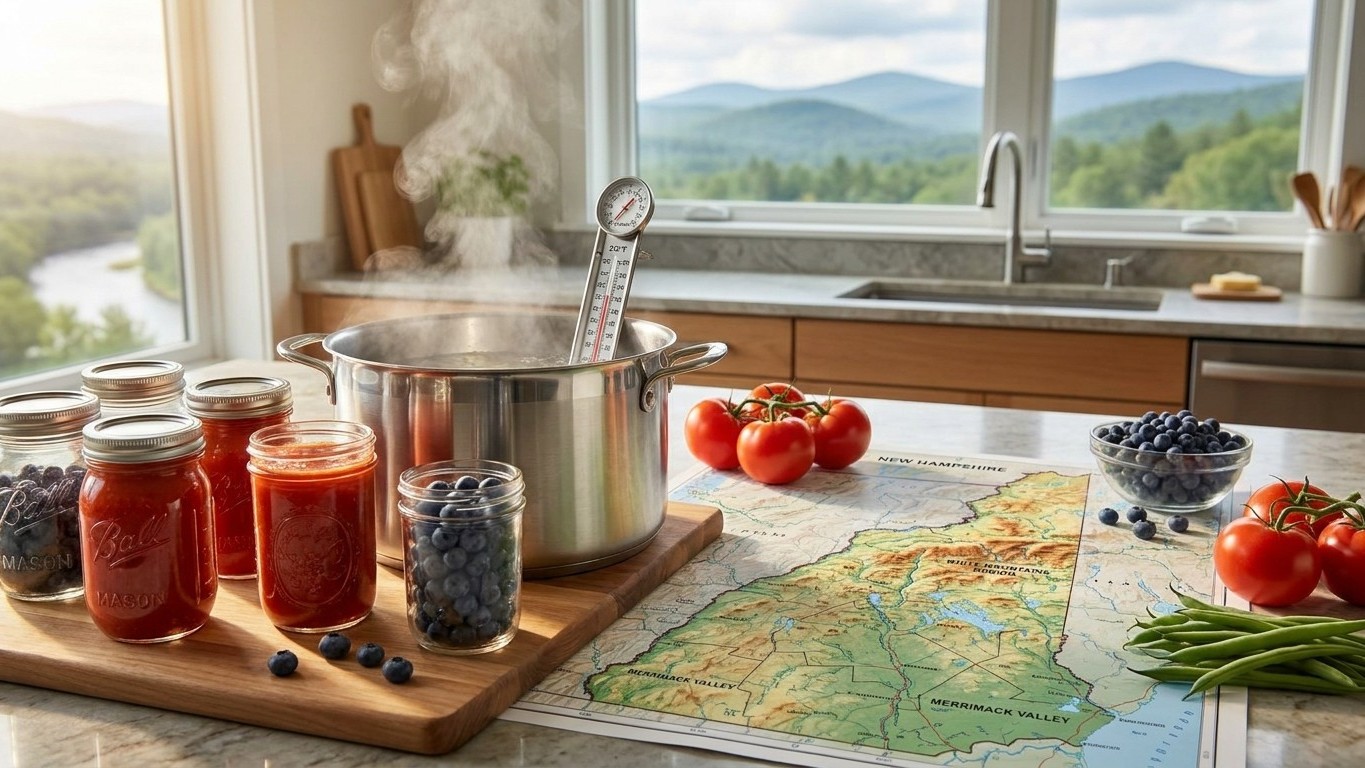

Manchester, New Hampshire sits at 262 feet above sea level, where water boils somewhere between 208°F and 212°F. That’s close enough to the standard sea-level boil that a home canner in Manchester itself has little to worry about. But New Hampshire is not one elevation. The state stretches from tidal marshes near the coast to mountain valleys and ridgelines far above that number, and the adjustment you need depends on where your kitchen sits, not on where the state capital sits.
The short answer

Manchester’s 262 feet puts it inside the lowest elevation band canning guides use, the 0 to 2,000 foot range, where published boiling temperatures run between 208°F and 212°F. That’s a soft boil difference of a few degrees at most, and for most home canners working at that elevation, it doesn’t force a change to the process. If your kitchen is in Manchester, Nashua, or another low-lying spot near sea level in the Merrimack or Connecticut River valleys, you’re likely canning at close to the same boiling point the original tested recipe assumed.
That’s the whole point of naming Manchester as a reference city rather than calling it “New Hampshire’s elevation.” No such single number exists. A state is a patchwork of river valleys, foothills, and mountain towns, and canning adjustments are keyed to feet above sea level at your address, not to a statewide average or a state capital.
Why the range, not a single figure
The 208°F to 212°F range reflects the band Manchester falls into, not a fixed reading for that one address. Elevation nudges the boiling point down gradually, a degree or two per thousand feet, so anywhere within that low band behaves close to sea level. Once you climb into the White Mountains or other higher terrain, the boiling point keeps dropping, and at some point that drop is large enough that a recipe written for sea level no longer delivers the heat it was designed to deliver. That’s the threshold this whole topic turns on, and it has nothing to do with how vigorously the water is boiling. It’s about how hot the boil actually is.
Why a lower boil is a weaker process
Water boils when it turns to vapor, and the temperature at which that happens depends on air pressure pushing down on it. Less air pressure, which is what you get as elevation rises, means water gives up and turns to steam at a lower temperature. At sea level that’s 212°F. By 10,000 feet, it’s dropped to 194°F. Those aren’t estimates; they’re the two ends of a well-documented curve published in the USDA’s canning guidance.
A lower boil is not a weaker-looking boil. It can bubble just as hard, roll just as visibly, and still be several degrees cooler than the boil a recipe was tested at. That matters because canning times are built around a specific temperature doing a specific amount of destructive work over a specific number of minutes. Cooler water does less of that work per minute. It’s not a matter of the jars looking underdone. They can look perfectly sealed and processed while the actual heat delivered inside them fell short of what the tested recipe assumed.
Boiling water harder does not fix this. Once water is boiling, adding more heat under the pot doesn’t raise its temperature further; the extra energy just makes more steam faster. There is no way to boil water hotter at a given elevation by turning up the burner. The only two levers that actually compensate for a cooler boil are time and pressure. In a boiling-water canner, the fix is more minutes in the pot, giving that cooler water longer to do the same job. In a pressure canner, the fix is more pounds of pressure, which raises the temperature inside the sealed canner well above what plain boiling water can reach on its own, restoring the heat a lower atmospheric boil took away.
This is why altitude shows up in canning charts as an add-on to a base processing time or pressure, never as a replacement for the whole recipe. The base numbers assume sea level. Elevation adds back what a thinner atmosphere subtracts.
Finding your own elevation
- Start with your street address, not your town’s name or its most famous landmark, since elevation can shift by hundreds of feet within the same town limits, especially in hilly or mountainous parts of the state.
- Use the National Center for Home Food Preservation’s “Find Your Elevation” page, built specifically so home canners can look up a number tied to processing charts rather than a general geography reference.
- Enter your address or zip code as instructed on that page and note the elevation in feet it returns for your location.
- Round up if your number falls near a boundary between elevation bands; canning guidance always treats an uncertain reading as the higher, more cautious elevation.
- Write that number down somewhere near your canning setup, since you’ll need it every time you open a recipe that asks for an altitude adjustment, not just once.
What goes wrong
- A jar that looks perfectly sealed but was under-processed. The lid popped, the seal held, the jar sat on the shelf looking exactly like a safe one. None of that tells you whether the contents reached a temperature high enough for long enough. The remedy is checking your elevation against the recipe’s chart every time, not judging success by appearance after the fact.
- A recipe pulled from a source that never mentions elevation at all. Plenty of recipes online and in older cookbooks are written for sea level and simply don’t say so. If a recipe gives one flat processing time with no altitude chart attached, treat that as a warning sign rather than a shortcut, and cross-check it against a tested source that does publish adjustments by elevation band.
- A pressure gauge read as if elevation doesn’t exist. The pounds of pressure a recipe calls for at sea level are not the pounds of pressure that deliver the same heat at higher elevation. Reading the gauge correctly means first knowing which elevation band you’re in, then applying the pressure that band’s chart calls for, not just the number printed as the default.
Where the exact adjustment comes from
This page will not give you a processing time or a canner pressure, and that’s deliberate. The right adjustment depends on the specific food, the jar size, and the tested recipe behind it, not on elevation alone. Those figures live in the tested recipes published by the National Center for Home Food Preservation, and that’s where the actual minutes or pounds for your food and your elevation band need to come from.
The reason to take this seriously rather than estimate is that the risk isn’t spoiled flavor or a wasted jar of tomatoes. It’s Clostridium botulinum, the organism behind botulism, and its toxin has no taste and no smell. A jar can look, smell, and taste completely normal and still be dangerous. That’s exactly why home canning adjustments are treated as non-negotiable rather than approximate.
Common questions
Does Manchester’s elevation apply to the whole state?
No. Manchester sits at 262 feet and is used here only as a reference point. New Hampshire includes coastal lowlands and mountain terrain that sit at very different elevations, and your own address is what determines any adjustment, not the city named in a guide.
If I live near Manchester, can I skip elevation adjustments entirely?
At an elevation like Manchester’s, inside the 0 to 2,000 foot band with a boiling point between 208°F and 212°F, most tested recipes won’t require the kind of adjustment that higher elevations do. Still confirm your specific address on the NCHFP elevation lookup rather than assuming, since even nearby towns can sit at different heights.
Why does the boiling point matter more than how hard the water is boiling?
Because a rolling boil and a gentle boil are the same temperature once the water is actually boiling. The temperature is fixed by elevation and air pressure, not by how much heat you apply. What changes the outcome is time or pressure, not the intensity of the bubbles.
What should I do if my address falls between two elevation bands?
Treat it as the higher band. Canning guidance is built to be cautious at boundaries, and using the higher elevation’s time or pressure when you’re unsure protects against under-processing without any real downside to the finished food.