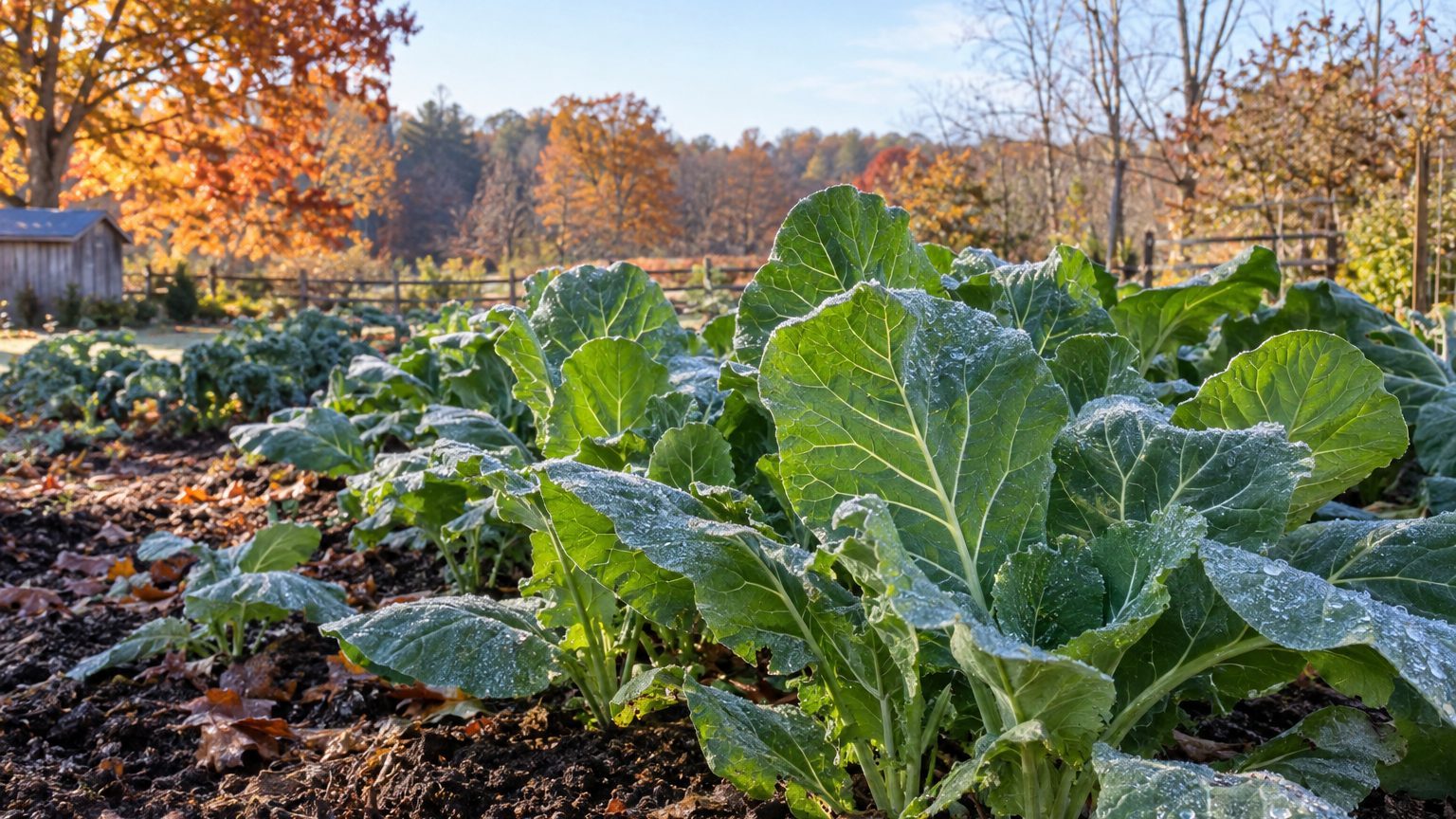

Collards go in twice in high-desert gardens: transplants in March, a few weeks ahead of the last freeze, and a second sowing from late July into August that matures in the cool months. Those dates come from Albuquerque’s frost record. Gardens at higher elevation or out in the country run one to two weeks behind in spring and ahead of it in fall.
The short answer for New Mexico
At the Albuquerque reference station, the last spring freeze falls between March 31 and April 12. The first fall freeze falls between October 29 and November 9. Both ranges are probabilities, not predictions. They mark the band where the chance of a 32°F freeze sits between 30 and 70 percent, so a freeze after the later spring date is still possible, and one before the earlier fall date is too. Rural and suburban gardens usually see the last spring freeze later and the first fall freeze earlier than an airport does.
Collards don’t need to wait for the frost band to pass. They handle light frost, which is why the spring calendar is built around the last-freeze dates rather than after them.
Spring planting
Start seed indoors about six weeks before the transplant date, which means late January to mid-February for a March move outdoors. Set transplants out from early to late March, ahead of the last-freeze band, and keep a row cover or old bedsheet handy for nights that dip hard. Direct sowing works too once the bed is workable and no longer soggy.
Fall planting
Collards typically need two to three months to reach a good harvest, and growth slows as days shorten. Counting back from the October 29 to November 9 band, sow seed or set transplants from late July through mid-August. The plants then size up in warm autumn weather and sweeten after the first cool nights.
| Planting | What to do | Timing (Albuquerque reference) |
|---|---|---|
| Spring, indoors | Start seed | Late January to mid-February |
| Spring, outdoors | Transplant, or direct sow | Early to late March |
| Fall | Sow seed or set transplants | Late July through mid-August |
The coldest month at the reference station has a mean daily minimum of 26.4°F. That is an average of the lows, so individual nights fall below it. Established collards tolerate that range far better than seedlings do. For more on the crop itself, see Growing Collards in New Mexico.
What will not work here
Summer heat and the weekly watering habit
A collard bed watered once a week fails in a high-desert summer. Strong sun and low humidity pull moisture out of the top several inches of soil within a day or two, and collards have most of their feeder roots right there. Plants set out in late April or May stall, toughen and turn bitter before they size up, and leaf quality drops fast once daytime highs stay up. Fall seedlings started in late July face the same heat, so they need light watering every day or two until they establish. Mulch two to three inches deep and a piece of shade cloth over the seedlings help a great deal.
Humidity-driven problems matter less here. Leaf diseases that punish close spacing in muggy climates are a smaller worry, but crowded plants still compete for water. Keep them about 18 inches apart anyway.
Slow varieties and late starts
A short season defeats the slowest varieties. Because rural and higher gardens lose one to two weeks at each end of the season, and more at elevation, a long-maturing type set out in late spring may be running out of weather before it reaches full size. Pushing the fall planting into September has the same problem, because the Albuquerque window of October 29 to November 9 is a reference-city figure, and other parts of the territory differ. The varieties that suit a short season are covered in The Best Collards and Greens for New Mexico.
One more assumption to drop is that collards will simply overwinter everywhere. At the reference station, a coldest-month minimum of 26.4°F is survivable. In colder parts of the state, where nights fall far lower and stay there, plants die back or need real protection.
What changes across New Mexico
The USDA Plant Hardiness Zone Map (2023 edition, built on 1991-2020 normals) places New Mexico in zones 4b through 9a. That spread covers several zones, so there is no single answer for the state. The map’s zones rest on one variable, the average annual extreme minimum temperature. It tells you how cold the worst nights get, not how long the growing season runs or how hot the summer is.
North and altitude
Gardeners in the northern mountains and on high plateaus should push the spring dates later and the fall dates earlier than the Albuquerque numbers. Start with one to two weeks and add more as elevation climbs. Summers there are cooler, which helps collards, but the frost-free window is shorter. Favor quicker-maturing types, use row covers at both ends of the season, and sow the fall crop at the early end of the window or even a little before it.
South and low desert
Warmer southern valleys flip the problem. Spring warms quickly, so the spring crop has to go in early, and the fall planting becomes the more reliable one, with harvests stretching into winter. Heat management matters more than frost protection.
To find your own zone, use the USDA map and enter your ZIP code. Don’t assume the zone of the nearest large city fits your yard, because a few hundred feet of elevation can change it.
Where to check this for your own county
The state’s land-grant extension service, New Mexico State University’s College of Agricultural, Consumer and Environmental Sciences, is the best next stop. Look for two things: the local vegetable planting calendar for your county, and any leafy greens varieties that have been trialled in your area. Your county extension office can often tell you the typical last and first freeze dates for your town, which may differ from the reference city by weeks.
A county recommendation beats a state one. Statewide timing, including the Albuquerque-based dates above, is a starting point built from a single weather station, and county staff work from local conditions and local trials. If their calendar and the dates here disagree, go with theirs.
Ask the office, too, about soil. Many gardens in the region have alkaline, low-organic-matter soil, and local advisers can tell you which amendments and watering schedules have worked in your county.
Checking this against your own garden
Your own observations outrank every date above. Three are worth tracking each spring, and none needs equipment.
- Soil warmth by feel. Push your hand into the bed to wrist depth. If the soil feels cold and clammy, wait. Compare a bed against a south-facing wall with one in an open or low spot. The warmer one is your early planting site, and the colder one tells you where cold air pools.
- The first catkins. Watch the local willows or cottonwoods as spring warms. When they appear in your neighborhood, compare that date year to year. An early or late shift tells you whether your spot runs ahead of or behind the airport figures.
- The first true leaves. On seedlings, the first true leaves come after the rounded seed leaves. Once they are out, the plants are ready to harden off. If seedlings in your cold frame or on a porch reach this stage later than expected, that area is cooler than your calendar assumes.
Keep a notebook of these dates for a season or two. They’ll show you your own frost pattern better than any regional average.
Some gardeners also time this by the Moon: when to plant collard greens by the moon, as almanac tradition rather than fact.
Common questions
Can I plant collards in summer?
Seed sown from late July into August works for a fall harvest if you keep seedlings moist and shaded. Sowing in the heat of June means seedlings that struggle and leaves that toughen, so most gardeners skip it.
Will collards survive a New Mexico winter?
At the Albuquerque reference station, the coldest month averages a daily low of 26.4°F, which established plants often tolerate, especially with a row cover. In colder zones, where nights drop much lower, expect die-back.
Is spring or fall planting better?
Fall usually gives the better leaves, because cool nights sweeten collards and the heat has passed by harvest. Spring plantings have to mature before summer heat arrives, so they are more rushed.
How early should I start seeds indoors?
About six weeks before the transplant date. For March transplanting at Albuquerque’s elevation, that means late January to mid-February. Gardeners at higher elevations should shift both dates later by at least one to two weeks.