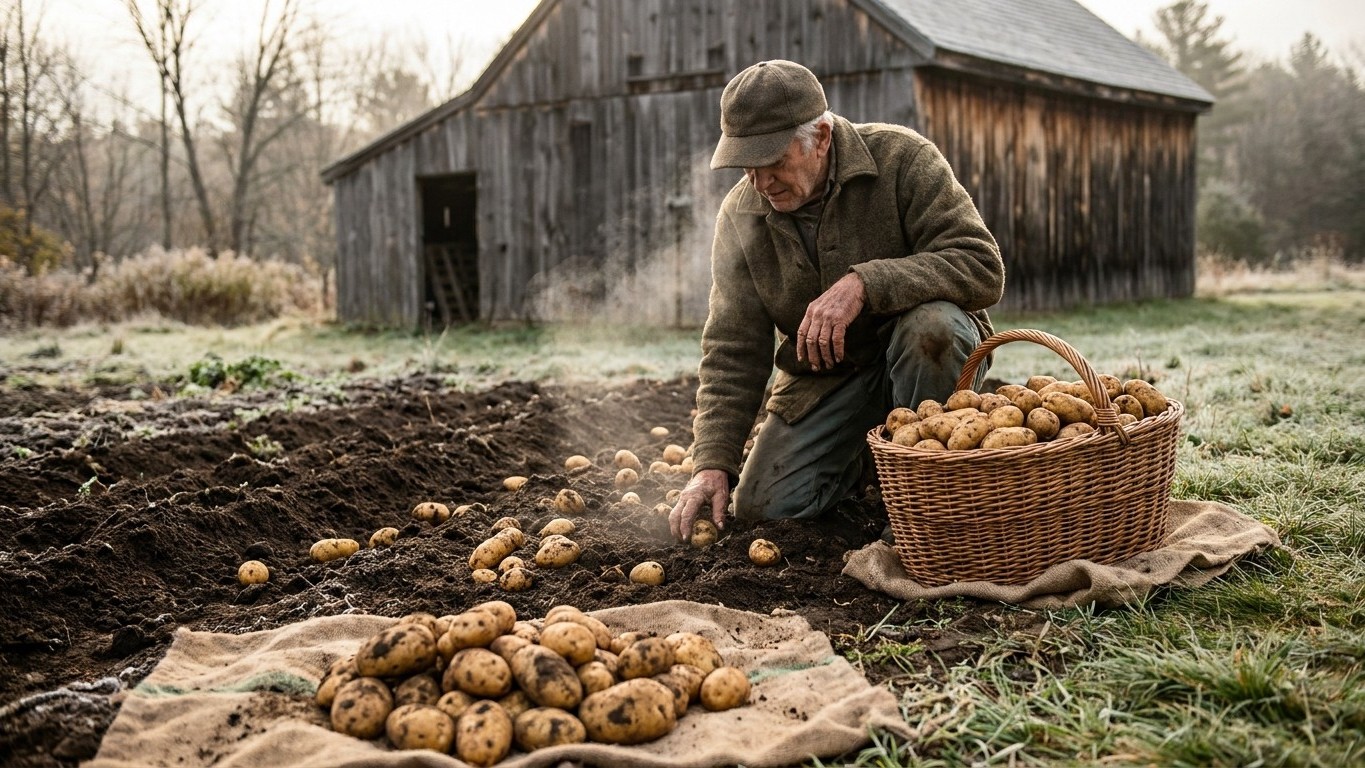

Dig potatoes here before that October 13 to October 26 first-frost window closes, cure them for two to three weeks in a warm, damp spot, then move them to a dark space that holds 40-45 F. An unheated shed won’t do that job once winter sets in, because this state’s coldest month averages a nightly low of 17.1 F.
The short answer
Two numbers decide everything about growing and keeping potatoes in New Hampshire. The first is the fall frost window: October 13 to October 26, based on NOAA NCEI’s 1991-2020 climate normals for the Manchester reference station. The second is 17.1 F, the mean daily minimum temperature for this state’s coldest month, also from that same station’s normals. Neither figure is a guarantee for your particular garden. Gardens outside the immediate Manchester area, especially rural plots or anything with elevation, tend to see frost arrive earlier than the airport data suggests, sometimes by a week or two. Check your own county’s frost history before you set a dig date.
What those two numbers mean in practice: get tubers out of the ground before the ground itself starts freezing, which typically follows close on the heels of that October frost window. Vines usually die back on their own before a hard frost, and that dieback is your best field signal to start digging, regardless of the calendar date. Waiting past frost risks tuber damage from freezing soil, not just cosmetic vine loss.
The 17.1 F figure matters more once the crop is out of the ground and you’re deciding where to keep it. That number is not the record cold snap of the year. It’s the average nightly low across the entire coldest month, which means most nights in January dip close to or below that mark. An unheated garage, a detached shed, or an unheated porch will track outdoor air temperature closely enough that they’ll spend weeks at a time well under the 40-45 F storage target that Utah State University Extension recommends. Potatoes left in that kind of space don’t just get uncomfortably cold; they freeze solid, and a frozen potato is a ruined potato. A basement attached to a heated house, by contrast, usually holds well above outdoor air temperature all winter, because it borrows warmth from the living space above it. That difference, insulated and buffered versus exposed to open air, is the whole ballgame for storage success in this climate.
Curing, and where
Curing is the step growers skip at their peril. Utah State University Extension specifies 55-60 F with high humidity, held for two to three weeks, before potatoes go into long-term storage. Skip it, and the crop stores poorly no matter how good the cold space is later. In New Hampshire, the trick is finding that temperature range at the exact moment you’re harvesting, which is right around the first fall frost, when outdoor air is already trending toward genuinely cold nights.
- Dig on a dry day. Wet soil clinging to tubers slows drying and invites rot during the cure. Wait for the ground to dry out after rain if you can.
- Don’t wash the tubers. Brush off loose soil by hand and let the rest dry on the skin; washing before curing keeps the skin from setting properly.
- Find a space near 55-60 F. By the time frost hits in mid-to-late October, outdoor daytime highs in New Hampshire are frequently already below that range, and nights are well below it. A shaded porch or an open garage, which might have worked for curing in early September, is usually too cold by harvest week. A basement, especially one near a furnace or water heater, holds that warmer range far more reliably.
- Keep humidity high. Loosely cover the curing area, or lay tubers in single layers on newspaper or slatted crates, to slow moisture loss without trapping condensation against the skin.
- Give it two to three weeks. Don’t shorten the cure because a cold snap makes the basement feel like the obvious next stop. The skin-set that curing produces is what prevents shriveling and infection later in storage.
If your only curing options are a garage or unheated porch, check them with an actual thermometer rather than guessing. If daytime highs there sit in the 50s and nights drop into the 30s or 40s, that space is marginal at best and won’t hold a steady 55-60 F. A basement corner, even a modest one, is usually the more dependable choice once the calendar reaches this state’s frost window.
Storing through this winter
Once cured, potatoes need a different environment than the curing space, and getting that switch right is where a lot of home storage falls apart. Utah State University Extension puts the storage target at dark conditions and 40-45 F. The University of Maine Cooperative Extension gives a tighter figure for longer holding: 38 F at 95 percent humidity. Both point toward the same general zone, cold but not freezing, and damp enough that the tubers don’t shrivel.
Set that against New Hampshire’s coldest month average minimum of 17.1 F, and the storage-location decision becomes fairly stark. A space with no insulation and no heat source, whether that’s a garden shed, an unheated garage, or an enclosed but uninsulated porch, will track close to outdoor air on cold nights, meaning long stretches well under 32 F. That’s not a minor deviation from the 40-45 F target; it’s a freeze, and a freeze turns stored potatoes soft, discolored, and sweet-tasting in a bad way as starches convert to sugar, well before they rot outright.
An unheated but attached basement, root cellar, or a below-grade corner of a foundation is the far more reliable answer here, because the surrounding soil and the heat leaking down from the living space above keep it from following outdoor swings. Many New Hampshire basements naturally sit in the 45-55 F range in midwinter, which is close enough to workable that a few adjustments, like an insulated storage bin or a spot farther from the furnace, can bring it into the ideal window. If your basement runs warmer than 45 F, potatoes will sprout early and lose quality faster, so a cooler corner, away from heating equipment, is worth seeking out specifically.
Humidity is the other half of the equation, and it’s often the one people ignore. A heated basement in winter tends to run dry, sometimes drier than outdoor air, because forced-air heat pulls moisture out. That dryness shrivels potatoes even at a good temperature. Covering stored tubers loosely with damp burlap, or layering them in boxes with slightly damp sand or sawdust, helps push humidity closer to that 95 percent figure the University of Maine cites, without letting condensation pool directly against the skins.
What goes wrong here
- Digging after the ground has already started to freeze. Waiting past that October 13-26 frost window, especially in a colder microclimate that frosts earlier than the reference station, risks frozen or bruised tubers in the top few inches of soil. Watch vine dieback rather than the calendar, and dig promptly once it happens.
- Curing in a space that’s already too cold by harvest time. A garage or porch that felt warm in September is often well under 55 F by the time frost arrives. Move curing indoors to a basement corner near a heat source rather than assuming last month’s warm spot still works.
- Storing in an unheated, detached structure through deep winter. With a coldest-month average minimum of 17.1 F, a shed or garage will spend much of January and February below freezing. That’s a hard freeze for the crop, not a minor chill. Move stored potatoes into an insulated basement space, or add real insulation and a low-level heat source to the outbuilding if that’s the only option.
- Storing too close to a furnace or heating duct. The opposite problem: a basement spot that runs warmer than 45 F encourages early sprouting and softening. Relocate the storage bin to the coolest, most stable corner of the basement, away from ductwork.
- Letting stored potatoes dry out in heated basement air. Forced-air heat drops humidity well below the 95 percent that the University of Maine recommends for best keeping. Add a loose damp covering, or store tubers in slightly moist sand, and check periodically that they haven’t shriveled.
Common questions
When should I dig potatoes in New Hampshire before frost hits?
Dig once the vines die back on their own, which typically happens close to the October 13-26 frost window at the Manchester reference station. Gardens elsewhere in the state, particularly rural or higher-elevation spots, often see frost earlier than that, so treat the window as a starting reference and confirm against your own local frost history.
Can I store potatoes in an unheated garage over a New Hampshire winter?
Not reliably. With a coldest-month average minimum of 17.1 F, an unheated garage will spend long stretches of winter below freezing, well past the 40-45 F range Utah State University Extension recommends. A basement or other space that stays buffered from outdoor air is a safer bet.
How long does curing take here, and where should I do it?
Utah State University Extension recommends two to three weeks at 55-60 F with high humidity. By the time New Hampshire hits its first fall frost, outdoor spaces like porches and garages are often already too cold for that range, so a basement corner near a heat source is generally the more dependable curing spot.
What humidity do stored potatoes need, and how do I manage that in a basement?
The University of Maine Cooperative Extension recommends 38 F at 95 percent humidity for storage. Heated basements often run dry in winter, so covering tubers loosely with damp burlap or layering them in slightly moist sand helps prevent shriveling without introducing standing moisture against the skins.