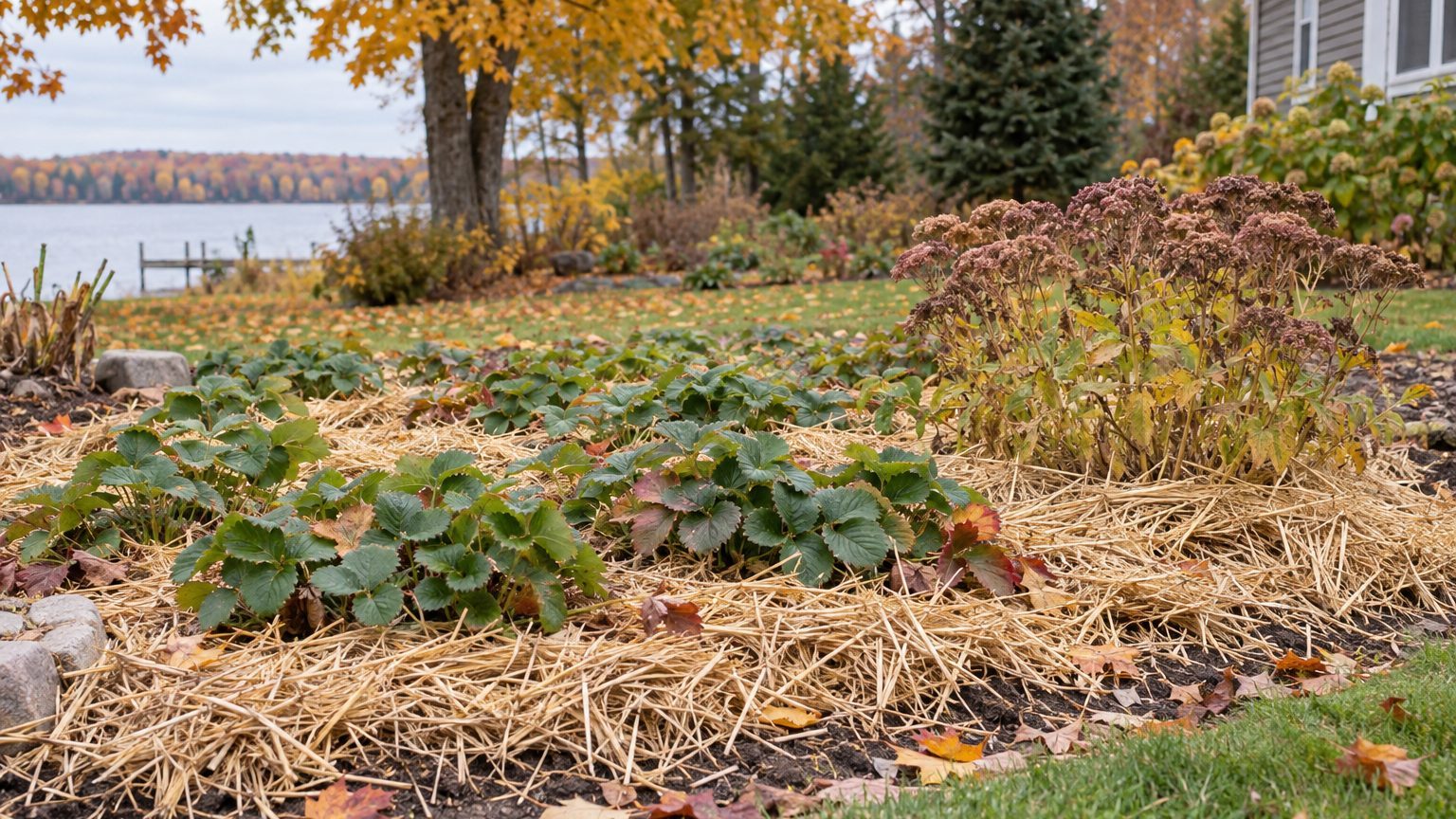

In New Hampshire, winter mulch goes on after the ground starts to freeze, not after the first frost. At the Manchester airport station, NOAA’s 1991-2020 normals put the first 32°F freeze between October 13 and October 26. Mulch comes weeks later than that, once soil has stiffened and plants have gone dormant. Colder, higher gardens run earlier. Clean straw suits strawberries, and a loose ring suits perennials. Both come off or get pulled back in spring. The rest of the seasonal calendar lives in the New Hampshire guides.
When to put winter mulch down in New Hampshire
Most gardeners assume mulch is a blanket that keeps plants warm. In a cold climate it works nearly the opposite way. Its job is to keep frozen soil frozen. The real danger to a strawberry crown or a young perennial is not a single cold night. It is the cycle of freezing, thawing and freezing again, which swells the soil and pushes shallow roots upward. A layer of mulch applied over frozen ground slows the thaws, so the soil stays put and so do the roots.
Put the same layer down in October, and the soil underneath is still warm. Moisture gets trapped against crowns, which invites rot. Mice and voles, always shopping for housing, find a fluffy, insulated apartment before the weather has even turned. So the first frost is not the starting gun. It is only the point where tender plants such as basil and tomatoes give up. Hardy perennials and strawberries actually need those cool nights and light frosts to harden off for winter.
The numbers tell you where to begin looking. NOAA NCEI’s U.S. Climate Normals for 1991-2020 give the first fall 32°F freeze at Manchester, in the 30 to 70 percent probability band, between October 13 and October 26. That is the opening of the freeze season, not the mulching date. The same station shows a mean daily minimum of 17.1°F in the coldest month, so the ground here does freeze solid, and the freeze-thaw logic applies fully. Wait until the soil surface has begun to freeze, which falls well after the October 13 to October 26 first-frost range, and mulch in that gap before deep winter sets in.
Those dates come from an airport weather station, and your yard is probably not at the airport. Suburban and rural gardens in New Hampshire often see the first fall frost one to two weeks earlier than the reference city, and hillsides and higher ground can see it earlier still. Because fall tasks move earlier in colder places, gardeners in the northern part of the state and at elevation should expect to mulch ahead of someone in the southern valleys, not behind them. For a closer read on your own county’s dates, the First and Last Frost Dates in New Hampshire page breaks it down.
A practical test beats a calendar. Push a trowel into the bed. If the top of the soil crunches, resists, or holds a crust that stays through the afternoon, the window has opened. If you can still dig easily and the soil is cool but crumbly, hold off. Lots of gardeners find this arrives around the time the leaves are down and the first few hard freezes have already come through.
Strawberries
Strawberry crowns sit right at the soil line, with the growing point exposed in a way most perennials never are. That makes them vulnerable twice over. Heaving lifts the crown, snaps the fine feeder roots and leaves the plant perched on the surface like a cork. Bare cold does the rest. With a Manchester coldest-month mean minimum of 17.1°F (NOAA NCEI Climate Normals, 1991-2020), and colder readings in the hills, an unprotected crown on a snowless stretch takes a beating from wind and temperature swings together.
What to use and how deep
Clean straw is the standard choice, and the word clean matters. Hay is full of seeds, so it seeds your bed with grass. Straw is the hollow stalk left after grain is harvested, so it is lighter, drains better and carries far fewer weeds. Shredded leaves can work too, but whole leaves tend to mat, which is covered below.
On depth, the only sourced figure here comes from the NC State Extension Gardener Handbook, which says: “A 2-inch to 3-inch layer of mulch suppresses most annual weed seeds and makes it easy to hand-pull any that do germinate.” That is general mulch guidance, not strawberry-specific, but it sets the practical range. Straw settles and compresses over winter, so aim for the thicker side, and do not go past it. A pile much deeper than that holds water against the crowns and tends to cause problems, not prevent them. Apply a 2-inch to 3-inch layer of clean straw once the soil surface has begun to freeze. Spread it evenly across the bed, over the leaves and between the rows.
If you are still deciding how to set up or renew a patch, the Growing Strawberries page covers the rest of the plant’s year.
Pulling it back in spring
Straw is not meant to stay. As the weather warms and growth resumes, rake it off the crowns and into the aisles, where it works as a weed barrier and keeps berries clean later. Do not strip the bed bare, though. Keep the straw close, because open blossoms are easily damaged by a late frost, and you will want to throw it back over the plants on a cold night. The timing follows your own last spring frost, which is later in cold, high gardens than in the reference city.
Perennials and borderline plants
Not every perennial needs mulch in New Hampshire. The USDA Plant Hardiness Zone Map (2023 edition, built on 1991-2020 normals) places the state in zones 3b-6a, a broad span. A well-established peony, hosta or daylily rated comfortably for your zone usually gets by on snow cover and its own roots. The plants that benefit are the shallow-rooted, the recently planted, and anything rated near the edge of what your garden can handle.
That list is longer than it first seems. A perennial planted this fall has not yet anchored itself, so heaving can lift it right out of the ground. Coral bells are famous for working their way upward over a winter. Garden mums often struggle through a first winter without protection. Plants rated for one zone milder than yours, which gardeners often try because the nursery tag looked promising, get the most value from a mulch ring. Herbs such as sage, thyme and lavender are the same story, and Getting Perennial Herbs Through the Winter goes into their particular needs, since several dislike wet crowns.
For material, shredded leaves, straw and evergreen boughs all work. The shape matters more than the material. Build a ring around the plant, not a mound on top of it. Leave a gap of bare soil right at the crown so air can move and moisture does not sit against the stems. Mounding mulch against a crown or trunk is how a mulch ring turns into a volcano, and a volcano holds water against bark where rot and rodents thrive. The longer treatment on this is in Mulching Without Killing the Plant.
On depth, the same NC State handbook says, on trees: “Provide a 3-inch layer of mulch to reduce water loss and maintain uniform soil moisture and temperature around roots.” That line was written for woody plants, but it lands in the same range as the weed-control figure. Treat 3 inches as the ceiling for a ring applied after the soil surface freezes, with the crown itself left uncovered. More is not better. Stay in the range and the plant gets the benefit without the soggy, airless pocket.
Timing follows the same rule as the rest of the garden. Wait for the freeze, then mulch. In the colder north and at elevation, that moment arrives sooner than it does near the southern part of the state.
What goes wrong
Mulching too early is the most common mistake, and it rarely looks like a mistake at the time. The bed looks tidy through October. Then the soil underneath stays warm and damp, crowns soften and turn brown at the base, and rodents move in. The fix is patience: wait for the soil surface to freeze, even if the neighbor next door has already finished the job.
Matting is the second problem. Whole maple and oak leaves pack into a wet, slick sheet after a few rains and snowmelts. Air stops moving, the layer rots, and the plants beneath it rot with it. Shredding leaves first, or switching to straw or boughs, keeps the layer springy. A mower pass over a leaf pile takes five minutes and solves it.
Voles and mice are the third, and they are the reason timing matters so much. A thick, loose layer laid over unfrozen ground gives them cover to tunnel and feed on crowns, roots and the bark of young shrubs all winter, out of sight under the snow. You usually learn this in spring, when you find runways and chewed stems. Delaying mulch until the freeze, keeping it off trunks and crowns, and keeping the layer within the 3-inch limit all help. Wrapping young shrub stems in hardware cloth adds a physical barrier.
The last one is forgetting to uncover. Strawberries left under straw too long send up pale, yellow, spindly growth, stay soggy, and are prone to gray mold on the fruit. Perennials under a heavy ring emerge late and weak. Pull the straw off strawberry crowns as soon as new growth appears, and keep it close for frost nights. Check the bed regularly in early spring, because the plants can grow a lot in a short, warm stretch.
Common questions
Should I mulch right after the first frost?
No. At Manchester the first 32°F freeze falls between October 13 and October 26 (NOAA NCEI, 1991-2020 normals), and the ground is still warm then. Mulch goes on after the soil surface starts to freeze, later in the fall. Colder gardens in the hills and the north reach that point sooner than the reference city.
Can I use fallen leaves instead of straw?
Yes, with a condition. Shred them first, since whole leaves mat and rot. Shredded leaves work well around perennials. For strawberries, clean straw is the more reliable choice, because it stays fluffy and sheds water.
If we get a heavy snow, do I still need mulch?
Snow is an excellent insulator, and plants under a steady snowpack do well. The trouble is that New Hampshire winters do not always deliver steady snow. Mulch is insurance for the bare, cold stretches and the midwinter thaws that melt the cover and then refreeze the soil.
How do I tell the ground has started to freeze?
Push in a trowel. A crusty, resistant surface that stays firm through the afternoon means the window is open. If the soil digs easily, wait. Frozen mornings that thaw by midday are a sign you are close, but not quite there yet, and a few days of waiting costs the plants nothing.