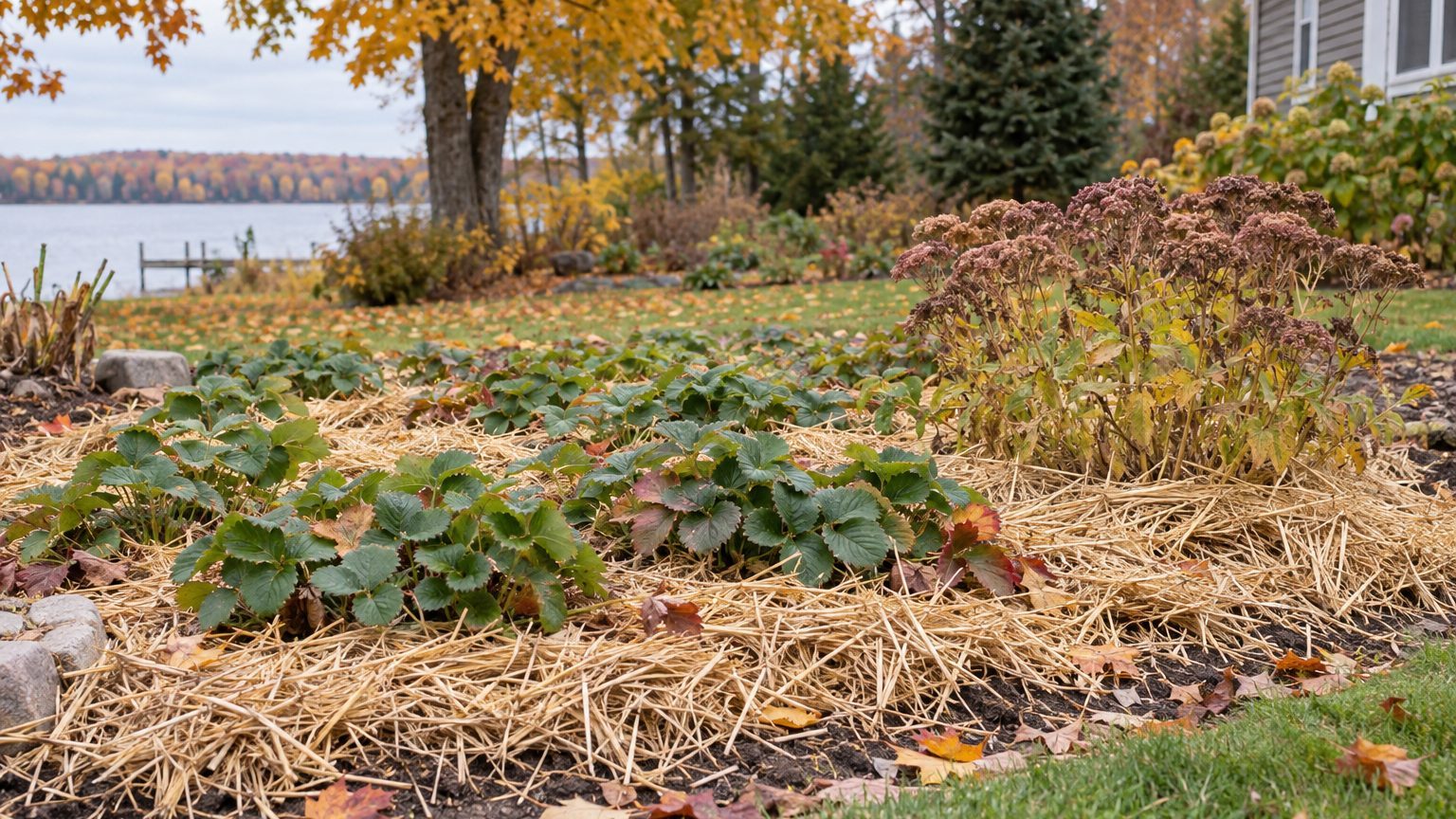

Put winter mulch down after the ground starts to freeze, not when the first frost blackens the tomato vines. At Newark, NOAA’s 1991-2020 climate normals put the first 32°F freeze between November 4 and November 16. For most New Jersey beds, the mulching job comes in the weeks after that range, once the soil surface has gone stiff. Strawberries and young, shallow-rooted perennials gain the most from it.
When to put winter mulch down in New Jersey
Winter mulch does a different job than the mulch you spread in May. It does not keep the soil warm. It keeps soil that has already frozen from thawing on a sunny afternoon and refreezing that night, and that repeated swing is what pushes shallow roots and crowns up out of the ground. Cover the bed too soon and you miss the point of the exercise.
The NOAA NCEI U.S. Climate Normals for 1991-2020 give the Newark airport station a first fall freeze (32°F) somewhere between November 4 and November 16. The same normals show an average daily low of 25.5°F in the coldest month, so frozen soil is the rule in a New Jersey winter, not an occasional event. Those are airport figures. Suburban and rural gardens often see the first fall frost one to two weeks earlier, and hillier, higher ground in the northern part of the state sees it earlier still. Colder gardens mulch earlier in the calendar; milder spots near the coast mulch later.
Mulch once the Newark first-freeze range of November 4 to November 16 has passed and the top of the soil has begun to freeze. In practice that means later in November and often into December, depending on how cold your own site runs. The First and Last Frost Dates in New Jersey guide is the place to check where your county sits against the airport numbers.
How do you tell the ground has started to freeze?
Skip the calendar and test the soil. Push a trowel or screwdriver into the bed in the morning. If the top inch or so is firm and crusty, or puddles carry a skin of ice that does not melt by lunch, the ground is on its way. Strawberry leaves tell you something too: once growth stops and the foliage turns dull and darker after several hard frosts, the plants are dormant and ready to be covered.
Why shouldn’t you mulch right after the first frost?
A first frost ends the tender garden, but the soil underneath is still holding summer heat. A thick blanket laid over warm, damp ground keeps crowns soggy and soft, which invites rot. It also gives mice and voles a cozy place to settle in before real cold arrives. Waiting a few more weeks costs the plants nothing, because they are already hardening off.
Strawberries
A strawberry plant grows from a short, thick crown at soil level, and that crown holds every leaf and flower bud for next year. When winter brings bare, frozen ground with little snow cover, two things go wrong. The cold itself can damage an exposed crown. Freeze and thaw cycles can also lift the plant, tearing fine roots and leaving the crown sitting above the surface. Plants that were set out this fall, with roots that have not anchored yet, are the most likely to heave. If you are still planning or renovating a bed, Growing Strawberries covers the setup that makes winter easier.
What should you cover strawberries with?
Clean straw is the standard choice, and clean is the important word. Straw is hollow and fluffy, so it traps air without packing down. Hay is a poor substitute because it is full of seed, and you will be pulling grass out of the berry bed all summer. Whole leaves, especially broad ones like maple, mat into a wet sheet that holds water against the crowns.
On depth, NC State Extension is plain about it: “A 2-inch to 3-inch layer of mulch suppresses most annual weed seeds and makes it easy to hand-pull any that do germinate.” That sentence is about weeds, but it sets a sensible ceiling for a strawberry bed as well. Spread the straw loosely and evenly over the crowns and leaves, keep it within 2 to 3 inches, and resist adding more for good measure. A deeper, packed layer holds moisture around the crowns instead of protecting them.
When do you pull strawberry mulch back in spring?
Straw that stays put too long smothers the plants. Check under it as the weather turns steadily mild. When you see new leaves coming up pale yellow or light green, the plants have started growing and need light. Rake the straw off the crowns as soon as new growth shows, and tuck it into the aisles between the rows. Left there, it keeps weeds down and keeps berries off bare soil later on.
Do not haul it away. A late frost can still catch open blossoms, and straw in the aisles can be pulled back over the plants for a night. Watch the forecast through the weeks around your county’s last spring frost, which the frost date guide above helps you estimate.
Perennials and borderline plants
The USDA Plant Hardiness Zone Map 2023 places New Jersey in zones 6a to 7b. That system is built on the average annual extreme minimum temperature, so it tells you whether a plant can survive the lowest cold of the winter at all. Mulch cannot raise a plant above its limit. What it can do is steady the soil, reduce heaving, and give a plant that sits near its limit a better chance of making it through. A perennial that is reliably hardy in the milder parts of the state may be borderline in the colder ones, so read the plant tag against your own zone and not the state as a whole.
Not everything in the border needs a winter blanket. These are the plants that benefit most:
- Perennials planted this fall, whose roots have not yet gripped the soil.
- Shallow-rooted plants such as coral bells, foamflower and garden mums, which are known for working their way up out of the ground.
- Anything the tag rates close to the cold limit of your zone.
- Woody herbs such as lavender and rosemary, covered in more detail in Getting Perennial Herbs Through the Winter.
Mulch fall-planted perennials and any plant rated near your zone’s limit, and leave established, tough clumps alone. Well-settled daylilies, hostas and most native perennials have handled New Jersey winters for years without help.
How deep should perennial mulch be, and where does it go?
Use the same range as for strawberries. NC State Extension, in its Extension Gardener Handbook chapter on woody ornamentals, says to “Provide a 3-inch layer of mulch to reduce water loss and maintain uniform soil moisture and temperature around roots.” That line is written about trees, but it lands in the same neighborhood as the 2-inch to 3-inch weed-control range, so stay inside it.
Shape it as a ring around the plant, leaving a small gap right at the crown or stems, and not a pile heaped on top. Shredded leaves, pine needles or chopped bark all work. Mulch pushed against a crown keeps it wet, and that is how a protective ring turns into a rot problem. Mulching Without Killing the Plant goes further into the volcano problem and how to avoid it.
What goes wrong
Most winter mulch failures come down to timing and material. They are easy to spot once you know what to look for, and just as easy to avoid.
What happens if you mulch too early?
Mulch laid over warm, damp soil produces soft, slimy crowns by midwinter. Strawberry centers turn brown and mushy, and perennial stems go dark at the base. Mulch that has matted down is the same problem in a different form. Wet whole leaves and compacted straw form a dense layer that stays soggy and keeps air from the crown. Prevent both by waiting until the soil has started to freeze and by choosing loose, fluffy material.
Can mulch attract voles?
Yes. Voles and mice like to nest under thick cover, and you will know they have been there when you find runways in the mulch, chewed stems, or gnawed bark at the base of a shrub. Late mulching helps because the animals have usually settled elsewhere by then. Keep a gap around woody stems and keep the layer to 2 to 3 inches. Tall grass beside the bed gives them another route in, so mow it short before winter.
What happens if you leave winter mulch on too long?
Plants under straw in spring grow pale, leggy and weak, and the crowns can rot in cold, wet weather. Check under the mulch every few days once the weather turns steadily mild, and pull it back at the first sign of new growth. Keep it close by for frost nights.
Common questions
Is it too late to mulch once the ground is already frozen?
No. Mulch spread over frozen ground still slows the thaw cycles that heave plants, and that is its whole purpose. The only real deadline is the weather: get it down before the deepest cold or a run of warm spells followed by hard freezes. Just do not try to work it into soil that has frozen solid. Spread it on top.
Can I use leaves instead of straw on strawberries?
Shredded leaves work in a thin layer because the pieces stay loose and let air through. Whole leaves mat into a wet blanket, especially broad ones like maple, and hold water against the crowns. Run them through a mower first, and keep the layer within the 2-inch to 3-inch range. Clean straw remains the easier and safer choice.
How thick should winter mulch be?
NC State Extension gives 2 to 3 inches for weed control and 3 inches around trees for moisture. Stay inside that range for strawberries and perennials alike. Going thicker does not add protection and makes rot and vole nesting more likely.
Does my garden follow the Newark dates?
Only roughly. The November 4 to November 16 first-freeze range comes from the Newark airport station, and gardens farther north or higher up tend to freeze one to two weeks earlier. Mulch there earlier, and check the soil itself before you spread anything. The New Jersey guides cover other seasonal timing, and your county Rutgers Cooperative Extension office can tell you how your local frost dates compare with the airport’s.