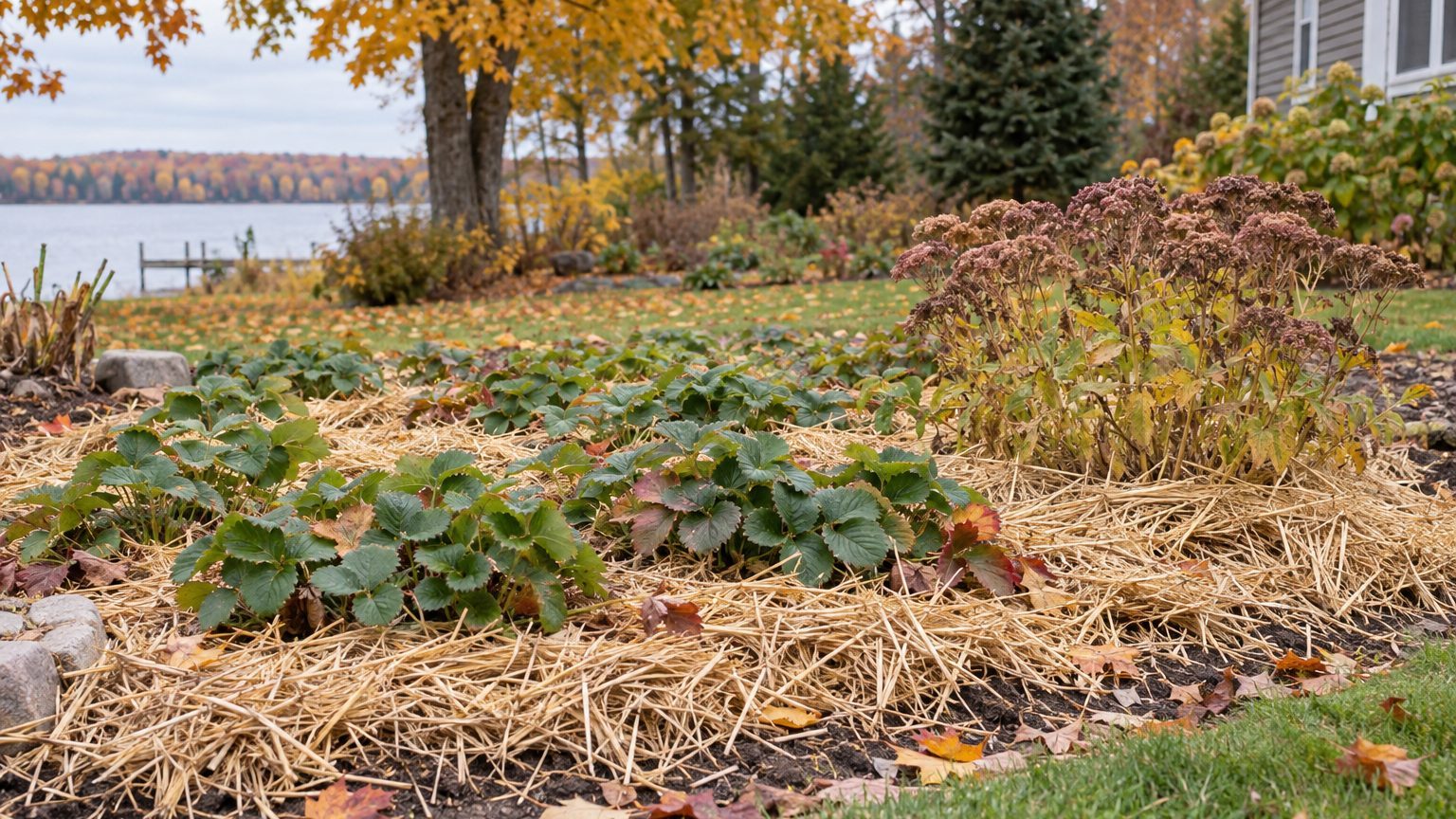

Winter mulch in Vermont goes on after the ground starts to freeze, not before. In Burlington, the first fall frost arrives between October 3 and October 13, and mulch follows well behind it, once nights stay below freezing and the soil surface stiffens. Strawberries get loose clean straw. Borderline perennials get a ring of mulch around the crown. Everything comes off or gets pulled back as growth wakes in spring.
When to put winter mulch down in Vermont
Most gardeners learn mulch as a blanket that keeps plants warm. In a Vermont winter it does the opposite job: it keeps the soil frozen. Plants rarely die from steady cold. They get hurt when the ground thaws on a sunny January afternoon, refreezes that night, and repeats the cycle until crowns and shallow roots are pushed up out of the soil. Mulch evens out those swings. Put on while the soil is still warm, it holds heat, stays damp, and gives mice and voles a cozy place to nest before the cold has even arrived.
The cold is real here. NOAA’s 1991-2020 Climate Normals for Burlington put the mean daily minimum of the coldest month at 12.9°F. That is an average of the nightly lows, not the worst night of the winter, so the cold snaps run lower. Ground freezes, and it freezes hard. The USDA Plant Hardiness Zone Map 2023 sorts the state into zones 3b to 5b, and Burlington is only one point on that range, so the dates below are Burlington’s and your own will differ.
Burlington’s first fall frost falls between October 3 and October 13, according to NOAA NCEI’s 1991-2020 normals (the 30 to 70 percent probability band for a 32°F freeze at the Burlington station). That is a trigger to start watching, not to start mulching. Wait until after the October 3 to October 13 first-frost window has passed and the top of the soil is actually beginning to freeze, then mulch. A single frost, even a hard one, does not freeze the ground. Plants keep taking up water and sugars for a while longer, and cold-hardy perennials use that stretch to finish hardening off. Look for a run of nights below freezing and a soil surface that is stiff in the morning and still crusty by midday.
Burlington sits on Lake Champlain, which makes it the mildest corner of the state. The Green Mountains and the Northeast Kingdom run substantially shorter, so first frost arrives earlier there and the ground locks up earlier too. That moves the whole fall mulching window earlier on the calendar for a hillside garden in Craftsbury or Jay than for a lakeshore one in Burlington. The logic does not change, only the timing. If you want to pin down your own frost pattern, the First and Last Frost Dates in Vermont page walks through how the numbers shift across the state.
Is mulch needed at all? For strawberries and anything borderline, yes. For a well-established perennial rated comfortably for your zone, it is optional. The sections below sort out which is which.
Strawberries
Strawberries are the plant most worth mulching in a Vermont garden, and the reason is the crown. The crown is the short, woody stem base where leaves and roots meet, and next year’s flower buds are already forming inside it by late fall. Bare cold can kill it. Heaving can lift it out of the ground, snapping the roots below and leaving the crown sitting on the surface like a tooth working its way loose. Both problems come from the same cause: soil that freezes and thaws repeatedly with nothing on top of it.
Use clean straw. Wheat or oat straw works because it is hollow, springy, and traps air, so it stays fluffy instead of pressing flat. The word “clean” is doing real work. Hay is full of seed heads and will seed your strawberry bed with grass and weeds come spring. Ask the seller whether the straw is free of weed seed, and look at a bale before you buy it. Shredded leaves can work in a pinch, but whole leaves tend to mat down and trap water against the crowns. For a refresher on getting the whole bed started, the Growing Strawberries guide covers the full season.
Depth matters as much as material. The only depth figure I can cite comes from NC State Extension’s Gardener Handbook, which says: “A 2-inch to 3-inch layer of mulch suppresses most annual weed seeds and makes it easy to hand-pull any that do germinate.” That sentence is about weed control, and it is written for general garden mulch rather than strawberries in particular. Still, it gives a sensible range for a layer that covers the crowns without burying them, and straw settles over winter, so spread it loosely and evenly over the whole bed. More is not better. A deep, packed layer holds moisture against the crowns.
Timing follows the same rule as everything else. Mulch strawberries after the first-frost window of October 3 to October 13 in Burlington has passed and the soil has begun to freeze, which in colder parts of Vermont comes earlier in the calendar. Plants that are still green and growing tolerate a light frost, and that exposure is part of how they harden off.
Spring is where people slip up. Pull the straw off the crowns, not out of the bed, as soon as you see pale yellow new growth poking through. Leave the straw loose between the rows, where it keeps berries clean and suppresses weeds, and keep it close enough to drag back over the plants if a frost is forecast during bloom. Frost-nipped flowers do not set fruit. Check against the last spring frost dates for your own town before you decide the danger has passed.
Perennials and borderline plants
Not every perennial needs a winter coat. A well-sited plant that is rated for your hardiness zone has spent years learning to handle a Vermont winter on its own. Mulch is for the plants at the edge: those rated close to your zone, anything planted this season whose roots have not settled in, and shallow-rooted types that heave out of the ground, like coral bells.
Zone numbers are how you tell. The USDA Plant Hardiness Zone Map 2023 runs Vermont from 3b to 5b, built on a single variable, the average annual extreme minimum temperature. Because that range is so wide, the useful move is to find your own spot on it. A plant labeled for a warmer zone than yours may come through a mild winter and fail in a hard one. Burlington’s coldest-month minimum of 12.9°F gives a sense of the typical cold at the mild end of the state, and gardens in the Northeast Kingdom or high in the Green Mountains should plan for worse.
The shape of the mulch matters more than the amount. Make a ring, not a mound. Spread mulch over the root zone around the plant, and leave a small gap right at the crown so the stems are not sitting in damp organic matter all winter. The common error is the “volcano,” where mulch is piled against the stem or heaped over the crown. That holds moisture against the plant, encourages rot, and gives rodents a sheltered place to chew. The Mulching Without Killing the Plant guide goes deeper on the ring method.
On depth, stay in the same range. NC State Extension’s handbook, in its woody ornamentals chapter, says: “Provide a 3-inch layer of mulch to reduce water loss and maintain uniform soil moisture and temperature around roots.” Together with the 2-inch to 3-inch sentence quoted above, that puts the order of depth at 2 to 3 inches. That is a North Carolina source, so treat it as a ceiling on depth, not a reason to go deeper because Vermont is colder. Ring each borderline crown with 2 to 3 inches of mulch, after the soil begins to freeze, and keep it clear of the stems.
Herbs follow the same rule with a twist: Mediterranean types like lavender and thyme hate wet crowns more than cold, so a light, airy cover beats a heavy one. The Getting Perennial Herbs Through the Winter guide covers which ones to cover and which to leave alone.
What goes wrong
Most winter mulch failures come down to timing and texture, not to the plant. The four below account for most of the damage, and each one is easy to avoid once you know what it looks like.
| Problem | What it looks like | How to prevent it |
|---|---|---|
| Mulching too early | Soft, damp crowns by midwinter; plants that keep growing into cold snaps | Wait until after the first-frost window and the soil begins to freeze |
| Matted, rotting mulch | Slimy, flattened layer; mushy crowns in spring | Use clean, loose straw; avoid whole wet leaves |
| Voles in the mulch | Runways under the layer; gnawed stems and roots | Mulch late, keep it off the stems, keep grass trimmed nearby |
| Forgetting to uncover | Pale, stretched, weak growth; crowns rotting under the layer | Pull back as growth starts; keep straw handy for frost nights |
Mulching early is the most common error and the hardest to see until it is too late. Warm soil under a thick blanket stays warm and wet, which is exactly what fungi and voles like. Mice and voles do not cause the damage by themselves. They show up because the early mulch offers shelter before the weather has driven them to look elsewhere. Waiting until the ground has started to freeze means the layer goes down when rodents have already settled elsewhere and the soil is cold enough to stay that way.
Matting is a material problem. Whole maple and oak leaves, wet grass clippings, and packed hay all collapse into a dense mat that sheds air and holds water. Straw and shredded leaves hold their shape. If you do use leaves, shred them first.
The spring mistake is the quietest. A bed left under mulch too long produces pale, floppy growth and crowns that stay wet and cold. Start checking under the mulch as soon as the snow is gone, and pull it back from the crowns once new growth shows, before the last spring frost has fully passed. Keep the pulled-back material nearby so a late frost does not catch you.
Common questions
How soon after the first frost should I mulch in Vermont?
Not right away. In Burlington the first fall frost lands between October 3 and October 13 (NOAA NCEI 1991-2020 normals), and mulch goes on after that window, once nights stay below freezing and the soil surface begins to freeze. In the Green Mountains and the Northeast Kingdom the first frost comes earlier, so the mulching window opens earlier too.
Is snow cover enough without mulch?
A deep, steady snowpack is an excellent insulator, and in some winters it does the job on its own. The trouble is that Vermont snow can arrive late, melt in a thaw, or blow off exposed beds, leaving crowns bare during the cold stretch. Mulch covers that gap. For strawberries and borderline perennials, it is cheap insurance.
Can I use shredded leaves instead of straw?
Yes, with a caveat. Shredded leaves stay loose and break down into useful organic matter. Whole leaves mat into a wet layer that rots crowns. Keep the layer within the 2-inch to 3-inch range NC State Extension gives for mulch, and keep it off the stems.
Where can I find more Vermont timing for fall garden jobs?
The Vermont guides collect frost, planting, and seasonal care information for the state. Since fall tasks like mulching come earlier in colder, higher towns, start there and then adjust for your own elevation and the first frost you actually see in the yard.