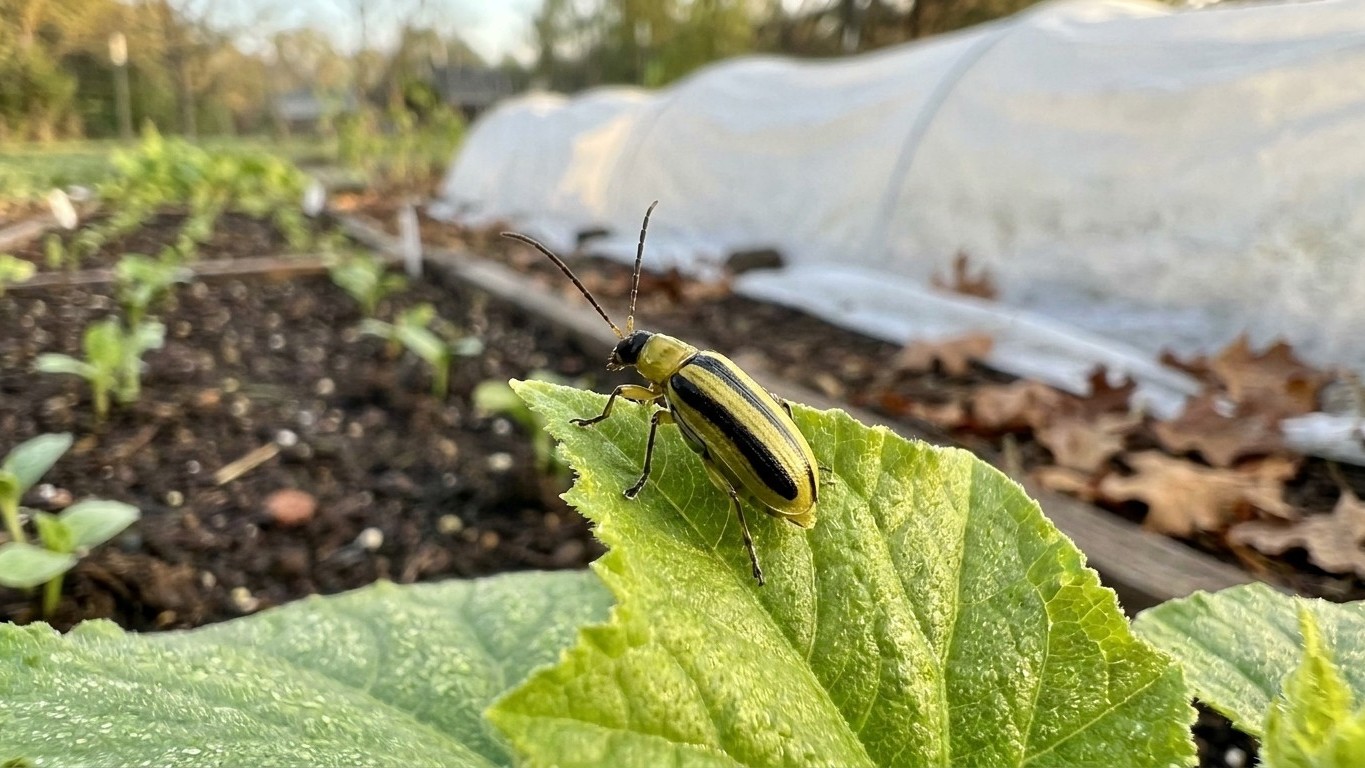

The striped cucumber beetle typically emerges in New Hampshire between mid-May and early June, right as soil temperatures climb past 55°F and cucurbit seedlings push through the ground. The insect itself is easy to identify (yellow-green wing covers with three bold black stripes), but the real damage comes from what it carries: a bacterium that can wipe out an entire squash or cucumber planting within weeks. Floating row covers installed at transplant, combined with removing garden debris each fall, remain the two most reliable tools home growers have against it.
The weeks to watch

This beetle overwinters as an adult, tucked into leaf litter, mulch, or the loose soil at field edges. It doesn’t survive by burrowing deep or forming a dormant egg stage the way some pests do. It just waits, sluggish and inactive, until the ground warms enough to get moving again.
In the Connecticut River Valley and the southern tier of the state, that usually happens by the third week of May. Up in Coos County or the higher elevations around the White Mountains, growers often don’t see beetle activity until the first week of June, sometimes later if a cold, wet spring drags on. That two-to-three-week gap matters for planning: a gardener in Keene transplanting cucumbers on May 20 is walking straight into peak beetle activity, while someone in Berlin might get a full extra week of seedling growth before the beetles find the patch.
Once temperatures settle above 60°F consistently, the beetles start feeding almost immediately on whatever cucurbit foliage is available, then mate and lay eggs at the base of host plants within seven to ten days. Eggs hatch into root-feeding larvae that spend two to three weeks underground before pupating, and by mid-summer a second generation of adults emerges. That second wave, usually late July through August, is often heavier than the first because it doesn’t have to travel far to find food. It’s already living in your garden.
Why Timing Your Planting Matters
Delaying transplant by even ten days can shift a cucumber patch out of the worst of the first-generation feeding window. This isn’t a guarantee, since beetles will still find later plantings, but younger seedlings with fewer than four true leaves suffer the most damage. Plants transplanted after the first wave has already fed elsewhere and moved on tend to establish faster and shrug off the lighter pressure from stragglers.
Growers who direct-seed instead of transplanting face a different problem: seedlings emerging right as beetles are most active can be stripped down to bare stems before they’ve developed enough leaf surface to recover. Starting cucurbits indoors and transplanting slightly larger, sturdier plants gives them a fighting chance the beetles’ mouths can’t undo overnight.
Spotting the Damage Before It Spreads
Adult beetles chew irregular holes in leaves and scar the surface of young fruit, but the visible chewing is rarely what kills a plant. The bigger threat is bacterial wilt, caused by Erwinia tracheiphila, which the beetles carry in their gut and transmit through feeding wounds. A plant infected with bacterial wilt looks healthy one week and collapses the next, with individual leaves or entire vines wilting suddenly even though the soil has plenty of moisture. Cut the stem open and you’ll often see a sticky, stringy sap, a telltale sign the vascular system is clogged with bacteria.
Cucumbers and muskmelons are far more susceptible to wilt than squash and pumpkins, which carry some natural resistance to the disease even when beetles feed on them heavily. That’s worth knowing before you decide where to spend your limited row-cover budget. If space or materials are tight, protect the cucumbers first.
The beetles also spread cucumber mosaic virus, a separate problem that causes mottled, curled leaves and stunted, misshapen fruit. Unlike bacterial wilt, mosaic virus doesn’t kill the plant outright, but it tanks yield and fruit quality for the rest of the season. Once a plant shows mosaic symptoms, there’s no cure. Removing and destroying infected plants limits how much virus circulates to healthy neighbors.
Host Plants Beyond the Garden Bed
Striped cucumber beetles feed almost exclusively on cucurbits: cucumbers, summer and winter squash, pumpkins, melons, and gourds. They’ll occasionally nibble on flower petals or pollen from unrelated plants, but they won’t set up shop in your tomatoes or peppers. That narrow diet is actually good news, because it means crop rotation and physical barriers work with real precision instead of guessing at a broader host range.
What Actually Stops the Striped Cucumber Beetle
Floating row covers are the single most effective tool available to home growers, and the data backs this up. Research from entomology extension programs across the Northeast has consistently shown that covering cucurbit transplants immediately after planting and keeping them sealed at the edges with soil or clips blocks the vast majority of early-season feeding and egg-laying. The catch is timing: covers need to come off once flowers appear, because cucurbits rely on bees for pollination and a sealed cover keeps pollinators out along with the beetles.
That pollination window is exactly when many gardeners lose ground, since removing the cover hands the plant right back to any beetles waiting nearby. Some growers split the difference by uncovering only during the two or three hours mid-morning when bees are most active, then resealing the cover for the rest of the day. It’s more labor, but it buys another week or two of protection during a vulnerable stage.
Beyond covers, a handful of other approaches make a measurable difference:
- Delayed and staggered planting to avoid the peak first-generation emergence window described earlier
- Trap cropping with an early-planted, sacrificial cucurbit variety (often Blue Hubbard squash) planted a few feet away, which draws beetles away from the main crop and can be treated or removed once heavily infested
- Kaolin clay sprays applied to foliage, which create a physical barrier that irritates beetle mouthparts and discourages feeding without harming beneficial insects
- Fall sanitation, removing plant debris and tilling garden beds after harvest to eliminate the leaf litter beetles use for overwintering
- Sticky traps or yellow sticky cards placed near cucurbit beds to monitor arrival timing and catch some adults before egg-laying
Row covers and trap crops work together well because they attack the problem from two directions: one keeps beetles off the crop entirely, the other pulls them toward a decoy. Growers who combine both methods, according to field trials run by land-grant university extension programs, typically see the lowest rates of bacterial wilt transmission compared with either method used alone.
Resistant Varieties Worth Considering
Plant breeders have made real progress on cucumber varieties with some tolerance to bacterial wilt, though “tolerant” doesn’t mean immune. Varieties bred with resistance to bacterial wilt still get fed on by beetles, but the plants are less likely to collapse once infected. Seed catalogs that list disease resistance codes usually flag bacterial wilt tolerance directly on the variety description, which is worth checking before ordering seed for next season. Winter squash and pumpkin varieties, as a category, hold up better against wilt regardless of specific breeding, simply because of their natural resistance to the bacterium itself.
Insecticides: When They’re Worth Using
For gardeners who reach an infestation level where physical barriers and trap crops aren’t cutting it, targeted insecticide applications can knock back adult populations, particularly right after transplant when plants are most vulnerable and before flowering begins. Once flowers open, any spray applied has to be timed carefully, either in the early morning or evening, to minimize harm to bees and other pollinators actively working the blossoms. Products labeled specifically for cucumber beetles on edible crops, applied according to label instructions, are far more effective than broad-spectrum sprays that also wipe out the predatory insects that would otherwise help keep beetle numbers in check over the following weeks.
One detail that surprises a lot of first-time squash growers: the beetle pressure in a given New Hampshire garden often has less to do with that garden’s own history and more to do with what’s growing on nearby farms or in neighboring yards. Because adults are mobile and will fly in from surrounding cucurbit patches once local food sources run low, a well-protected garden can still get hit hard in years when regional beetle populations spike, something that tends to happen after a mild winter that let more overwintering adults survive.
Related guides
- Striped cucumber beetle in Maine: When It Shows Up and What Stops It
- Striped cucumber beetle in Massachusetts: When It Shows Up and What Stops It
- Striped cucumber beetle in New Jersey: When It Shows Up and What Stops It
- Striped cucumber beetle in New Mexico: When It Shows Up and What Stops It
- Striped cucumber beetle in Connecticut: When It Shows Up and What Stops It