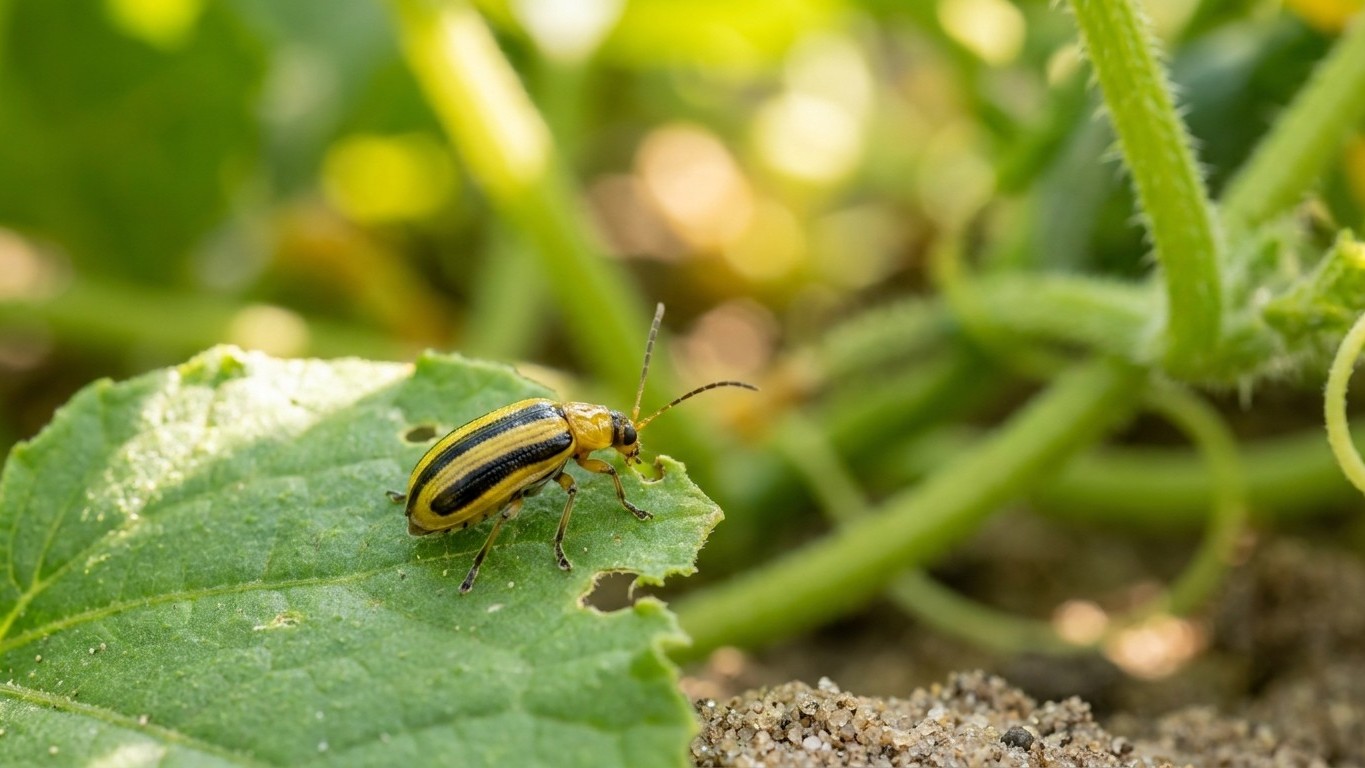

Striped cucumber beetles show up in New Jersey gardens as soon as soil temperatures climb past 65 degrees, usually in the last two weeks of April in South Jersey’s farm belt and closer to mid-May farther north and inland. What actually stops them isn’t a single spray but a combination: floating row covers timed to plant emergence, trap crops that pull beetles away from your cucumbers, and knowing exactly when the insect’s real threat, a bacterial disease it carries, becomes a problem worth treating.
This isn’t a beetle you can ignore until you see damage. By the time chewed cotyledons catch your eye, the bigger risk, bacterial wilt, may already be moving through the plant’s vascular system. Timing your defense to the calendar matters more with this pest than almost any other cucurbit invader.
Why New Jersey’s Growing Conditions Suit This Beetle

New Jersey’s mix of sandy loam soils in the south and the state’s long cucurbit-growing season, running from early transplants under cover through fall pumpkins, gives striped cucumber beetles (Acalymma vittatum) plenty of runway. Cumberland, Salem, and Gloucester counties, which anchor a large share of the state’s vegetable production, sit right in the beetle’s comfort zone: warm sandy ground that heats up fast in spring and hosts the cucumbers, melons, and squash this insect depends on for its entire life cycle.
The beetle itself is easy to identify once you know what to look for. It’s about a fifth of an inch long, with three black stripes running down a yellow-orange back and a black head. A close relative, the spotted cucumber beetle, shows up in the same fields with black dots instead of stripes and causes similar damage, though it’s a bit less aggressive toward seedlings.
Adults overwinter in soil, leaf litter, and the edges of woodlots bordering fields and backyard gardens. That habitat preference explains why gardens near tree lines or unmowed field margins tend to see heavier pressure than plots surrounded by open lawn. The insects wait out winter in a dormant state and become active the moment soil warms, often before most gardeners have even started hardening off transplants.
The New Jersey Timeline: From Overwintering to Second Generation
Adult beetles emerge from winter shelter in a narrow window, generally April 15 through May 10 depending on how quickly spring warms up that particular year. They fly directly toward the smell of germinating cucurbit seedlings, sometimes covering surprising distances to find a host plant. That’s the phase when a five-day-old cucumber seedling can go from healthy to skeletonized almost overnight, since young cotyledons carry so little tissue to spare.
Once beetles find a host, mating happens fast. Females lay eggs in the soil at the base of plants, and larvae hatch within a week or two to feed on roots and lower stems underground, largely invisible to anyone scouting from above. Larval feeding rarely kills established plants outright, but it stresses root systems enough to open the door for secondary rot organisms, especially in wet years.
New Jersey typically sees two full generations per season, with a partial third generation possible in warm years that stretch into October. That second wave, arriving in July as the first generation’s larvae mature into adults, often coincides with flowering and fruit set on squash and melons. It’s the generation most likely to catch gardeners off guard, since the spring beetles seem to have disappeared by early summer, only for a fresh cohort to appear right when plants are setting fruit.
The Real Threat Isn’t the Chewing
Leaf damage looks alarming, but it’s rarely what kills a plant. The bigger problem is bacterial wilt, caused by the bacterium Erwinia tracheiphila, which striped cucumber beetles carry in their gut and transmit through feeding wounds. Once the bacteria enter a plant’s vascular tissue, they multiply and physically clog the pathways that move water from roots to leaves. A cucumber vine that looked fine on Monday can be collapsed and wilted by Thursday, with no amount of watering bringing it back.
Susceptibility varies sharply by crop, and this is where a lot of home gardeners get caught off guard. Cucumbers and muskmelons are highly vulnerable, often losing entire plants to a single infected beetle’s feeding. Winter squash and pumpkins tolerate the disease far better, sometimes showing no symptoms even with noticeable beetle pressure. Watermelon sits closer to the resistant end of that spectrum. That’s why extension guidance treats a single beetle per cucumber seedling as a reason to act, while the same beetle count on a butternut squash plant might not justify any intervention at all.
Because the disease transmits during feeding rather than requiring a large beetle population, protecting the seedling stage matters more than total season-long beetle counts. A cucumber plant that survives its first three weeks without significant beetle feeding has a much better shot at dodging wilt altogether, even if beetle numbers pick up later once the plant has matured past its most vulnerable window.
What Actually Stops Striped Cucumber Beetles
Row covers remain the single most reliable tool for the seedling stage. Lightweight floating covers, installed at planting and sealed at the edges with soil or landscape staples, create a physical barrier beetles can’t cross. The catch is timing removal: covers need to come off once flowers open, since cucurbits depend on bee pollination and a sealed cover blocks that too. Most gardeners pull covers the moment they spot the first yellow blossoms, accepting a short window of beetle exposure in exchange for weeks of protection during the most fragile growth stage.
Trap Crops and Timing Tricks
Blue Hubbard squash has earned a reputation among growers as a trap crop, since striped cucumber beetles find it more attractive than most other cucurbits. Planting a border of Blue Hubbard around the perimeter of a cucumber or melon patch, roughly two to three weeks before the main crop, can pull a meaningful share of beetles away from the plants you actually want to harvest. Some growers treat the trap crop border with an insecticide while leaving the main planting untreated, concentrating any chemical use on a small perimeter instead of the whole garden.
Delaying planting by even a week or two, or starting seedlings indoors and transplanting larger, sturdier plants outside, gives cucurbits a head start against the beetle’s spring emergence window. A transplant that’s already past the fragile cotyledon stage when beetles arrive has a much better chance of shrugging off feeding damage without triggering wilt.
When Treatment Makes Sense
For cucumbers and melons, a threshold of one beetle per plant during the seedling stage is generally cited as the point where intervention pays off, given the wilt risk. Squash and pumpkin can typically tolerate five or more beetles per plant before yield losses become likely, which is part of why blanket insecticide schedules rarely make sense for a home garden growing a mix of cucurbit types.
Insecticidal options range from spinosad and pyrethrin-based products favored in organic systems to synthetic pyrethroids used more heavily in commercial plantings. Kaolin clay, applied as a fine white coating on leaves and stems, works as a physical deterrent rather than a poison, making plants less recognizable and less palatable to feeding beetles. Whatever product gets used, timing applications to early morning or evening, when pollinators are less active, reduces collateral damage to bees working the same flowers.
Crop rotation helps at the margins but won’t solve the problem on its own, since adult beetles fly readily and overwintering populations in nearby woodlots can recolonize a garden regardless of what grew there the previous season. Combined with row covers during the seedling window and a trap crop border, though, rotation adds one more layer that shifts the odds in the gardener’s favor rather than the beetle’s.
One detail that surprises a lot of gardeners: yellow sticky traps, often marketed as a monitoring tool for other pests, actually attract striped cucumber beetles at a rate high enough to function as a modest control measure on their own, since the insects are drawn to yellow the same way they’re drawn to yellow cucurbit blossoms. Placing a few traps at the edge of a cucurbit bed in late April can give an early read on when the season’s first wave has arrived, often days before any visible feeding damage shows up on the plants themselves.