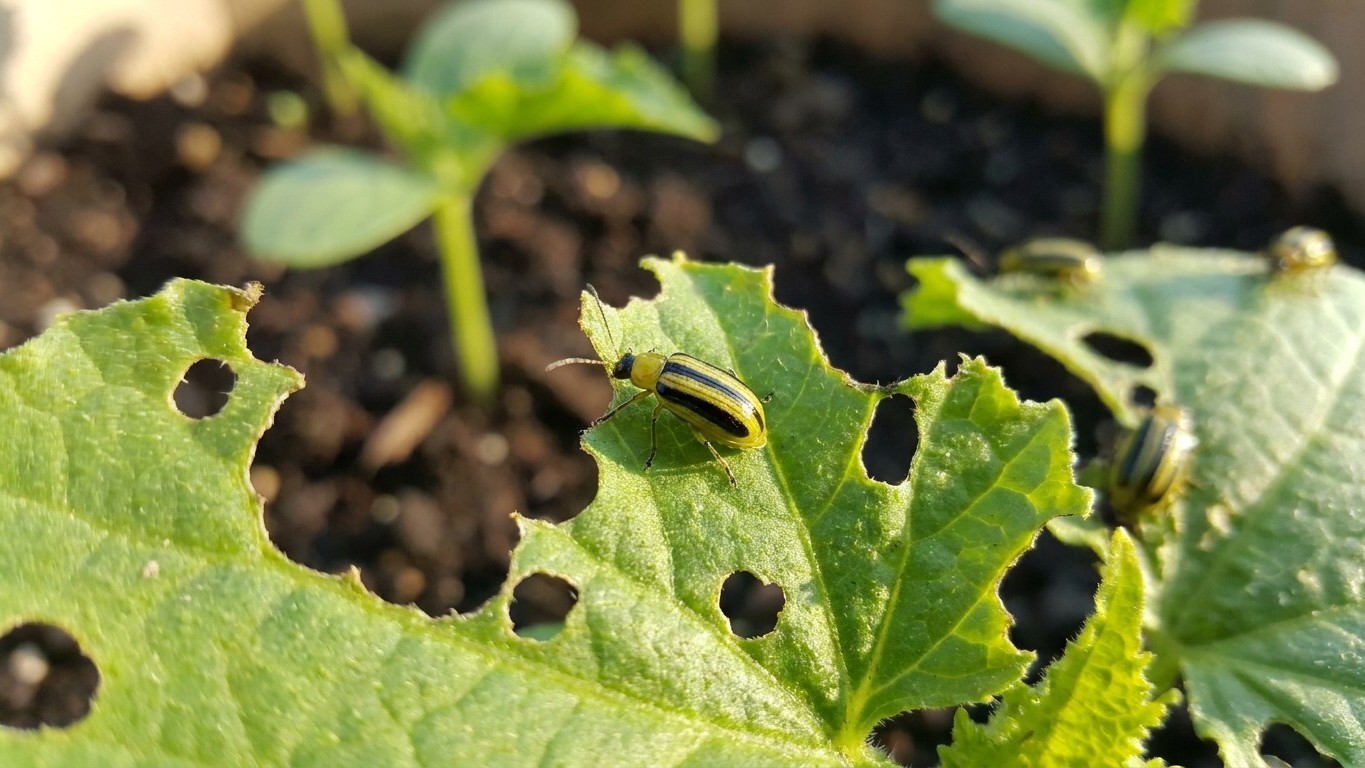

Striped cucumber beetles start showing up in Massachusetts gardens as soon as soil temperatures climb into the mid-60s, which usually lands somewhere between mid-May and early June depending on the county. If you grow cucumbers, squash, melons, or pumpkins in this state, that window is the one to watch. The beetle itself is easy to spot: about a quarter-inch long, yellow-green wings marked with three black stripes running lengthwise, and a habit of clustering on young seedlings the moment they break ground.
What makes this pest worth tracking isn’t just the chewed leaves. It’s the disease it carries. Adult beetles transmit bacterial wilt, a pathogen that can turn a healthy cucumber vine into a limp, collapsed mess within a couple of weeks. In Massachusetts backyards and small farms alike, that one-two punch of feeding damage plus disease transmission is why this beetle gets more attention than its size would suggest.
Where the beetle survives the winter

Striped cucumber beetles (Acalymma vittatum) don’t migrate into Massachusetts each spring. They’re already here, tucked into leaf litter, grass clumps, and debris along field edges, stone walls, and wood lines. Adults overwinter in that shelter and wait for the ground to warm. This matters for anyone trying to get ahead of an infestation: the beetles closest to last year’s cucurbit patch are the ones most likely to find your seedlings first this season.
Overwintering survival rates depend heavily on snow cover and how consistently the ground freezes. A winter with steady snowpack tends to insulate the beetles better than a winter of freeze-thaw cycles with bare, exposed soil. That’s one reason beetle pressure can swing noticeably from year to year in the same garden, even when nothing else about the planting changed.
When striped cucumber beetles show up in Massachusetts
Timing follows soil temperature more than the calendar. Once soil hits roughly 65°F at a few inches deep, dormant adults become active and start searching for food. In most of Massachusetts, that lines up with mid-to-late May in the Connecticut River Valley and coastal areas, and can push into early June across the Berkshires and colder inland pockets. Cucurbit seedlings emerging around the same time become an easy target because the beetles are hungry and there’s not much else green yet.
A second wave typically follows in July and August as a new generation of adults emerges from larvae that fed on roots earlier in the season. This second generation is often smaller in number but still capable of damaging fruit and continuing disease spread late into the growing season, particularly on fall squash and pumpkins planted for October harvest.
Early warning signs to watch for
- Small, ragged holes in cotyledons or first true leaves right after seedlings emerge
- Beetles clustered at the base of stems, often hiding in soil cracks nearby
- Wilting on one side of a plant before the whole vine collapses (a bacterial wilt signature)
- Scarring or feeding marks on young fruit rinds
Yellow sticky traps placed near cucurbit rows in late May give a reasonably reliable early read on beetle pressure before damage becomes visible on the plants themselves.
What the damage actually looks like
Seedlings take the worst of it. Beetles feed on stems right at the soil line, sometimes girdling a young plant so thoroughly it topples over within days. Established plants tolerate more leaf feeding, but flowers and developing fruit are still vulnerable. Beetles will chew into blossoms and scar the surface of young cucumbers or squash, leaving marks that don’t disappear as the fruit matures.
The larvae, which most gardeners never see, live in the soil and feed on roots and lower stems. That root damage weakens the plant’s ability to take up water, which becomes a real problem during a dry Massachusetts July when cucurbits are already under moisture stress.
Bacterial wilt is the part that catches people off guard. A plant can look fine one week and be dead the next. The bacteria, carried in the beetle’s gut and transmitted through feeding wounds, clogs the plant’s water-conducting tissue. Cucumbers and muskmelons are the most susceptible; winter squash and pumpkins show more natural tolerance, though they’re not immune.
What actually stops striped cucumber beetles
No single tactic solves this on its own. The combinations that work best in Massachusetts gardens layer physical barriers, planting strategy, and targeted treatment only when needed.
Row covers, timed correctly
Floating row covers placed over seedlings immediately after planting block adult beetles from ever reaching the plants. This is one of the most effective, lowest-cost defenses available to home gardeners. The catch is timing the removal: covers need to come off once flowers appear, since cucurbits depend on bee pollination and a sealed cover keeps pollinators out along with the beetles. Removing covers at first bloom, then scouting closely for beetles in the days that follow, gives plants their best shot at establishing before exposure.
Trap cropping
Blue Hubbard squash is more attractive to striped cucumber beetles than most other cucurbits. Planting a border of Blue Hubbard around the perimeter of a cucumber or zucchini patch draws beetles to the trap crop first, where they can be treated or removed without spraying the main planting. This perimeter trap cropping approach has been studied by university extension programs in the Northeast and consistently reduces the need for broad insecticide use on the primary crop.
Delayed planting and transplants
Direct-seeded cucurbits are more vulnerable simply because they spend more time as tiny, defenseless seedlings during peak beetle emergence. Starting plants indoors and transplanting larger, sturdier seedlings after the first beetle wave has passed cuts down on the window of highest risk. Waiting even a week or two past the typical Memorial Day planting date can make a measurable difference in a bad beetle year.
Organic and chemical options, used selectively
Kaolin clay applied as a spray coats leaves and fruit in a fine white film that deters feeding without killing the beetle outright. Spinosad and pyrethrin-based products offer more direct control and are accepted under organic certification, though they should be applied in the evening to minimize harm to bees. Neonicotinoid seed treatments are available for larger plantings but come with pollinator concerns that have pushed many home gardeners and small farms toward the alternatives above.
Crop rotation helps break the cycle over multiple seasons. Beetles that overwinter near last year’s cucurbit bed have a much easier time finding this year’s plants if that bed is in the same spot. Moving cucurbits to a different section of the yard, even 20 or 30 feet away, forces beetles to search harder and gives your plants a head start.
Why Massachusetts conditions matter
Coastal Massachusetts, with its milder winters and earlier soil warming, tends to see beetle activity slightly earlier than the Berkshires or the Pioneer Valley’s colder pockets. Gardeners in Cape Cod and the South Shore should start monitoring by mid-May, while those farther inland and at higher elevations have a bit more buffer into early June. Local frost dates and soil temperature, not a fixed calendar date, remain the most reliable guide for when to put row covers on and when scouting needs to start in earnest.
One detail that surprises a lot of gardeners: striped cucumber beetles rarely travel far from where they overwintered. A beetle population problem in a Massachusetts backyard is often less about pests flying in from elsewhere and more about what survived the winter within a few dozen feet of last year’s cucumber patch.
Related guides
- Striped cucumber beetle in New Hampshire: When It Shows Up and What Stops It
- Striped cucumber beetle in New York: When It Shows Up and What Stops It
- Striped cucumber beetle in Michigan: When It Shows Up and What Stops It
- Striped cucumber beetle in Minnesota: When It Shows Up and What Stops It
- Striped cucumber beetle in Ohio: When It Shows Up and What Stops It