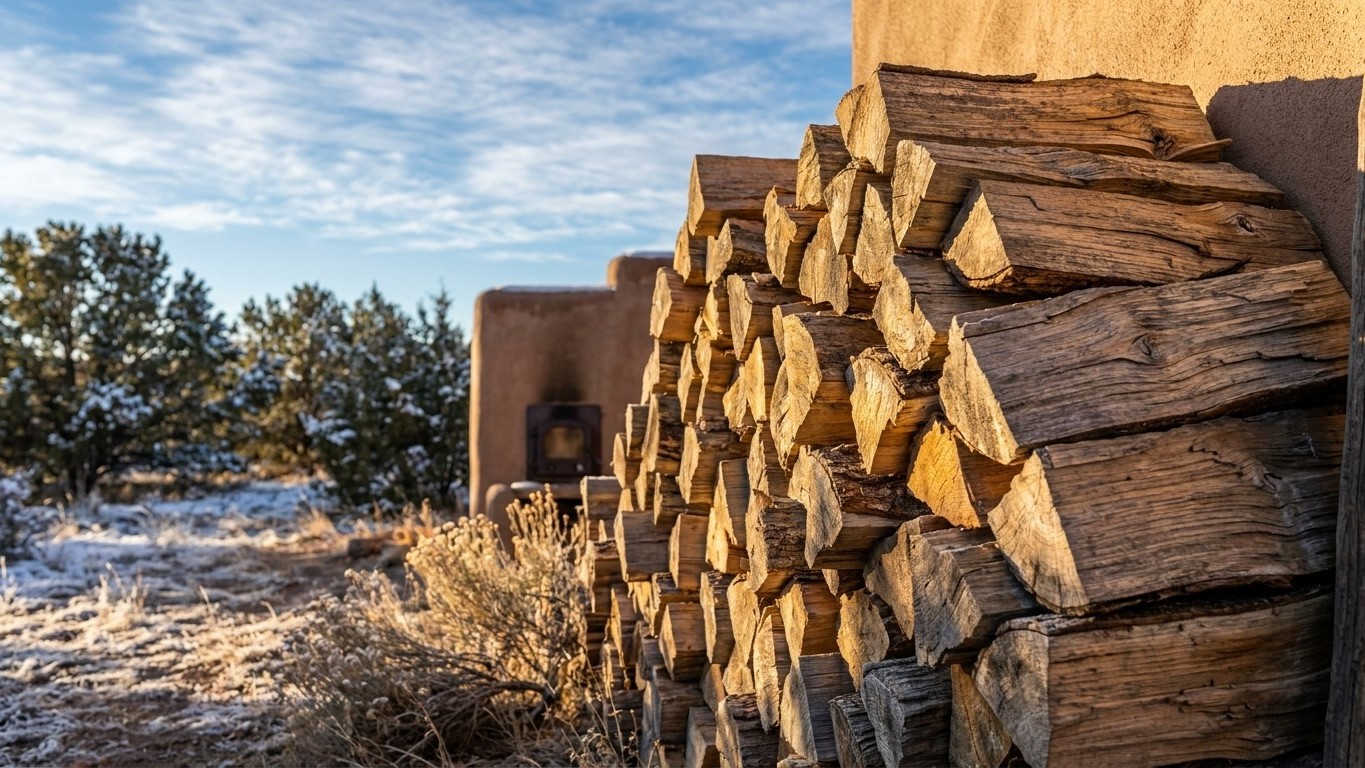

New Mexico winters split into two different climates depending on elevation, but the number that matters most for a wood stack is the average low in January: 26.4°F at Albuquerque, the state’s reference weather station. That figure decides how many cords you’ll burn, which species are worth chasing down, and how much lead time your drying schedule actually needs.
How cold it actually gets here

According to NOAA’s Climate Normals for 1991-2020, Albuquerque’s coldest month averages a nightly low of 26.4°F. That’s not a record cold snap, it’s the routine overnight temperature for weeks at a stretch. Anyone burning wood through a New Mexico winter is dealing with real, sustained cold, not just a few chilly evenings that call for atmosphere.
A mean low in the high 20s means water freezes solid most nights from December through February, pipes need protecting, and a house without a functioning heat source becomes uncomfortable fast. This is below the threshold where wood heat is optional decoration. At 26.4°F, a stove or fireplace carrying real heat load through the night is doing actual work, not just setting a mood.
Higher elevations change the math further. Places like Taos, Santa Fe, and mountain communities in the northern part of the state sit well above Albuquerque’s elevation and run colder overnight than the reference figure suggests. If you’re at altitude, treat 26.4°F as a floor, not a worst case, and plan your wood supply with a margin rather than cutting it close.
What this means for the reader
Wood heat here needs to actually perform, not just look nice through a sliding glass door. That changes every decision downstream: which species you bother seeking out, how many cords you stack before the first freeze, and how strict you are about moisture content before a log goes in the firebox. A mild-climate reader can get away with sloppy seasoning and whatever wood is cheapest. A New Mexico winter with nightly lows in the high 20s does not offer that same forgiveness, especially on the coldest nights when the stove has to carry the house from 10 p.m. to sunrise without a reload.
None of this means New Mexico winters are brutal in the way a Minnesota or Montana winter is. But 26.4°F is cold enough that heat output, burn duration, and how a species behaves overnight all matter more here than they would in a climate where the coldest month barely dips below 40°F.
Which woods are worth the effort here
With a coldest-month low sitting at 26.4°F, density becomes the variable that decides whether a cord gets you through the night or leaves you reloading at 2 a.m. A cord is a fixed volume, always a stack measuring 4 feet by 4 feet by 8 feet, or 128 cubic feet total. That’s the legal and practical definition, and it’s worth repeating because a mismeasured or loosely stacked “cord” is the single most common way a firewood buyer gets shorted. Because the volume is fixed, a denser species packs more actual wood mass, and more mass, into the same stack, which is what translates into more usable heat and a longer overnight burn.
According to Michigan State University Extension, a cord of well-seasoned hardwood delivers roughly 20 million BTU on average, comparable to about 145 gallons of #2 fuel oil or 215 gallons of LP gas. That figure is an average across species and assumes proper seasoning; a green or poorly dried load of the same wood delivers noticeably less usable heat, because energy goes toward boiling off trapped moisture before the wood contributes warmth to the room.
Matching wood to the job
In practice, this means treating your wood supply as two different jobs rather than one pile. Dense hardwoods earn their keep on the coldest nights, the ones where you want a slow, hot, long-burning load that’s still producing coals by morning. Lighter, faster-burning woods are for a different job entirely: getting a fire started quickly, or carrying the house through mild shoulder-season evenings in October or April where a full hardwood load would be overkill and mostly wasted heat.
Local availability shapes this as much as any performance chart does. A dense species you can never find seasoned and ready to burn is worse, in practical terms, than a lighter wood you can reliably buy dry. In New Mexico, piñon and juniper are widely sold and locally cut, which makes them the default choice for most households regardless of where they rank on paper. Oak and other dense hardwoods are less commonly local and often get trucked in, which raises cost and makes seasoning history harder to verify.
| Species | Relative density | Smoke | Sparks |
|---|---|---|---|
| Piñon pine | Medium | Aromatic, moderate | Some, watch open fireplaces |
| Juniper | Medium | Aromatic, moderate | Frequent, popping common |
| Cottonwood | Light | Heavier smoke if damp | Low |
| Oak (where available) | Dense | Low, clean burn when seasoned | Low |
Note that the 20 million BTU figure above is a whole-species-category average for seasoned hardwood, not a per-species number pulled from a lab test for each row in that table. Treat density as the relative guide it is, and prioritize a seller who can show you a load has actually been split and stacked long enough to season, over one who simply names a species you recognize.
How much wood a winter takes
Any published “cords per winter” figure you find online is close to useless without knowing three things about your specific situation. The first is the local cold figure itself, 26.4°F for the Albuquerque reference point, colder at altitude. The second is how well your house actually holds heat. The third is whether wood is your main heat source or a supplement to a furnace or heat pump that’s doing most of the work.
The mechanism that moves the estimate the most is insulation, and it moves it by a lot. A poorly insulated house in a New Mexico winter can burn roughly double what a tightly sealed, well-insulated house burns in that exact same climate, heating the exact same square footage. Leaky doors, uninsulated attics, and older single-pane windows let heat escape as fast as the stove produces it, forcing far more reloads and far more cords to get through the same stretch of cold nights.
Run your own estimate using these variables rather than trusting a generic number:
- Local winter severity: how close your elevation and location sit to the 26.4°F reference, and whether you’re higher and colder
- Home insulation and sealing: attic insulation, window quality, and how airtight the structure is overall
- Role of wood heat: whether it’s your only heat source, your primary source with backup, or purely supplemental
- Square footage heated: a single stove warming one main room burns far less than one expected to heat an entire house
- Stove or fireplace efficiency: a modern EPA-certified stove extracts more usable heat per cord than an open fireplace
Stack those five factors against each other for your specific house before buying wood by the cord in bulk, and you’ll land closer to a real number than any generic average could get you.
Drying wood in this climate
Seasoning matters more than species selection almost everywhere, and New Mexico’s climate has its own rhythm for how long that process takes. The target is the same no matter where you live: wood should reach 20 percent moisture or less before it goes in the stove. Green, freshly cut wood can measure over 60 percent moisture, and all of that water has to boil off before the wood gives you any real heat, which is exactly why a green load feels smoky, hisses, and refuses to catch.
What actually dries firewood is airflow and time, not direct sun exposure. Wood needs to be split first, then stacked loosely enough that air moves freely through the pile, ideally off the ground and away from anything blocking wind. New Mexico’s low humidity and long dry season work in a wood-burner’s favor here compared to more humid regions, but that advantage only pays off if the wood is actually split and stacked correctly rather than left in unsplit rounds, which dry dramatically slower no matter how dry the air around them is.
The most common local mistake
Cutting or buying wood in spring with the plan to burn it that same coming winter is the single most common error households make here. Split, stacked hardwood typically needs a full summer of exposure to airflow to reach that 20 percent target, and some species need longer. Red oak in particular dries slowly because of its cell structure, according to Michigan State University Extension, and needs more time stacked than most other hardwoods before it’s ready to burn clean.
Given the 26.4°F reference low, that means wood intended for this coming winter should already be split and stacked by late spring at the absolute latest, ideally the year before. A stack started in April or May for burning in December is cutting it close for most species, and too close for oak. Buying seasoned wood from a supplier who can tell you when it was actually split, not just cut, is the more reliable path if your own stack didn’t get an early enough start.