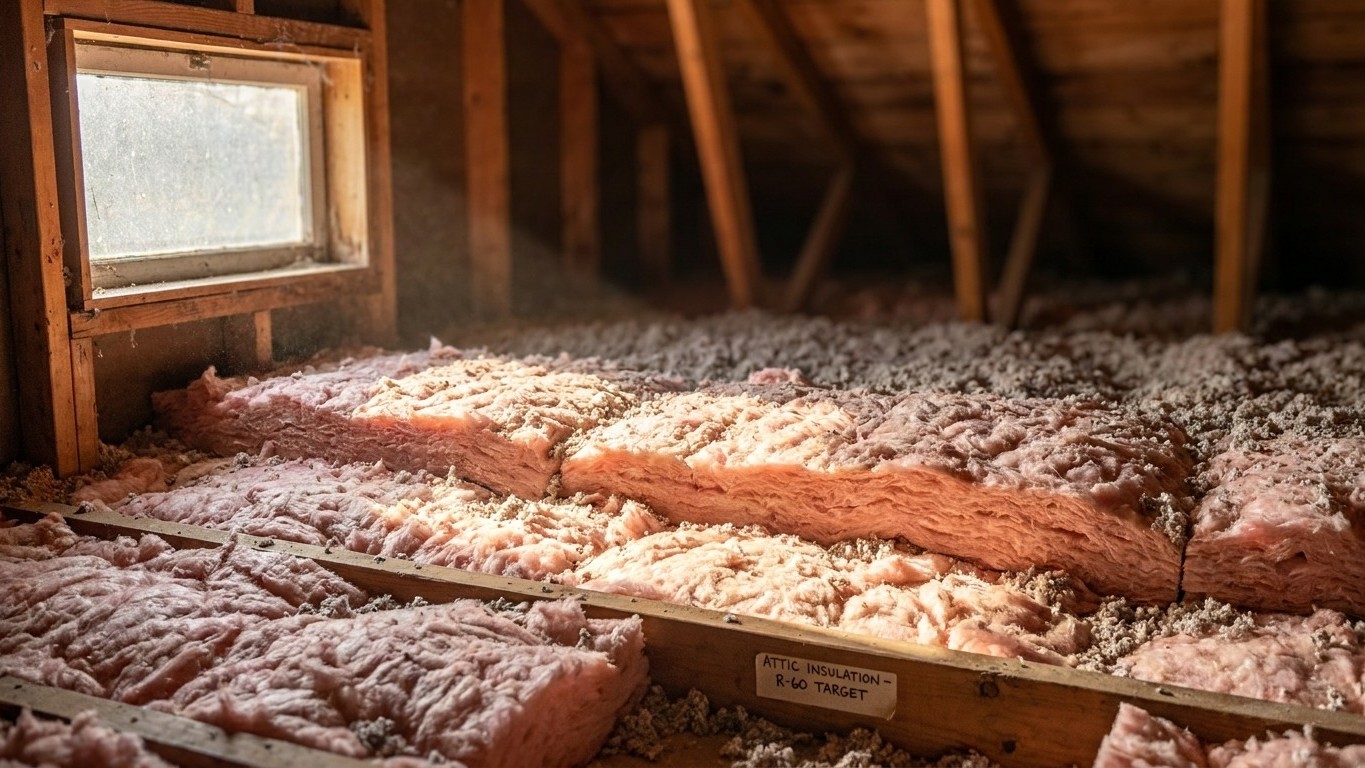

New Mexico doesn’t have one insulation answer. The state spans three IECC climate zones, so the right R-value depends on which of the state’s 33 counties a house sits in, not on a single statewide rule. Below, the county spread, the exact retrofit levels, and the order that makes any of it work.
Which climate zone New Mexico is in

There is no single answer for this state. New Mexico’s 33 counties split across three IECC climate zones: 13 counties fall in zone 4B, 12 counties fall in zone 5B, and 8 counties fall in zone 3B, according to the 2021 International Energy Conservation Code (IECC), Table R301.1. That’s a real spread, not a rounding error, and it means a homeowner in one part of the state is shopping for a different insulation level than a neighbor three counties over.
A climate zone is a construction-code classification built around how cold, hot, or dry a location runs over the year. The number (1 through 8) tracks severity, with 1 being the mildest and 8 the harshest. The letter that follows tracks moisture: A means moist, B means dry, and C means marine. Zones 7 and 8 don’t carry a letter at all. That letter isn’t decoration. The ENERGY STAR insulation table groups zones by both number and letter (it treats “4A and 4B” as one row, and lumps “6, 5, and 4C” into another), so knowing you’re in zone 4 without knowing the B changes nothing about which row you actually read.
Here’s the county count for New Mexico, exactly as the 2021 IECC lists it:
| Climate zone | Number of counties |
|---|---|
| 4B | 13 |
| 5B | 12 |
| 3B | 8 |
Notice what that table does and doesn’t say. Thirteen counties in zone 4B is a count of counties, not a share of population. Zone 5B, with 12 counties, could hold more people or fewer, depending on which counties they are. A single populous county can outweigh a dozen sparsely settled ones on the map. So this page won’t tell any individual reader which zone they personally live in. That answer lives at the county level, and the way to find it is the county-by-county IECC table itself, or ENERGY STAR’s own climate zone map. What this page can do is show the spread and make sure nobody in New Mexico assumes the whole state buys the same bag of insulation.
The insulation levels that apply here
ENERGY STAR publishes retrofit insulation levels for existing wood-framed buildings, organized by climate zone, based on the 2021 IECC Residential Provisions. These are retrofit numbers, meaning they’re aimed at homes already built and being upgraded, not new-construction requirements. The table has a header that gets misread constantly: “Add Insulation to Attic” actually spans two separate figures, one for an attic that currently has no insulation at all, and one for an attic that already has 3 to 4 inches in place. A third, separate column covers the floor. Three numbers per zone, but only two of them are attic values. The third is floor.
Here is the full table exactly as ENERGY STAR publishes it:
| Zone | Attic if uninsulated | Attic if already 3-4 inches | Floor |
|---|---|---|---|
| Zone 1 | R30 | R25 | R13 |
| Zone 2 | R49 | R38 | R13 |
| Zone 3 | R49 | R38 | R19 |
| Zones 4A and 4B | R60 | R49 | R19 |
| Zones 6, 5, and 4C | R60 | R49 | R30 |
| Zones 7 and 8 | R60 | R49 | R38 |
For New Mexico, three rows matter, and none of them can be averaged into one figure. The 8 counties in zone 3B read the “Zone 3” row: R49 for an uninsulated attic, R38 if there’s already 3 to 4 inches up there, and R19 for the floor. The 13 counties in zone 4B read the “Zones 4A and 4B” row: R60 uninsulated, R49 if partially insulated, R19 floor. The 12 counties in zone 5B read the “Zones 6, 5, and 4C” row: R60 uninsulated, R49 partially insulated, and a higher R30 for the floor. That floor number is the clearest sign these rows aren’t interchangeable. A homeowner in a zone 5B county and one in a zone 4B county land on the same attic target but a different floor target, and averaging the two would get both of them wrong.
One more note on reading this table correctly: none of these figures convert into a thickness in inches. Depth depends entirely on which material is used, fiberglass batts, blown cellulose, spray foam, and the R-value-per-inch varies by product. That number is printed on the packaging, not derived from this table.
Sealing comes before insulating
ENERGY STAR treats air sealing and insulation as two steps of the same project, and its own project guidance puts attic air sealing before attic insulation, not after. That order isn’t arbitrary. Insulation slows heat moving through a material. It does nothing to stop air moving around it, through gaps, chases, and penetrations. Lay batts or blown insulation over an unsealed attic floor and you haven’t closed those gaps. You’ve just hidden them under a few inches of material, making them harder to find on the next inspection.
The practical order of work, as ENERGY STAR lays it out, runs like this:
- Seal air leaks in the attic first, around chimneys, plumbing stacks, wiring penetrations, and the attic hatch.
- Add or upgrade attic insulation to the level that matches the local zone row.
- Seal and insulate the rim joist, the band around the house where the floor framing meets the foundation.
- Address the floor over a crawl space or an unheated area.
- Only then move to wall insulation, which is a bigger and more disruptive job in an existing house.
Worth being precise here: the widely cited savings estimate for this kind of work covers sealing and insulating together, as one project. There isn’t a separate published figure for sealing on its own. For the mechanics of each step, drafting, weatherstripping, foam sealant, attic hatch covers, this site’s national insulation guides walk through the specifics; this page is about which R-value New Mexico’s zones call for, not how to run a caulk gun.
What the winter here actually asks for
At Albuquerque Intl AP, the NOAA 1991-2020 climate normals put annual heating degree days at about 3,996, against roughly 1,438 cooling degree days. Degree days aren’t a temperature reading; they’re a running measure of demand, adding up, day by day, how far the average temperature sat below 65°F for heating (or above it for cooling) across the whole year. Nearly 4,000 heating degree days against under 1,500 cooling degree days tells you plainly which season drives the energy bill in this reference city: winter, by a wide margin. That said, this is one station’s figure. A mountain county elsewhere in the state can run considerably colder, which is exactly why the county-level zone matters more than a single statewide average.
What New Mexico households actually heat with, per the U.S. Energy Information Administration’s 2020 Residential Energy Consumption Survey: 67% use a furnace as their main heating equipment, and 7% use a steam or hot-water boiler. Central heat pump figures were not reported, meaning the survey found too few households to publish a reliable number, not that none exist. By fuel, 76% use natural gas and 13% use electricity; fuel oil or kerosene had none reported, and propane’s figure was suppressed as an estimate too unreliable to publish. Neither “not reported” nor “none reported” means zero. It means the data doesn’t exist in a form the survey could confidently publish.
A state running two-thirds furnaces means ductwork is doing most of the heat delivery, and ducts routed through an unconditioned attic are a separate loss point that ceiling insulation alone doesn’t touch. Sealed ducts and insulation work together; one without the other leaves money on the table. Priorities for a New Mexico retrofit, roughly in order:
- Seal and insulate the attic to the level matching the local county’s zone row.
- Check and seal ductwork running through the attic or any unconditioned space, since a furnace-heavy state loses conditioned air right where the attic insulation ends.
- Address the rim joist and any floor over a crawl space, particularly relevant given the smaller share of homes on boilers and radiators, which skip ductwork loss entirely but still lose heat through the floor.
This site’s duct sealing and insulation guides go into the specifics of finding and closing duct leaks; they’re the natural next stop for a furnace-heated home in a state with this many heating degree days.
What the work is worth
ENERGY STAR’s own published estimate, worth quoting exactly rather than paraphrasing: “EPA estimates that homeowners can save an average of 15% on heating and cooling costs (or an average of 11% on total energy costs) by air sealing their homes and adding insulation in attics, floors over crawl spaces, and accessible basement rim joists.” Two percentages, two different denominators, and both matter: 15% of the heating and cooling portion of a bill, or 11% of the whole energy bill once everything else, water heating, appliances, lighting, gets folded in.
Those figures come from energy modeling of a “typical” existing U.S. home, not a guarantee for any specific New Mexico house. A drafty adobe in a zone 5B county and a newer stick-built home in a zone 3B county won’t see identical results even if both start from an uninsulated attic. The estimate also names exactly where the modeling was done: attics, floors over crawl spaces, and accessible basement rim joists. It doesn’t extend to walls, windows, or doors, and it shouldn’t be blended with two other numbers floating around on the subject. ENERGY STAR’s own program landing page separately cites “up to a 10% savings on your annual energy bills” for the same category of work, worded as a ceiling rather than an average. And the Department of Energy’s commonly cited 10% figure is about a thermostat setback of 7 to 10°F held for eight hours a day, which has nothing to do with insulation at all. Three real numbers, three different claims, and the 15%/11% pairing above is the one that actually describes sealing and insulating a home.