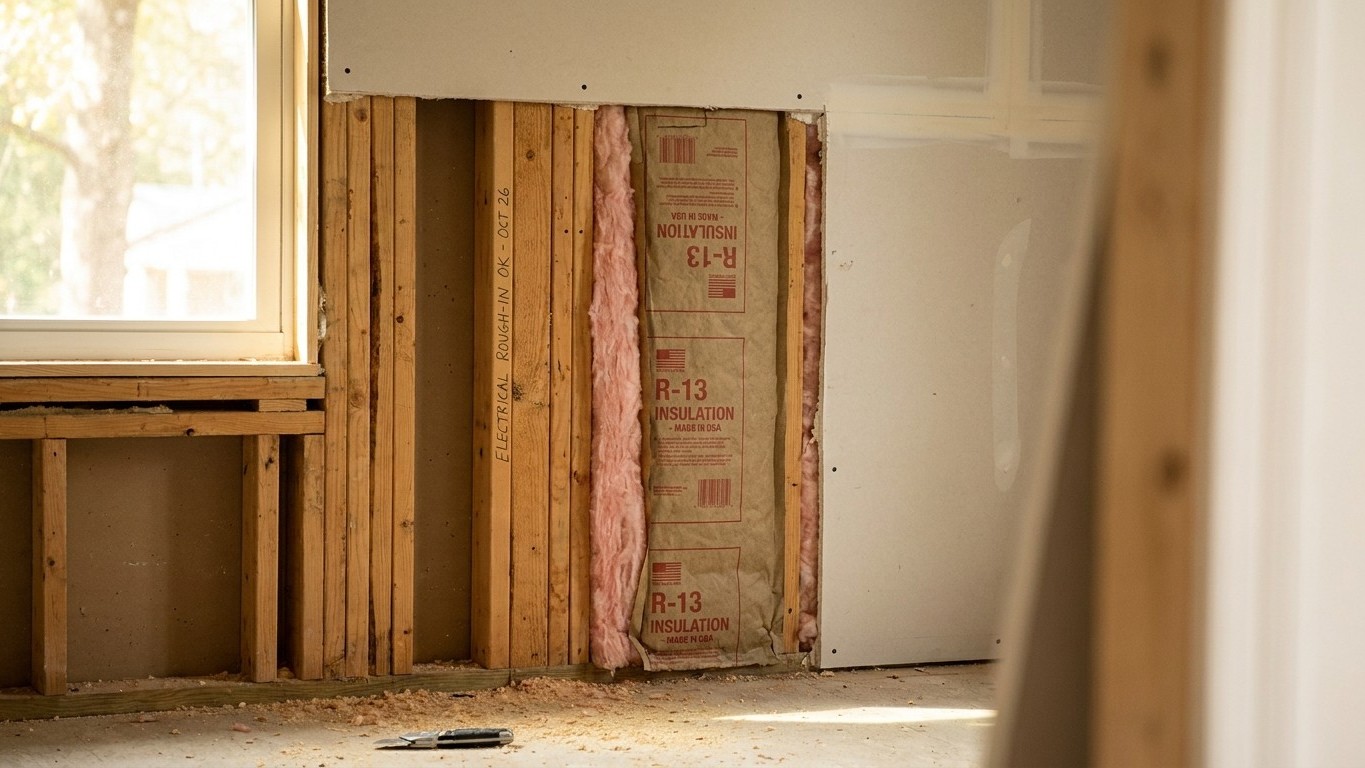

Whether a New Mexico wall needs an interior vapor retarder depends on which of the state’s three climate zones that wall sits in. Under the 2021 International Residential Code, retarders are required in Zones 4B and 5B but not in Zone 3B, and New Mexico’s 33 counties split across all three. There’s no single statewide answer, only a county-by-county one.
What the code asks for in New Mexico

The 2021 International Residential Code, Section R702.7, states it plainly: a vapor retarder of the class listed in Table R702.7(2) “shall be provided on the interior side of frame walls.” That’s the baseline rule for most of the country. Then the code carves out an exception that flips the answer for warmer regions: “A vapor retarder shall not be required in Climate Zones 1, 2 and 3.”
New Mexico doesn’t sit neatly in one zone. Thirteen of its 33 counties fall in Zone 4B, twelve fall in Zone 5B, and eight fall in Zone 3B. That means roughly a quarter of the state’s counties are covered by the exception, while the rest, the 4B and 5B counties, which together make up 25 of the 33, fall under the general rule and are expected to have an interior vapor retarder of the appropriate class.
So a homeowner near Las Cruces, likely in a 3B county, may be working under a different set of expectations than a neighbor two counties north in 4B territory. Neither situation is unusual, and neither is a violation waiting to happen, it’s just how the model code was written, zone by zone.
One clarification matters here: “not required” is not the same as “not allowed.” The Zone 3 exception removes an obligation. It doesn’t ban a vapor retarder, and it doesn’t make one illegal to install. It simply means the code doesn’t force the issue in that zone the way it does in colder ones, which, as the next section explains, is intentional and tied to which direction moisture is moving through the wall.
None of this substitutes for a call to the local building department. The IRC is a model code; what actually governs a specific wall is the edition and amendments that the reader’s county or municipality adopted. A wall built with the wrong vapor control doesn’t announce itself with a crack or a stain the week after drywall goes up. It rots quietly, inside the cavity, and the damage often surfaces years later as soft framing or a moldy stud bay behind an otherwise normal-looking wall.
Why the answer is the opposite in a warm climate
The logic behind the Zone 3 exception isn’t arbitrary. It comes down to which side of the wall the moisture is starting from. In a cold climate, warm, humid air lives inside the house. Without a retarder, that indoor moisture pushes toward the wall cavity, hits cold sheathing near the exterior, and condenses there. An interior vapor retarder stops that moisture before it ever reaches the cold surface, which is exactly why the rule exists in Zones 4 and 5.
In a warm, humid climate, the water is coming from the other direction. Outdoor air carries the moisture, and it’s pushing inward, toward the cooler, conditioned interior. If a builder installs a Class I retarder, sheet polyethylene, on the interior side anyway, that impermeable layer becomes the cold surface the vapor condenses against, just moved to the wrong side of the wall.
The U.S. Department of Energy’s Building America program describes exactly what happens next: “If the wall contains a vapor retarder on the interior side of the insulation, the water vapor will condense on this cool, impermeable surface,” resulting in “ruined insulation, mold, and structural rot of framing members.” That’s not a minor cosmetic issue. It’s the same category of damage a cold-climate retarder is meant to prevent, just triggered by installing one in the wrong climate.
This is the reason the code writes different rules for different zones. It isn’t bureaucratic inconsistency, it’s the code tracking which way the water vapor is actually traveling through the assembly in each region. A rule that protects a wall in Minnesota can actively damage one in southern Florida, and New Mexico’s split between 3B, 4B, and 5B means both logics apply somewhere within the same state’s borders.
The three classes, and why the word matters
The IRC doesn’t ask for “a vapor barrier” as a single generic product. It defines three classes by how much moisture they let through, measured in perms. Getting the class right matters more than the yes-or-no question of whether one is present at all.
| Class | Example materials | Perm rating |
|---|---|---|
| Class I | Sheet polyethylene, nonperforated aluminum foil | 0.1 perm or less |
| Class II | Kraft-faced fiberglass batts, vapor retarder paint | Above 0.1, up to 1.0 perm |
| Class III | Latex or enamel paint | Above 1.0, up to 10.0 perm |
Polyethylene sheeting is a vapor retarder in the code’s language, but calling it “a vapor barrier” without noting it’s Class I misses the point. It’s the tightest, most impermeable option, the one that causes trouble when placed on the interior side in a warm-humid zone, as described above. Most disagreements between builders in different regions aren’t really about whether to include a retarder at all. They’re about which class belongs on which side of the wall.
Here’s a detail most homeowners never think about: ordinary latex or enamel paint qualifies as a Class III vapor retarder. Millions of walls already have one, painted on, without anyone treating it as a code component.
Worth separating out: a vapor retarder is not an air barrier. They do different jobs, one slows moisture diffusion through a material, the other stops bulk air movement through gaps and cracks — even though a single sheet product sometimes performs both.
Where the rule stops
R702.7 lists specific situations where the interior vapor retarder requirement doesn’t apply, regardless of climate zone:
- Basement walls
- The below-grade portion of any wall
- Construction where accumulation, condensation, or freezing of moisture will not damage the materials
The basement exception is the one most readers actually run into. Concrete in contact with soil holds and releases moisture for years, it’s porous, and groundwater keeps feeding it. A basement wall assembly needs to be able to dry toward the interior. Seal that with an impermeable interior sheet and the moisture has nowhere to go; it stays trapped against the concrete and the framing built against it, setting up the same rot and mold problem described earlier, just below grade instead of above it.
This is a big enough topic on its own that it deserves separate treatment, see this site’s guide to basement wall vapor barriers for the detail on how that assembly is supposed to be built and dried.
Who actually decides, in New Mexico
The IRC is a model code. It becomes law only when a state, county, or municipality adopts it, and adoption isn’t uniform or instant, some jurisdictions amend sections, some lag several code cycles behind the current edition. For a question that already splits three ways by climate zone within a single state, that local layer matters more than usual. The only reliable answer for a specific address comes from that jurisdiction’s building department and the code edition it has actually adopted, not from the model code text alone.
The reference station at Albuquerque International Airport logs about 3,996 heating degree days a year against roughly 1,438 cooling degree days, a heating demand nearly three times the cooling demand, at base 65°F. That lopsided number is exactly why this question carries weight in New Mexico at all: a heating-dominated climate is the setting where the R702.7 interior retarder requirement was written to apply, which lines up with why the state’s 4B and 5B counties fall under the rule while its 3B counties don’t.
None of that tells an individual reader what to install in their own wall. It tells them what depends on where they are, and where to go to get the answer that’s actually enforceable: the local building department, working from the code edition their county or city has adopted. Getting the class or the placement wrong doesn’t show up as a failed inspection down the road, it shows up years later, as rot inside a wall that looked fine the day it was closed up.