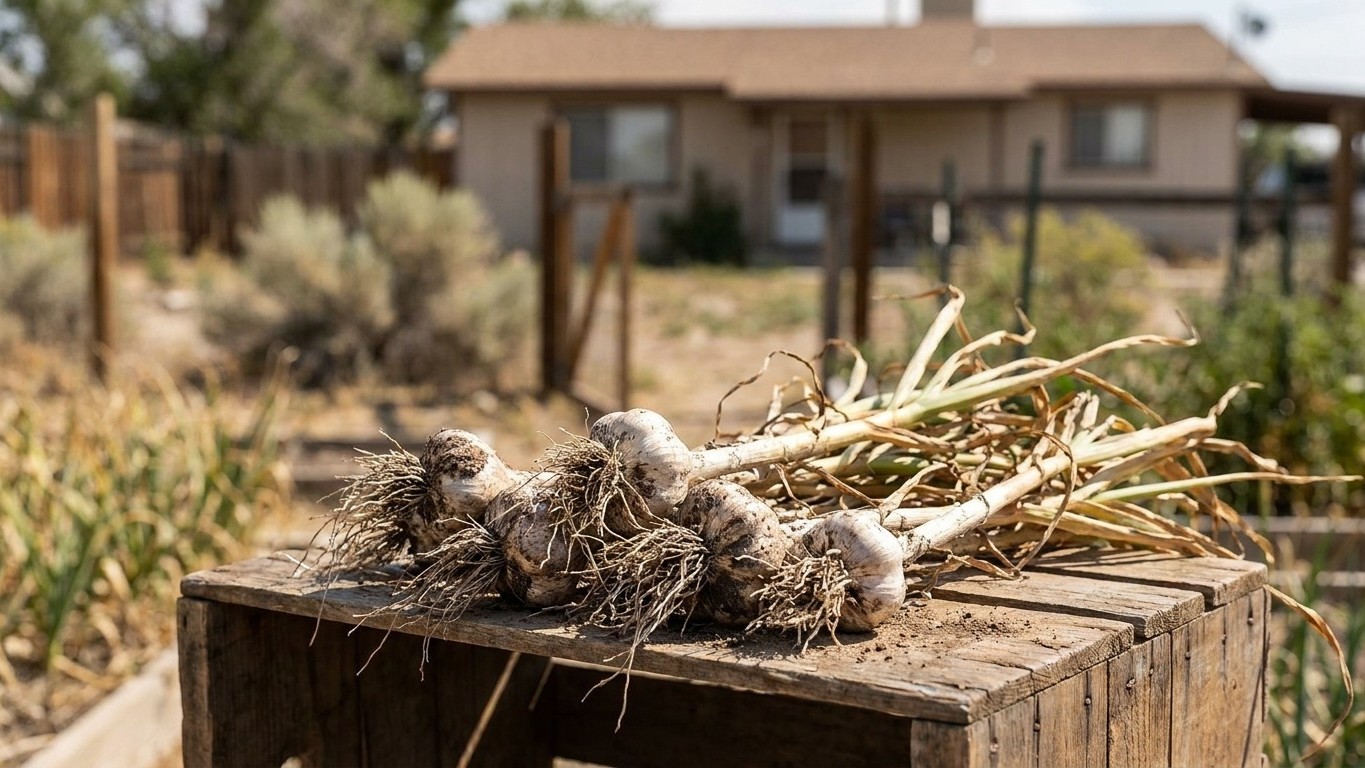

Garlic in New Mexico is ready to lift when the bottom third to half of the leaves have browned and dried while the top leaves stay green, usually sometime between early June and mid-July depending on elevation and planting date. Pull a test bulb, check the wrapper layers, then cure the whole crop for three to four weeks in a shaded, airy spot before trimming and storing it cool and dry for winter.
When garlic is ready to lift in New Mexico
Forget the calendar. Garlic tells you when it’s done by its leaves, not by the date on the wall. The rule growers rely on is simple: count green leaves. When a plant has five or six green leaves left and the rest have browned from the bottom up, the bulb underneath has usually finished dividing into cloves and packed on its papery wrapper layers. Pull too early and you get a bulb that looks like a single clove, unifferentiated and soft. Wait too long, past the point where most leaves have collapsed, and the wrappers split open in the ground, leaving cloves exposed to soil moisture and rot.
New Mexico’s dry heat speeds this whole process along compared to wetter climates. In the Mesilla Valley and other low-desert growing areas, dry-down often happens faster than growers moving from other regions expect, because low humidity and intense sun pull moisture out of the foliage quickly once the bulb stops actively growing. At higher elevations around Santa Fe or Taos, the season runs cooler and the same leaf-die-back signal can show up a few weeks later. There’s no substitute for walking the rows and checking leaf color yourself.
The timing traces back to how the crop went into the ground the previous autumn. Garlic planted in New Mexico goes in as cloves in fall, ahead of hard ground freezes, so it can establish roots before winter dormancy and then bulb up through the following spring and early summer heat. At the reference weather station used for regional climate normals, the first fall freeze falls at a midpoint of October 29 to November 9, according to NOAA NCEI’s 1991-2020 U.S. Climate Normals. That’s a midpoint, not a guarantee: about half of all years see that first freeze arrive later than the range suggests, sometimes well into November. Rural and higher-elevation gardens away from the airport station where that data was collected often see frost arrive one to two weeks earlier, so check your own county’s typical pattern rather than treating this figure as fixed. A cooperative extension office through the New Mexico State University Extension can help pin down local timing for your specific area.
Curing it, and where to hang it here
Curing is the step that turns a freshly pulled bulb, still full of moisture, into something that will keep for months. Skip it or rush it, and even a perfectly grown bulb rots or sprouts early in storage. The process itself is straightforward: get the whole plant, roots, stalk, and all, out of direct sun and into a spot with good airflow and shade for three to four weeks. You’ll know it’s done when the outer wrappers turn papery and the neck where the stalk meets the bulb tightens and dries completely.
Where dry heat helps and where it hurts
New Mexico’s low humidity is an advantage for curing, in theory, since it discourages the mold and rot that plague growers in muggy climates. But that same dry heat becomes a liability the moment garlic sits in direct sun. Bulbs left uncovered on a patio or driveway in July can actually cook, and the outer cloves scorch or turn glassy before the inner ones finish drying properly. The fix is shade, not shelter from moisture. A covered porch, an open-sided shed, a garage with the door cracked for airflow, or a shaded ramada all work better than anywhere direct sun reaches.
Bundle plants loosely, six to ten stalks per bunch, and hang them upside down so air moves freely around each bulb, or lay them in a single layer on a screen or slatted rack if hanging space is tight. Avoid stacking bulbs in piles or sealed boxes during this stage. Trapped moisture from freshly pulled plants, even in a dry climate, is enough to start rot in the neck of a bulb before it’s had a chance to seal itself off. A box fan pointed at the curing area, run a few hours a day, helps move stagnant air in garages where summer temperatures climb and airflow otherwise stalls.
Once the necks are tight and dry, trim roots and cut stalks down to an inch or two above the bulb if you’re not braiding. Braiding works only with softneck types, since hardneck garlic’s stiff central stalk won’t bend. Either way, curing isn’t finished until the outer wrapper feels dry and paper-thin all the way around, not just on the surface.
Storing it through a New Mexico winter
Cured garlic wants three things in storage: cool temperatures, low light, and moderate humidity. Not bone-dry, not damp. That last part surprises a lot of New Mexico gardeners, because the instinct in a desert climate is to assume drier is always better. It isn’t. Garlic stored in air that’s too dry for too long will shrivel, the cloves shrinking and losing quality faster than they would at a slightly higher humidity level.
A pantry shelf, a closet on an exterior wall, or a detached garage that doesn’t freeze all work as storage spots, as long as the location stays out of direct light and away from heat sources like a furnace closet or a sunny window. Homes running evaporative coolers, common across much of New Mexico’s high desert, tend to have drier indoor air during the shoulder seasons than homes relying on refrigerated air, so a storage spot away from the cooler’s direct airflow path helps prevent over-drying.
Keep bulbs breathing, not sealed
Mesh bags, loosely woven baskets, or paper sacks with a few holes punched in them all let air circulate around stored bulbs. Plastic bags and airtight containers trap the small amount of moisture bulbs naturally release, and that trapped moisture is exactly what starts mold in an otherwise good-looking bulb. Braided softneck garlic hung in a cool hallway or unheated back room does the job without any container at all.
Check stored bulbs every few weeks through winter. Set aside any that feel soft, show green sprouts, or have gone papery and hollow at the neck, since a single soft bulb sitting against others in a bag can spread rot to its neighbors faster than most people expect. Bulbs destined for next fall’s planting should be the largest, healthiest ones from this harvest, set aside separately from the eating stock so they don’t get used up by mistake in the kitchen before fall planting rolls around.
What goes wrong here
Most garlic failures in New Mexico trace back to one of two things: lifting at the wrong moment, or curing in conditions that don’t match the climate. Pulling bulbs while too many leaves are still green produces immature, thin-skinned garlic that won’t store well no matter how carefully it’s cured afterward. Waiting until nearly all the foliage has collapsed risks split wrappers and bulbs that have already started to loosen apart underground, which shortens storage life before the garlic even reaches the curing rack.
Pest pressure during the growing season also shows up later as poor storage quality, even when the damage looks minor at harvest time. New Mexico State University Extension documents several pests affecting home garden crops in the region that gardeners growing alliums should watch for through spring and early summer:
- Aphids
- Bagrada bug (Bagrada hilaris)
- Beet leafhopper (Circulifer tenellus)
- Corn earworm
- Grasshoppers
- Lygus bugs
- Spotted cucumber beetle
- Squash bug
- Striped cucumber beetle
- Thrips
Thrips in particular can stress garlic foliage enough to trigger premature leaf die-back, which throws off the leaf-count method growers use to judge harvest timing. A plant that looks ready because its lower leaves have browned from pest damage, rather than natural dry-down, may still have an underdeveloped bulb underneath. Checking a test bulb before pulling the whole row catches this before it costs you the crop.
The other recurring problem is curing garlic in full sun to save time, which scorches outer cloves in New Mexico’s intense summer light faster than growers moving from cloudier climates anticipate. Shade and airflow, not speed, are what get garlic through curing intact.
Common questions
Can you harvest garlic early in New Mexico if leaves are still green?
It’s better to wait for the bottom leaves to brown naturally. Garlic pulled while most of the plant is still green hasn’t finished forming its full wrapper layers, and those underdeveloped bulbs don’t cure or store as well as fully mature ones.
How long does cured garlic last in New Mexico storage?
Storage life depends heavily on how well the bulbs were cured and where they’re kept afterward. Cool, dark, moderately humid conditions with good airflow give garlic the best chance of lasting through winter without shriveling or sprouting early.
Should I braid garlic or use mesh bags?
Braiding only works with softneck varieties, since hardneck garlic’s stiff seed stalk won’t bend. Mesh bags or open baskets work for either type and are the simpler option if you’re not braiding.
What’s the best month to harvest garlic in New Mexico?
There’s no single fixed month statewide. Low-desert areas like the Mesilla Valley often finish earlier in the season than higher-elevation gardens around Santa Fe or Taos, so leaf die-back is a more reliable signal than any specific calendar date.